
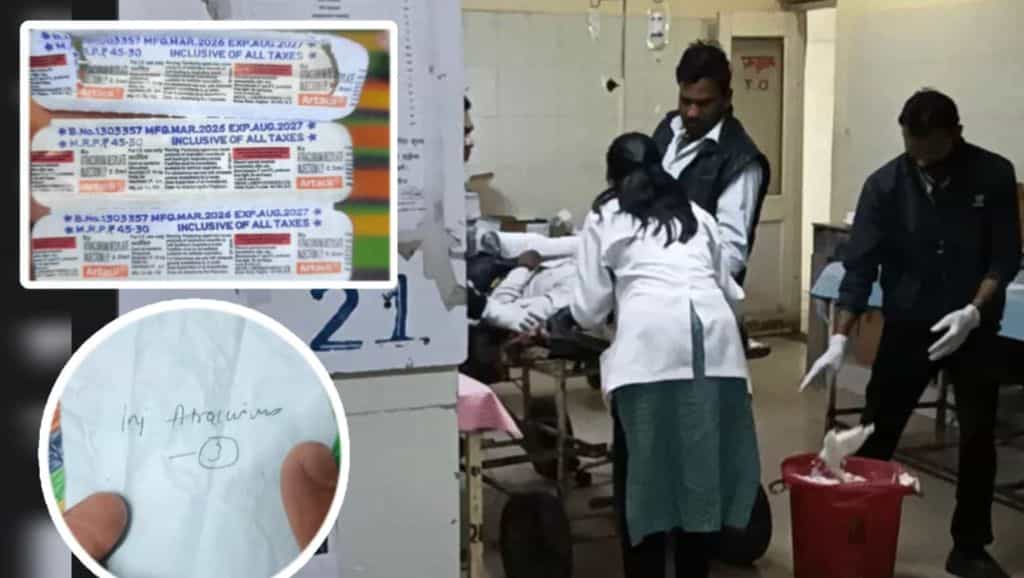
Big negligence in Bundelkhand Medical College: Nurse talking on the phone gave wrong injection of anesthesia to the patient, painful death after 11 days

Sagar/Bhopal: A shocking case of negligence has come to light from Bundelkhand Medical College (BMC) located in Sagar, Madhya Pradesh. A patient has lost his life due to the alleged gross negligence of the hospital. The family members seriously allege that while on duty in the ward, a nurse busy talking on mobile phone and Bluetooth earphones, despite being interrupted, gave a wrong and extremely dangerous injection to the patient. After this heart-wrenching incident, while on one hand there is chaos in the victim’s family, on the other hand there is panic in the entire hospital administration and health department of the state. Devendra had come to get a small lump examined, carelessness took away his life. The deceased has been identified as Devendra Pathak, a resident of Sagar. Devendra was admitted to the ENT department of Bundelkhand Medical College on June 12 for examination and biopsy procedure of a small lump in the throat. The doctors had asked him to order a special injection named ‘Atracurium Besylate’ from the medical store of the hospital in preparation for his operation and examination the next day. Doctors planned to use this medicine within the operating theater (OT). Bluetooth was connected to his ears, despite his refusal the nurse gave him ‘high-risk’ medicine Devendra Pathak’s wife Rita Pathak has made very shocking allegations in her complaint lodged with the police. According to the complaint, the nurse on duty, Shikha Patle, had Bluetooth earphones in her ears and was completely busy talking to someone on the phone. Meanwhile, she proceeded to give injection to Devendra. When the family saw that the nurse was concentrating on the phone, they stopped her and asked her to stop talking, but the nurse completely ignored them. While talking on the phone, the nurse administered the ‘Atracurium Besylate’ injection to Devendra in the ward itself, which was to be given at the time of anesthesia the next day. Battle for life on ventilator for 11 days, finally breathing stopped. In medical science, ‘Atracurium Besylate’ is considered a ‘high-alert’ and extremely sensitive medicine. Its main function is to completely relax (paralyze) the patient’s muscles during the operation. It is given only under the direct supervision of anesthesiologists and in the presence of ventilator support. As soon as this medicine entered Devendra’s body without written permission from the doctor and without any double-checking, his health started deteriorating in just a few seconds. He started having severe difficulty in breathing and started writhing in agony. When the doctors got wind of this, they immediately started efforts to save him. Doctors gave continuous CPR for about 45 minutes, but seeing his condition not improving, he was immediately taken to ventilator support. Devendra kept swinging between life and death on the ventilator for about 11 days, but finally he died on the morning of 23 June. Accused nurse suspended, health experts raised 5 big questions on the system As soon as the matter gained momentum, the hospital management, after initial internal investigation, suspended the accused nurse Shikha Patle with immediate effect. The Health Minister of Madhya Pradesh has also termed this incident as extremely shameful and has issued instructions to the higher officials to investigate the matter impartially and take the strictest legal action against the culprits. However, this incident has exposed the entire security system of the hospital. Health experts believe that this cannot be suppressed by calling it a personal mistake of just one nurse. The failure of the entire medical college system behind this is clearly visible, which raises many serious questions: How did such a sensitive and high-alert category medicine reach the general ward without the approval of a doctor or pharmacist? Why were international safety protocols for the handling and use of ‘high-risk’ medicines not followed within the hospital? Was there no system of ‘double-checking’ (matching twice) the medicines before giving them to the patients in the ward? If the nurse had any doubt about the name or use of the medicine, why did she not confirm it with the on-duty doctor? At present, both Sagar Police and Medical College Administration are investigating this entire matter in depth at their respective levels. After post-mortem, the body has been handed over to the family members. Police officials say that on the basis of the final report of the post-mortem and the investigation of the Medical Board, further legal action will be taken by registering a case against the accused nurse and other responsible management officials under other serious sections including culpable homicide.

Comments are closed.