

The price of Musang King, or Mao Shan Wang, has slipped to S$20 per kilogram, down from a peak of about S$28 in March.
Some stalls are selling the fruit for as low as S$8 per kilogram, though these are typically smaller or lower-grade fruits, according to a report by financial website Dollar and Sense last Wednesday.
Other varieties have also become cheaper. Black Thorn is selling at S$12-33 per kilogram while other popular types such as D24 and Red Prawn go for as little as S$10 and S$12 per kilogram, respectively.
Kelvin Tan, co-founder of durian dessert and fruit shop 99 Old Trees in central Singapore, told The Straits Times that the fruit is “the cheapest it’s been in the last five years.”
Singapore sources most of its durians from Malaysia, particularly Johor and Pahang, where peak seasons typically fall around June to July, and December.
Prices in Malaysia have plunged, with Musang King selling for around RM6 (US$1.5) per kilogram, down sharply from around RM90 previously. Other varieties like 101 and Red Prawn have fallen to as low as RM2 per fruit, according to Sin Chew Daily.
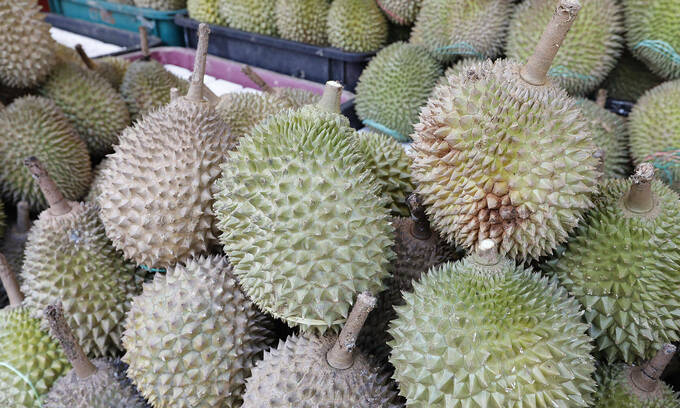
Selection of durians for sale on a small street fruit market in Singapore. Photo by IMAGO via Reuters |
However, sellers in Singapore have said that the price drop there is expected to be less steep.
Melvin Chua, who has spent the last 13 years running his Durian Garden stall, which mainly offers home deliveries, said operating costs in the city-state are very high.
“As a producer country, (Malaysia is) flush with stock and can afford to sell it… cheap,” Chua told ST. “Once you add on the costs of overheads, transport and GST (Goods and Services Tax), we cannot lower it until that level.”
Another ‘durian tsunami’ sweeps Malaysia
The current glut in Malaysia, echoing one seen late last year, is driven by a surge in local production during the peak harvest season following years of rapid expansion in durian cultivation, and tighter import restrictions in some export markets. Such a flood of supply has come to be dubbed a “durian tsunami” by local media.
As durians cannot be stored for long periods, farmers and vendors in Malaysia have rolled out generous promotions to clear stock and avoid spoilage.
Cheah Kim Wai, manager of the DurianMan shop in Petaling Jaya, told AFP that traders were concerned about shrinking profits but had little choice other than to keep selling because “business must go on.”
“Durian really has become something ordinary people can afford to eat, priced like the old kampung (village) durians used to be.”
Some are letting customers fill large gunny sacks with as many durians as possible for just RM100 per bag while others are handing out large plastic bags and allowing customers to pick their own durians, charging them per fruit.
Consumers have been quick to capitalize on the price slump. Videos circulating online show long queues and large crowds gathering at durian stalls that offered durians for just RM0.5 each in Bangi, Selangor, according to AsiaOne.
At an event organized by Malaysia’s Federal Agricultural Marketing Authority, one customer named Sik Siao Peng told AFP: “Malaysians are getting to enjoy cheaper durian … it makes us happy.”
For fans of the pungent fruit in Singapore, some supermarkets and businesses have recently rolled out durian sales and promotions, including all-you-can-eat buffets, free-flow durian and even a giveaway.
Local sellers also expect Musang King prices to slide further to around S$18 per kilogram, roughly in line with levels seen during the earlier glut in Malaysia.
Comments are closed.