
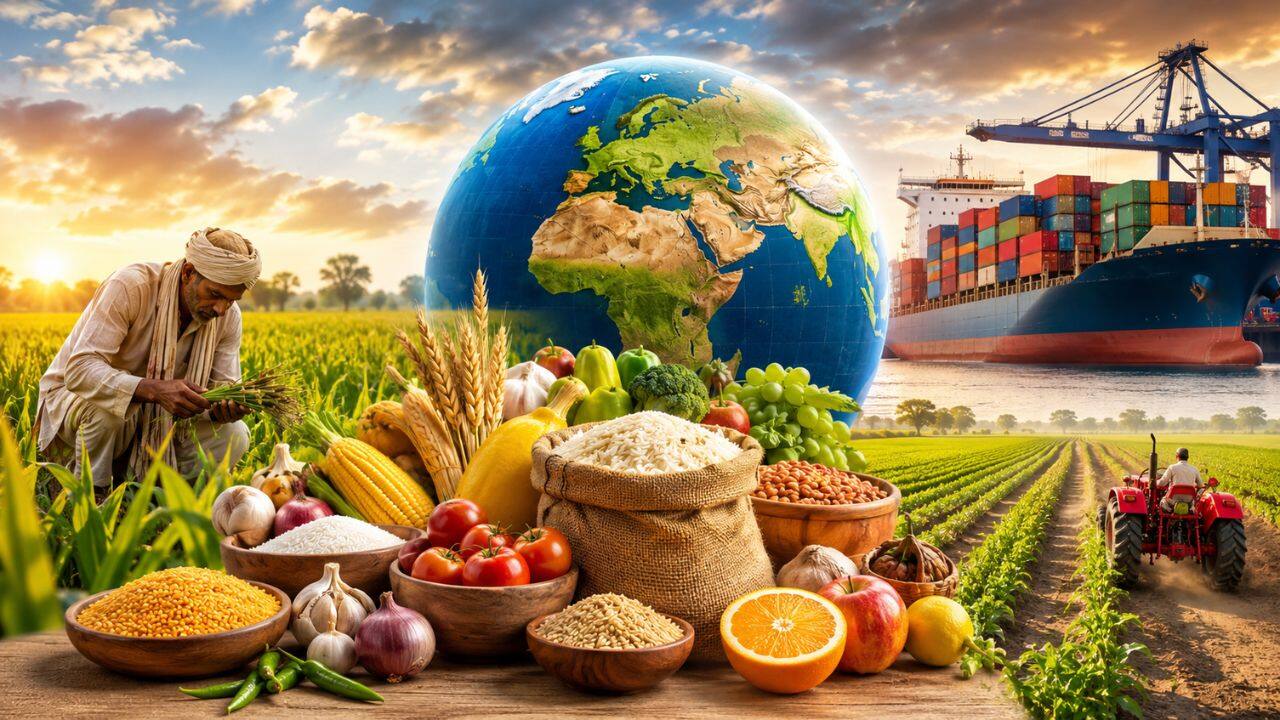
43% of the population are farmers, only 2.2% share in the global market, where is India missing?

India is one of the largest agricultural producing countries in the world, but does India also have the highest share in world trade? The figures are not in India’s favor. According to National Statistical Office (NSO) data, 43.0% of India’s total workforce is directly employed in agriculture and allied sectors. Data from the Economic Survey 2025-2026 show that India’s share in the global agricultural export market is only around 2.2 percent. Food grain and horticulture production in the country is continuously touching new heights, but India has still not become a ‘superpower’ in terms of exports. This contradiction shows the deep gap between India’s agricultural potential and actual global performance.
It is not that agricultural production in India is at a bad level. Food grain production is estimated to reach 3,577 lakh metric tons in the year 2024-25. This is 254 lakh tonnes more than last year. Horticulture production overtook that of food grains to 362–367 million tonnes. The contribution of agriculture to China’s economy is about US$ 1270 billion, while India’s agricultural economy is US$ 639 billion.
Where is India better?
India is the world’s largest onion producer and ranks second in vegetable, fruit and potato production. India is now doing better in allied sectors like animal husbandry, fisheries and horticulture. The overall agriculture and allied sector growth averaged 4.4%. After these achievements, India’s position in the global market is not strong. Agriculture and food exports stood at about $49.43 billion in fiscal year 2025, which is only 11.2 percent of the total exports. The share of processed has increased, but the total global share is low. The reason is that quality and infrastructure need to be improved.
Also read: Why did Apple increase MacBook and iPad prices by 20-40%? The whole story of chip crisis
Horticulture production has increased very rapidly in the last 11 years. In the year 2013-14 it was 280.70 million tonnes, which increased to 367.72 million tonnes in 2024-25. This includes production of fruits 114.51 million tonnes, vegetables 219.67 million tonnes and other horticultural crops 33.54 million tonnes.
India is the world’s largest dry onion producer and India alone produces about 25% of the world’s total production. Apart from this, India ranks second in the world in the production of vegetables, fruits and potatoes. India produces 12-13% of the world’s total production in each category.
Why is there such a difference?
According to the Economic Survey 2025-2026, the yield of many major crops in the country is still less than the global average. Small-scale farming, lack of storage and cold chain, post-harvest losses, quality of produce, limited access to seeds and fertilizers and uneven irrigation facilities are some of the constraints India grapples with. Which impacts production and exports.
Also read: 50 robots ate the jobs of more than 1000 people, the giant company scared the world
How much is exported from which country?
- United States: $172.36 billion
- Brazil: $141.89 billion
- Netherlands: $133.90 billion
- Germany: $102.21 billion
- China: $84.33 billion
- France: $83.45 billion
- Spain: $74.30 billion
- Italy: $70.53 billion
- Canada: $65.30 billion
- Belgium: $62.42 billion
- Poland: $53.84 billion
- Indonesia: $49.86 billion
- Mexico: $49.45 billion
- Australia: $46.13 billion
- Thailand: $45.32 billion
India is at 15th position in this list. These figures are based on the Food and Agriculture Organization of the United Nations.

Is the health of the soil deteriorating?
Due to poor use of chemicals and fertilizers in India, the health of the soil is also deteriorating. Three elements are required for the growth of crops. It has been said in the Economic Survey that of nitrogen, phosphorus and potassium. Their ideal ratio should be 4:2:1 but now it has deteriorated to 10.9:4. It has been said in the Economic Survey that due to urea subsidy, excessive use of nitrogen is affecting the fertility of the soil.
Farmers are emphasizing on more profitable crops instead of different crops. People are focusing on the production of crops like maize, due to which land for crops like pulses and mustard is being snatched away. People are cultivating maize because of ethanol production. Now there is dependence on imports for edible oil. Climate change, regional disparities are destabilizing production.
Also read: Who is Kunal Shah, the new CEO of WhatsApp? Zuckerberg will give money to his company CRED
What is the government doing?
The government is now running some schemes like PM Kisan, Pradhan Mantri Krishi Sinchai Yojana, National Food Security Mission, Integrated Horticulture Development Mission, Electronic National Agriculture Market, Farmer Producer Organization, Digital Agriculture Mission, Sahakar Se Samriddhi. Emphasis is on fixing the Minimum Support Price at 1.5 times the cost, micro irrigation, soil health. Right now these are not being implemented on a large scale.
Reasons due to which exports are affected
- Home Security: India is a country with a population of 140 crores. The priority is to fulfill our needs first and then export. In some years, heavy taxes were levied or levied on exports of non-Basmati rice, sugar and onions. India’s image as a reliable supplier was affected. The world turned to Vietnam, Brazil, Thailand and China.
- Weak Processing: India sells cotton, rice and spices but lags behind in selling packaged food items. Profits on raw materials are low and losses are bound to occur as prices fall in the global market. These items also get spoiled quickly. If we sell chips and potato powder instead of tomatoes and potatoes, the value of exports will increase and the goods will also remain safe.
- VaiDefault in Schweik Standards: America and European Union countries lay emphasis on product quality and standards. Indian farming is pesticide and fertilizer based. They are rejected at the international level. Our scientists and farmers are not farming as per global standards.
- Poor cold storage: The maintenance cost of products in India is high. Modern cold storage and refrigerated vans are in short supply. Dairy products cannot be stored for long. In such a situation, our supplies do not reach the world at the time of need.
Where are we lagging behind in statistics?
The report of the Economic Survey 2025-26 shows that in the year 2000, India’s share of agriculture in the global market was 1.1 percent, which has increased to only 2.2 percent after 24 years. Exports have ranged from $34.5 billion in 2020 to $51.1 billion in 2025. The real concern is that India’s agricultural exports are at a standstill from 2023 to 2025. The world has gone far ahead of us. Global agricultural market exports increased from $2.3 trillion to $2.4 trillion, demand is increasing in the world but India is not able to take advantage.

Comments are closed.