
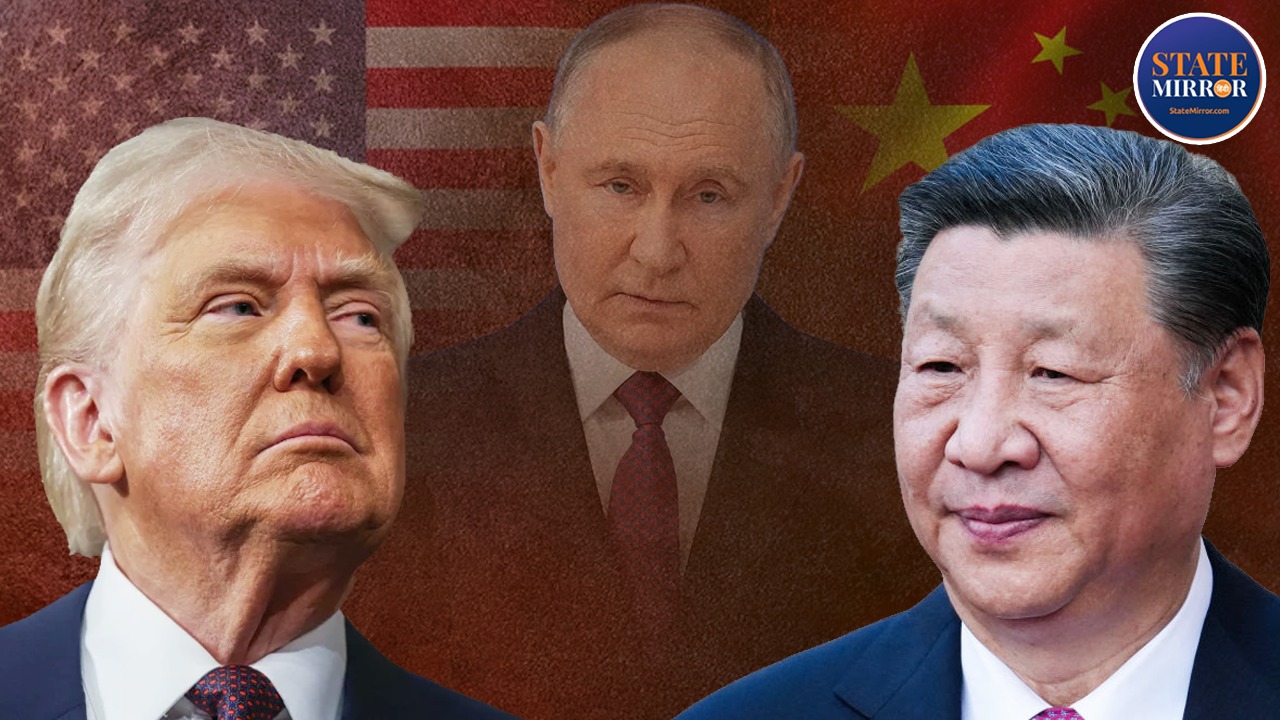
Trump 2.0 and the changing world order: Is the world heading towards a new Cold War? How different from before?

America, which was at the forefront in creating and running the global system after the Second World War, is today the same America moving towards changing it? donald trump The second term of the government has raised this question before the world. The policy of “America First”, increasing strategic competition with China, increasing pressure on allied countries and changing trade policies have brought international politics to a new turn. In such a situation, the debate is intense whether the world is again moving towards a new cold war, or this is the beginning of a completely different multi-polar world order. In this changing scenario, India’s role and strategy has become more important than ever.
America played an important role in building and leading the global order after the Second World War. It remained the cornerstone of international politics for decades. During this period, NATO, United Nations, International Monetary Fund (IMF), World Bank and free trade based economic structure got strengthened. But now in the second term of Donald Trump, America’s foreign and economic policies have intensified the debate whether the same country is now challenging many of the old beliefs of the system which it itself had established. It is clear that the international balance of power is going through a crisis.
Diplomats around the world have started speculating whether this is the beginning of a second cold war. This is because the first Cold War also started after the Second World War, which ended in 1991 due to the disintegration of Russia (the then Soviet Union).
First Cold War: Competition between two superpowers
In fact, the first Cold War started in the world only after the Second World War. In the first Cold War that lasted from 1947 to 1991, the world was divided into two clear groups. On one side were America and its allies, while on the other side were the then Soviet Union and its supporting nations. At the military level, NATO under the leadership of America and Warsaw Pact under the leadership of Soviet Union were face to face. Ideologically it was a competition between capitalism and communism, while at the political and diplomatic level both sides were trying to increase their influence in different regions of the world.
During this period, America not only provided military leadership but also gave strong support to the United Nations, IMF, World Bank and the global free trade system. The basic objective of US policy was to strengthen institutional alliances with allied countries and advance the international rules-based order.
What is different about Trump 2.0?
In Trump’s second term, the most important basis of American foreign policy has been “America First”. This means giving priority to US economic, security and industrial interests before international commitments. Under this thinking, the demand for increasing defense expenditure from the allied countries was repeated and the message was given that America expects more responsibility from its allies.
Important changes are also visible in trade policy. While earlier the US considered free trade agreements as a means of global economic development, now more emphasis is being placed on protecting domestic industries, reducing import tariffs, promoting the manufacturing sector and shifting important supply chains to the US or friendly countries.
Competition against China intensified in the fields of technology, semiconductor, artificial intelligence (AI) and investment. Bilateral agreements and national interests were given priority over multilateral institutions. The administration argues that the purpose of these changes is to strengthen America’s edge in American industry, employment, national security, and global competitiveness.
American credibility downgraded or status enhanced?
Experts are still divided on this question. Critics believe that increasing pressure on allied countries, protectionist policies and distance from the traditional multilateral system raised questions about America’s credibility and leadership ability. On the other hand, supporters argue that Trump’s policies increased America’s bargaining power, forced allies to take more responsibility and more aggressively faced emerging challenges like China.
Therefore, it would be appropriate to say that the nature of America has changed, but its influence has not ended. Its military, economic and technological power is still central to global politics, but its leadership style has become more transactional and national interest-oriented than before.
China biggest rival
America’s main rival in the first Cold War was the Soviet Union. Today that place has been taken over by China to a large extent, but the circumstances are completely different. Competition between the US and China has intensified over technology, artificial intelligence (AI), semiconductors, trade, investment and influence in the Indo-Pacific region. Despite this, the economies of the two countries are still deeply linked. This is why current competition appears to be more towards “de-risking” and reducing strategic dependencies rather than complete economic isolation.
Equations with Russia are also not the same as before
In the first Cold War, the Soviet Union was a clear opponent of America. Today relations between Russia and America are more complex. There is serious tension between the two countries due to the Russia–Ukraine War and Western countries have imposed extensive sanctions on Russia. At the same time, there remains a need for dialogue on nuclear arms control, the Middle East and other global security issues. That is, relations are not limited to conflict only, but elements of both competition and limited cooperation are present.
Is this Cold War 2.0?
Many experts avoid calling the current era a “new Cold War”, because today’s world is very different from the 20th century. Earlier there were only two superpowers, whereas now America, China, European Union, India, Russia, Japan and regional powers are together creating a multipolar system.
Earlier economic isolation was relatively high, whereas today global supply chains, investment, technology and trade link countries with each other. Earlier the ideological conflict was prominent, whereas now the competition is focusing on technology, cyber security, artificial intelligence, semiconductors, rare minerals and important sea routes. Military power is still important, but economic and technological capability have become equally decisive.
What does it mean for India?
India’s foreign policy is considered an example of balance in this changing scenario. India is a member of the Quadrilateral Security Dialogue and is increasing strategic cooperation with the US, Japan and Australia. It is also a member of BRICS and maintains defense relations with Russia. India has been consistently emphasizing the policy of “Strategic Autonomy”, under which it cooperates with different countries according to its national interests rather than becoming part of any single power bloc.
That is, Trump’s second term appears to challenge many of the old notions of the global order, which America itself had promoted for decades. Still, it is too early to say that the entire global system has changed. Today the world is in a period of crisis, where the decisions of the US, China, Europe, India and other major powers will determine in the years to come whether the international system moves forward in a modified form of the old structure or a truly new multipolar world order takes shape.

Comments are closed.