
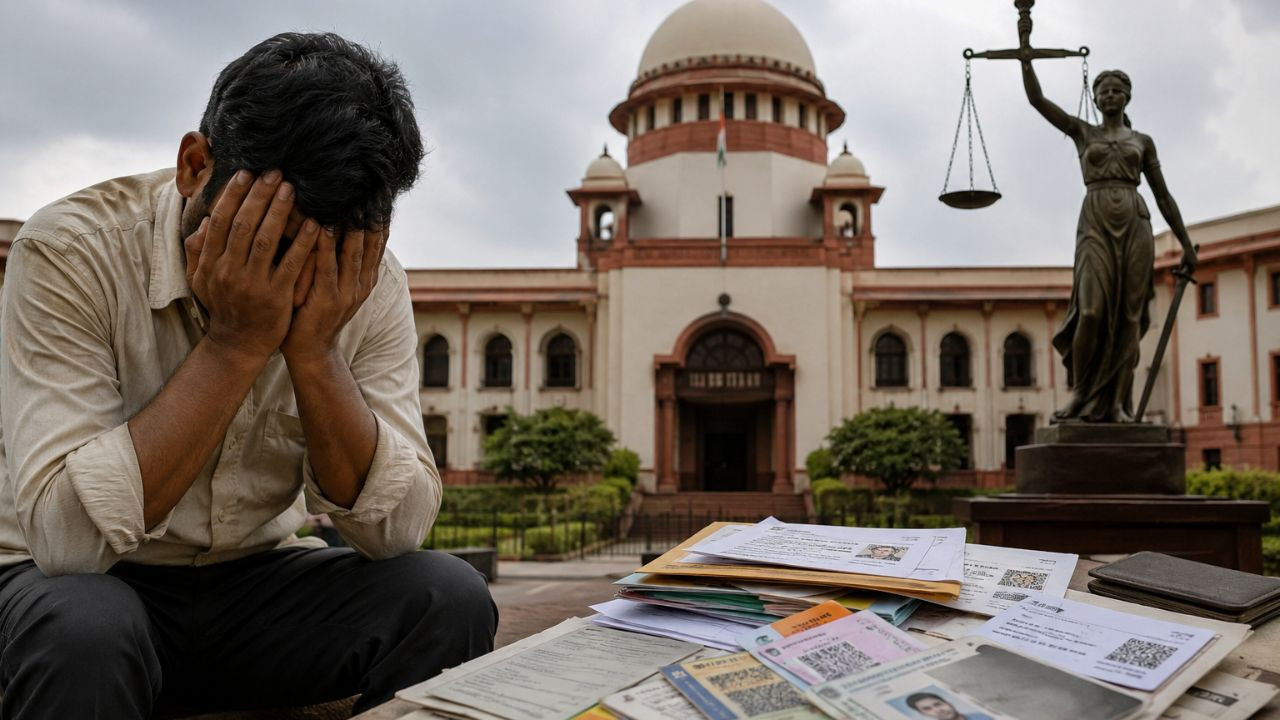
Big decision of Assam High Court, Indian citizenship not proved even after presenting 15 documents

New Delhi: A case related to the Indian citizenship of a daily wage laborer has come to light in Assam, where he had reached the Guwahati High Court. During this time, the court upheld the decision of the Foreigners Tribunal in which he was declared a foreigner. Let us tell you, the court said that the petitioner could not present any legally acceptable and reliable evidence in support of his claim, which could prove his Indian citizenship. However, in view of the sensitivity of this matter, the court has not made public the identity of the petitioner, this is because he still has further legal options available.
When was the petition rejected
According to the information, the division bench of Justice Kalyan Rai Surana and Justice Shamima Jahan had rejected the petition after hearing on June 30. Citing Section 9 of the Foreigners Act, 1946, the court said that the onus of proving citizenship was on the petitioner himself, but he could not fulfill this legal obligation. The High Court also said that the Foreigners Tribunal had properly evaluated the available evidence and no legal or factual errors were found in its order.
Presented 15 documents in his favor
Let us tell you, the petitioner had presented 15 documents in his favor. These included the names of father and grandparents in the 1951 NRC, various voter lists from 1966 to 2017, land registry of 1973, school certificate of 2017, PAN card, voter ID and oral testimony of the father. However, the court found that a clear and continuous link between the family lineage and citizenship could not be established through these documents.
Why did it refuse to accept the documents?
The court also refused to accept the copies of the 1951 NRC. According to the court, these were merely computer-generated copies, which were not authenticated as per law. At the same time, the required certificate under the Indian Evidence Act was also not presented. The court also said that due to the provisions of the Census Act, 1948, such records cannot be accepted as evidence.
The school certificate was rejected because neither the headmaster was made a witness nor the admission register was produced. The 1973 land registry was also not helpful in proving citizenship, as continuous records of inheritance and land ownership were not available. Along with this, the court also clarified that PAN card and Voter ID can be identity documents, but they are not proof of Indian citizenship. Many discrepancies related to age and family details were also revealed in the voter lists. On the basis of all these facts, the High Court upheld the decision of the Foreigners Tribunal and dismissed the petition.

Comments are closed.