
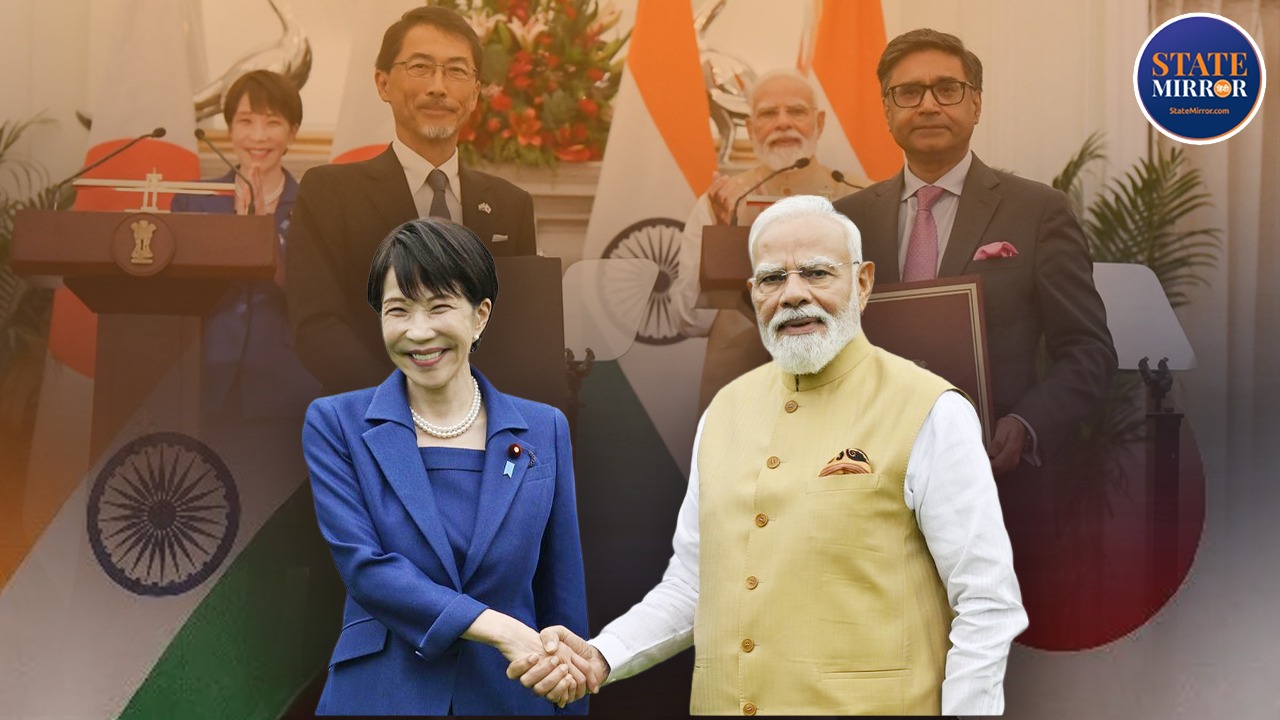
India-Japan Reset: Why did 5 sectors including defence, AI, semiconductor become the biggest game changers of Modi-Takaichi summit?

The world is currently going through three major crises. First, China’s aggressive foreign and military policy, which increased tensions from the South China Sea to the Taiwan Strait and India’s LAC and the Indian Ocean. Second, the Russia-Ukraine war and the Iran-Israel conflict in the Middle East, which destabilized energy and global supply chains. Third, the US-China technology war, which made semiconductors, AI and rare earth minerals the weapons of the new era.
Amidst the changing geopolitics, the relationship between India and Japan is no longer limited to only ODA loan, bullet train or trade. Both the countries are building such a strategic partnership in which security, high technology, industry, supply chain and balance of power of Indo-Pacific are joined together. This is the biggest message of this summit. Decisions taken regarding defence, AI, semiconductor, investment will prove to be game changers in the times to come.
1. Alliance is the answer to China’s ‘Two Front Challenge’
After 2014, there was the fastest expansion in defense relations between India and Japan. Japan has now become India’s special strategic and global partner. 2+2 Ministerial talks, Acquisition and Cross Servicing Agreement (ACSA) and regular military exercises like Dharma Guardian, Veer Guardian and Malabar Naval Exercise are taking place between the two countries.
For the first time, Japan is seriously considering exporting defense equipment and dual-use technology. Both countries are increasing cooperation in maritime domain awareness, drones, cyber security and underwater surveillance.
This is important because China has been adopting a strategy of simultaneously putting pressure on the East China Sea, Taiwan, South China Sea and India’s border. In such a situation, defense cooperation between India and Japan in the Indo-Pacific is already being considered a strategic challenge for China.
2. Semiconductor: India wants to become the new alternative to China
Today, about 75% of the world’s production of advanced chips is concentrated in East Asia. Japan is a major world player in photoresist, silicon wafers, high-end machinery and chip materials. Whereas India provides design engineers and a large electronics market.
India has started a Semiconductor Mission worth 10 billion dollars (about ₹ 76 thousand crores). Japanese companies like Renesas, Tokyo Electron, Rapidus and many supply chain companies are looking for opportunities in India.
If Japanese technology and Indian manufacturing come together, India will not just be a mobile assembly hub but can become a part of the entire chip value chain. This will also reduce global dependence on China-based supply chains.
3. AI and high technology: India will provide scale, Japan will provide technology
America and China are at the forefront in the global race of AI, but India and Japan want to create different models. India offers the world’s largest digital public infrastructure, huge data base and millions of AI engineers. On the other hand, Japan is at the forefront in robotics, industrial automation, sensor technology and high precision manufacturing.
Both countries plan to increase joint research in healthcare, smart factory, education, cyber security, quantum computing and industrial AI. Its goal is not only to develop technology but also to create a third reliable technology ecosystem between America and China.
4. Why is Japan betting so big on India?
Japan has been India’s largest development partner for the last two decades. Delhi-Mumbai Industrial Corridor, Mumbai-Ahmedabad High Speed Rail, Metro Project, Freight Corridor and many industrial projects are running with Japanese assistance.
In 2022, Japan had announced a target of 5 trillion yen (about 42 billion dollars) investment and financial cooperation in India in the next five years. This investment extends to green energy, digital infrastructure, logistics, manufacturing, startups and smart cities.
With the new government, both the countries are now working towards taking this goal forward and increasing cooperation in new generation technologies, clean energy, green hydrogen, batteries and electric mobility.
5. What does Japan want from India?
- Japan is not only investing, but it wants three big benefits from India.
- First, a reliable manufacturing base as an alternative to China.
- Second, a huge consumer market with a population of 1.4 billion.
- Third, a young and skilled workforce, which is rapidly decreasing in Japan as the population ages.
- This relationship is equally important for India because it can get capital, high technology, defense cooperation, industrial knowledge and a place in the global supply chain from Japan. Therefore, this relationship is not just based on investment but on Technology, Talent and Trust model.
Why is the friendship between the two growing rapidly?
Till the 2010s, the relationship between the two countries was mainly economic, but after 2020, geopolitics changed it into a strategic partnership. The Galwan conflict, Taiwan crisis, increasing Chinese activities in the South China Sea, Russia-Ukraine war and the Middle East conflict have made it clear that a supply chain dependent on any one country or region is not safe for the future.
The beginning of Asia’s new power equation
The biggest message of the Modi-Takaichi summit is that India and Japan now want not just bilateral cooperation but also want to create a new economic and strategic system for the Indo-Pacific. Growing partnerships in areas such as defence, semiconductors, AI, green energy, supply chains and high-tech investments could influence Asia’s balance of power in the coming decade. This India-Japan partnership is being considered one of the most important pillars in the effort to create an alternative to the global system dependent on China.

Comments are closed.