
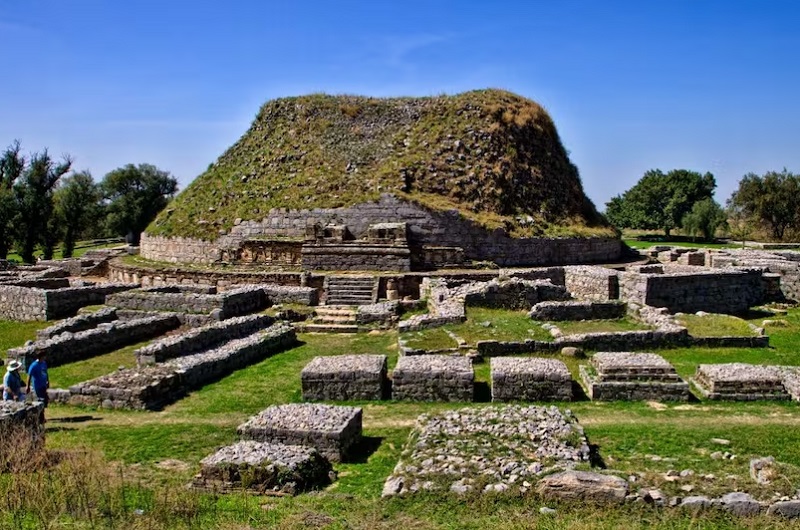

New Delhi. In Pakistan, the historical heritage and big archaeological site Taxila Archaeological Site (Ancient Taxila/Takshila University) is in danger. UNESCO has expressed objection to the conservation work done by Pakistan here. The United Nations cultural organization UNESCO has warned the Pakistan government that if the interventions made in the Takshashila complex are not corrected, then Takshashila can be removed from the list of ‘World Heritage’ sites and included in the ‘World Heritage in Danger’ list.
According to the report of Pakistani newspaper Dawn, the Department of Archeology and Museums of Pakistan used cement and modern masonry in ancient structures in the name of conservation work. UNESCO believes that the use of such material is against international conservation principles and affects the historical authenticity and original character of the monuments.
This controversy is especially regarding the conservation work done at two important sites of Taxila archaeological complex, Sirkap and Mohra Moradu. According to the report, in a recent meeting with officials of Pakistan’s Ministry of National Heritage and Culture, UNESCO described these works as ‘unnecessary interference’.
UNESCO clarified that such changes in archaeological monuments weaken their historical credibility. The organization also indicated that it will not shy away from taking strict action if these changes are not carried out in the same condition as before or if conservation standards are not followed.
It is reported that a tourist who came here in March had sent pictures and information about these conservation works to the UNESCO representative of Pakistan in Paris. After this the matter came to the notice of UNESCO. According to the agency, the complaint said that at many places the original archaeological walls were replaced with new masonry or their height was increased. UNESCO recognized that such interventions could affect the authenticity and integrity of the World Heritage Site.
Dawn also reviewed the photographs of the concerned sites claiming that at many places new masonry is visible in place of ancient stones. While the original construction was made of irregularly shaped ancient stones, the new restoration uses modern and carved stones of uniform shape.
What arguments has Pakistan given?
Pakistan’s Punjab Archeology Department has rejected these allegations. The department’s Director General Malik Zaheer Abbas told Dawn that it was wrong to call it reconstruction. According to him, this work was done only for conservation so that the weakened structures could be taken care of. He said the department had acted in accordance with international conservation principles and there was no question of rolling back any reconstruction as no reconstruction had taken place there.
UNESCO team had arrived for investigation
After the controversy, on June 12, UNESCO also investigated it along with officials of Pakistan’s Department of Archeology and Museums and Ministry of National Heritage and Culture. During this, the Takshashila Museum and surrounding archaeological sites were inspected. During the investigation, the Punjab Archeology Department also gave a presentation of its conservation work and claimed that all the work has been done to preserve the archaeological heritage.
Pakistan’s plans may be affected
This dispute is not limited to Takshashila only for Pakistan. According to the report, if UNESCO takes a strict stance in this matter, then Pakistan’s efforts to include other heritage sites in the World Heritage List may also be affected. Pakistan has been trying to include 24 additional sites in the UNESCO World Heritage List since 1997. These also include historical places like Rani Ghat, the Buddhist site of Khyber Pakhtunkhwa and Bhanbhor of Sindh province. Officials believe that the Takshila controversy may affect the evaluation of these proposals.
The history of Takshashila is connected with Ramayana-Mahabharata, Charak and Chanakya.
Takshashila, located about 35 kilometers north-west of Islamabad in the Punjab province of present-day Pakistan, has been an important center of the oldest learning and cultural traditions of the Indian subcontinent. In ancient times, it was a part of the Gandhara region, which is mentioned in Ramayana, Mahabharata and many Sanskrit texts.
From the sixth century BC to the fifth century AD, Takshashila was a major center of education, philosophy, politics and medicine. According to tradition, Acharya Chanakya (Kautilya) and famous physician Charak are also considered to be related to Takshashila. The Maurya emperor Chandragupta Maurya included it in his empire after conquering the Punjab region around 316 BC.
The Taxila complex contains archaeological remains from the Achaemenid, Maurya, Indo-Greek, Kushan and Gupta periods. That is why it is counted among the most important cultural heritages of South Asia.
In view of its extraordinary global importance, UNESCO included Takshashila in the World Heritage List in the year 1980. In such a situation, the current controversy is not limited to conservation techniques only, but is related to the conservation of the common civilizational heritage which is considered an important link in Indian history from the Vedic period to the Buddhist and later periods.

Comments are closed.