
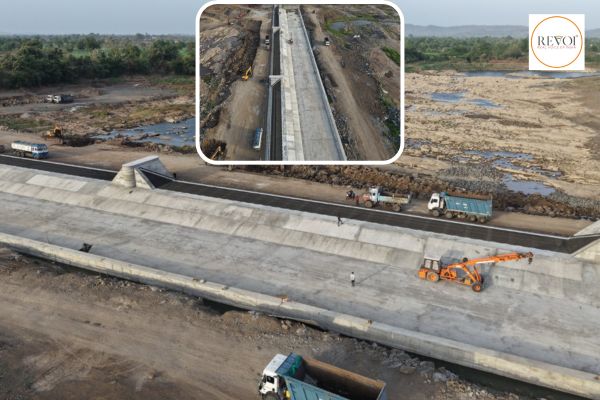
For the first time, two ‘air-field rubber dams’ will be built in the state with South Korean technology.

- Rajvasna of Chhotaudepur on river Heran for Rs. An expenditure of more than Rs. 82 crores and Rs. Two modern rubber dams under construction at a cost of more than Rs 79 crore
Feature of Rajvasna Rubber Dam:
Under this project, a modern rubber bladder with a length of 180 meters and a height of 3.5 meters will be installed on the Heran River. The main feature of this rubber dam technology is that it will unprecedentedly increase the water storage capacity of Hayat Juna Dam and a total of 3.5 million cubic meters – MCM of water can be stored. As a result, the underground water level of the surrounding areas will become very high so that irrigation and drinking water will be easily available. As of present, 75 percent work of this dam has been completed.
Rajvasana Rubber Dam:
✓Rajwasna Rubber Dam of Chhotaudepur will directly benefit 3420 hectare area of 25 villages.
✓With the storage of 3.5 MCM water, the problem of floods and tremors of Heran River will come to a permanent end.
✓ State-of-the-art rubber dam will be completed in 30 months on Heran River at Bodlina Rajvasana.
✓As of now, 75 percent of the dam work has been completed.
other benefits
Silt and Trembling Freedom:
Due to accumulation of sand and silt in the old embankment, the water storage capacity was decreasing, now complete removal of this silt will be possible with the rubber dam method. Flood Control: In case of heavy flood during Chhomsa, the rubber dam can be deflated, so that the flood water can be drained quickly and the surrounding villages can be saved from damage. A 900 meter long flood protection wall (protection work) will also be built on the left bank of the river and 500 meter long on the right bank.
Operation for 10 years:
This contract itself covers operation and maintenance (O&M) for the next 10 years, so that the technical facility will remain operational continuously.
3420 hectare area of 25 villages will get Sanjeevani: With the completion of this rubber dam, the farmers of the area will get sufficient water for farming in both the seasons of Ravi (शियालू) and Kharif (Chomasu) through dam based canals. Not only this, in future the canals of Rajvasana Dam Scheme will be connected with the lakes of around 25 profitable villages. By filling the village ponds with this additional water, the problem of drinking and irrigation water in the entire pantha will become a thing of the past forever.
About Pathakwadi Rubber Dam:
A historical and modern revolution is about to take place in the water harvesting sector in Tapi district of South Gujarat, which is full of natural beauty and has perennially flowing rivers. The government has planned to build an advanced ‘air-field rubber dam’ (Hawa Bharela Dam) at a cost of ₹ 79.13 crore on Ambika river passing through Pathakwadi village of Dolwan taluka in the interior of Tapi district. If this scheme is implemented, the farmers of Pathakwadi including villages like Dhodiawad, Unai and Sindhai will get sufficient water for Kharif and summer crops. At present, 90 percent work of this dam has been completed.
Pathakwadi Rubber Dam:
✓ 650 hectares of land will get irrigation water from the advanced ‘Rubber Dam’ based on Japanese design.
✓ This rubber bladder provides excellent performance even in temperatures above 50 degrees Celsius with a lifespan of approximately 30 years.
✓At present 90 percent work of this dam is complete.
Excellent solution of modern technology against geographical challenge:
Due to this area of Tapi district being flat and the banks of the river being low, it was traditionally not possible to construct a high height check dam or weir structure here. The survey was conducted by the department following the presentation of local farmer leaders and Vyara MLA Mr. Mohanbhai Konkani. In which a new decision has been taken to build ‘air-field rubber dam’ of Japanese technology with more water storage capacity instead of traditional barrage.
Features of Japanese design and Korean rubber bladder:
The entire design of this unique dam has been done as per Japanese code 2000. A special type of rubber bladder used in this project has been procured from South Korea, whose thickness ranges from 18 MM to 32 MM. This rubber bladder is capable of providing excellent performance even in temperatures above 50 degrees and its lifespan is approximately 30 years.
Operation will be done through SCADA automation:
The biggest specialty of this dam is that without any manpower, the work of inflating and deflating the rubber bladder can be done easily through computer through SCADA automation system. The 2.50 meter rubber bladder will be fixed on the 2.00 meter concrete base with “J” bolts, so that the total height of the dam will be 4.50 meter and the total length will be 280 meter (4 span).
Floods and soil erosion will stop during monsoon season:
Compared to traditional steel gated dams, rubber dams do not obstruct the river flow at all during monsoon floods, thus preventing soil erosion. Additionally, by deflating the rubber, the tension in the river will be easily carried away, due to which the water storage capacity of the dam will be maintained for years.
Rejuvenating 650 hectares of land and raising the level of wells:
This modern rubber dam will store a huge quantity of water of approximately 3.50 lakh cubic meters (3.50 MCM). As a direct benefit of which, 650 hectares of surrounding land will come under irrigation. Not only this, by increasing the underground water level of wells and bores in the surrounding areas, the local people will get permanent relief from the problem of pure drinking water. In future, this technology will also prove to be very useful as a ‘tidal regulator’ to prevent the salt water of the sea from mixing with fresh water.

Comments are closed.