
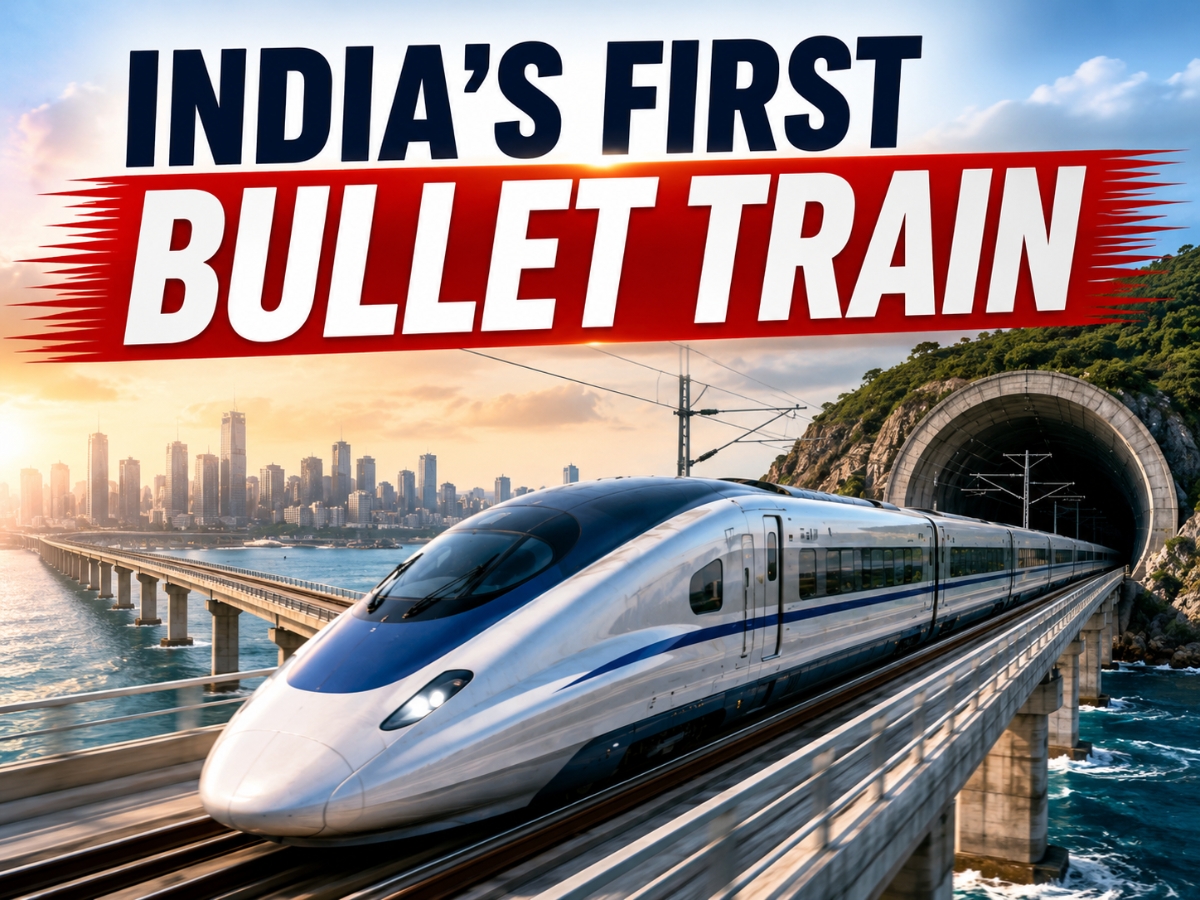
India’s First Bullet Train: Launch Timeline, Key Features And Future Rail Corridors Explained

India’s first bullet train is no more just a paper dream. The Mumbai-Ahmedabad high-speed rail project has completed 80% of its construction, bringing it closer to the launch of India’s first high-speed train services. This corridor will serve as a launchpad for a greater bullet train network across India. Drawing from the Japanese Shinkansen technology, the project aims to accelerate journeys, modernise India’s rail system and turn a new page in the country’s transport infrastructure.
When will India’s first bullet train be launched?
In January 2026, Union Railway Minister Ashwini Vaishnaw announced that the first operational stretch of the Mumbai-Ahmedabad Bullet Train corridor is likely to be commissioned on 15th August 2027.
The first stretch between Surat and Bilimora will be the first to have passengers. The other sections will be opened in phases as construction progresses:
Letter–Bilimora (2027)
Letter-Vapi
Vapi-Ahmedabad
Ahmedabad–Thana
Ahmedabad-Mumbai
The government says work continues to progress steadily and is concentrated on completing the corridor on schedule.
Why the bullet train project is important for India
India’s first foray into high-speed rail travel, the Mumbai-Ahmedabad High-Speed Rail corridor. The bullet train will run at 320 km/h against the conventional trains’ design speed of 350 km/hr.
But the most convenient aspect of travel for passengers is the time factor. The Mumbai-Ahmedabad 508 km journey will take only 1 hour and 58 minutes, compared to the existing travel time by train. The route is expected to have 12 stations in all, linking key commercial and industrial centres and enhancing regional connectivity.
India’s first-ever underwater bullet train track
A highlight of the project that has garnered much discussion is the undersea tunnel around Mumbai, which will be India’s first undersea train tunnel.
Besides the unique undersea tunnels, other engineering marvels of the corridor include the construction of 17 bridges that have already been completed, along with elevated viaducts and complicated tunnel projects.
What’s the technology behind the bullet train?
The corridor is being built on Japan’s world-famous Shinkansen technology with a good safety record, speed and operational reliability.
Some of the main features are:
- First introduction of J-Slab ballastless track technology in India
- Over 20,000 overhead electrification (OHE) poles
- Modern 2×25 kV traction system
- 12 traction substations, 2 depot traction substations, and 16 distribution substations.
- Rolling stock depots at Sabarmati, Surat and Thane
- Advanced train control and signalling systems High-speed operating
These systems have been designed to deliver improved reliability, reduce maintenance and enhance the safety and efficiency of travelling at high speed.
How will the average traveller benefit from this?
While the first corridor connects the cities of Mumbai and Ahmedabad, the implications of these advanced systems will extend well beyond it.
Some of the main benefits include:
- Shortened travel time for business and leisure travellers
- Greater connectivity between major economic centres
- New investment opportunities in stations and industrial centres
- Additional employment opportunities during construction and operation
- India’s growing expertise in high-speed rail technology
The experience gained from this project is also expected to help standardise engineering and construction practices, making future bullet train projects faster and more cost-effective.
Seven more bullet train corridors are in the pipeline
The Mumbai-Ahmedabad route is only the first step. The government has identified seven more high-speed rail corridors spanning almost 4,000 km with a proposed investment of about Rs 16 lakh crore.
Proposed routes include the following:
| Proposed Corridor | Estimated Travel Time |
|---|---|
| Delhi to Varanasi | 3 hours 50 minutes |
| Varanasi–Patna–Siliguri | 2 hours 55 minutes |
| Chennai–Bengaluru | 1 hour 13 minutes |
| Bengaluru–Hyderabad | 2 hours |
| Chennai–Hyderabad | 2 hours 55 minutes |
| Mumbai–Pune | 48 minutes |
| Pune–Hyderabad | 1 hour 55 minutes |
If developed as planned, these corridors could cut the travel time of trips that currently take hours down to a fraction of that.
What this means for India’s travel future
The Mumbai-Ahmedabad Bullet Train is not just a faster way to travel between two cities. It is India’s first major step towards building a modern high-speed rail network with world-class technology and emerging domestic expertise. As construction advances and more corridors are created, the project could enhance connectivity, boost economic growth and speed up, smooth out and make long-distance travel more convenient for millions of people.
Also Read: Why Has StanChart Closed 20 India Branches? What It Means For Customers And Wealth Push
Priyanka Roshan is a business writer and assistant editor at the NewsX website who tracks everything from stock market swings and corporate earnings to personal finance trends and policy shifts. Known for turning fast-moving business developments into sharp, reader-friendly stories, she combines speed, accuracy, and a data-driven approach to break down complex financial news for everyday audiences.
With over 9.5 years of newsroom experience, Priyanka has worked with leading media organisations, including Bussiness, Times Now, and Ping Digital, covering diverse beats such as business, politics, technology, auto, travel, sports, and the world. From live breaking news desks to SEO-led digital storytelling, she specialises in creating engaging content that keeps readers informed without overwhelming them.
The post India’s First Bullet Train: Launch Timeline, Key Features And Future Rail Corridors Explained appeared first on NewsX.

Comments are closed.