
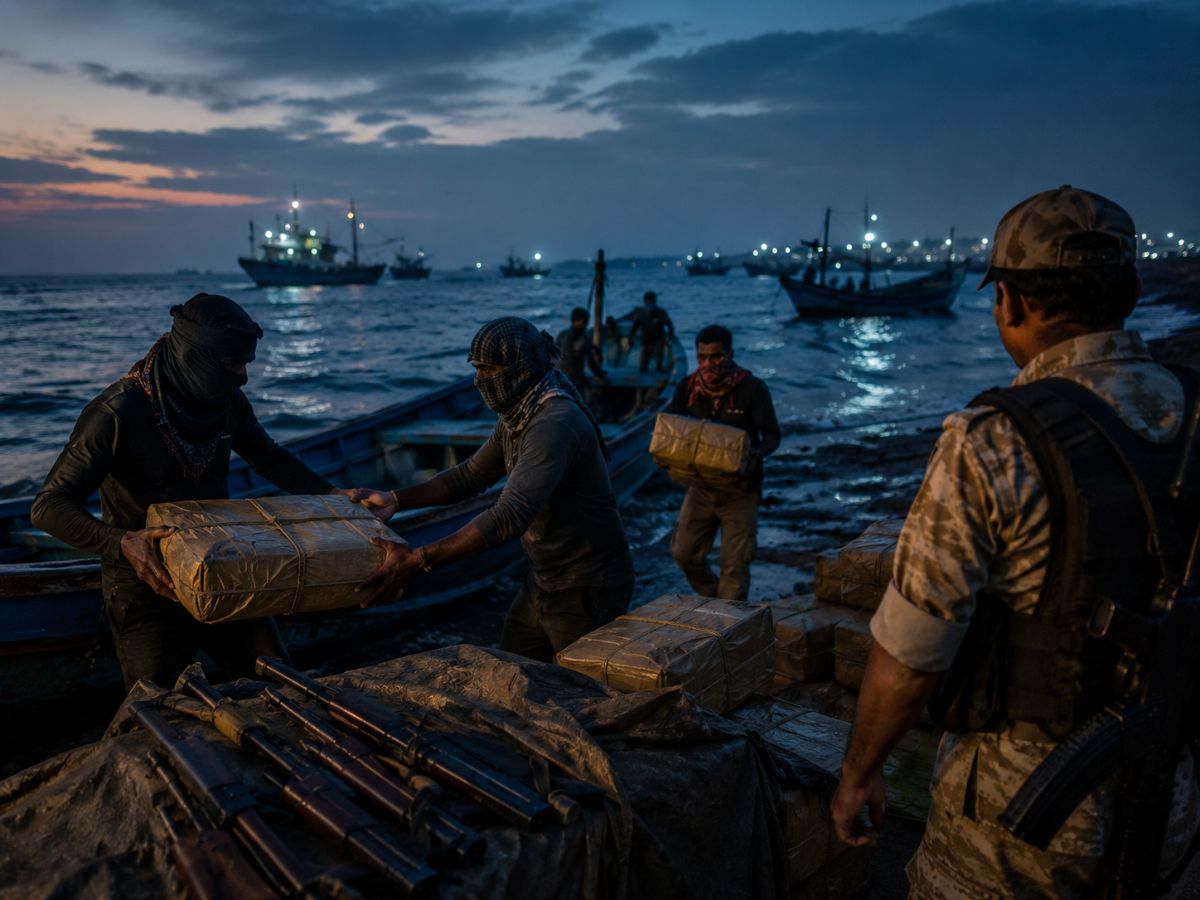

India’s western coastline stretching across Gujarat and Maharashtra has emerged as one of the country’s biggest security concerns, with intelligence agencies warning that it is increasingly being used as a maritime route for smuggling illegal arms from Pakistan into India. An official assessment submitted to the Ministry of Home Affairs (MHA), based on inputs from multiple security agencies, says traffickers are shifting towards the sea as they constantly change routes to stay ahead of enforcement agencies. The report says the same network also operates through land borders in Punjab and Rajasthan, but the maritime route along the western coast has become a growing focus because smugglers are exploiting fishing boats and small coastal vessels that often escape conventional surveillance systems.
Maritime route under scanner as smugglers switch from land to sea
According to the Narcotics Control Bureau’s (NCB) Annual Report 2025, the South Asian arms trafficking network reaches India through both land and sea. While one branch continues to move through Punjab and Rajasthan, another has increasingly turned to the maritime route along Gujarat and Maharashtra.
The report states, “The South Asian arm flows through Pakistan into India via both the land frontier in Punjab and Rajasthan, and the maritime frontier along the Gujarat and Maharashtra coastlines, the latter a route of increasing concern given its use of fishing vessels and coastal craft that operate below the detection threshold of standard maritime surveillance.” Officials say traffickers hide illegal consignments among legitimate fishing activity and coastal movement, making them harder to detect.
Security agencies have observed that criminals always change their tactics in order to evade any security measures taken against them. Due to the increasing importance of the maritime route, it has become necessary for coastal security agencies to enhance their monitoring capabilities.
Maritime route linked to wider global trafficking networks
The report indicates that India has emerged as both a destination and a transit country for arms and drug traffickers in the international market. Trafficking channels, according to the evaluation, are constantly changing due to enforcement challenges and geopolitical shifts and are always diverted to new locations when the current ones attract attention.
Apart from this, it must be remembered that “the routes of drug trafficking are neither fixed nor predictable,” as they change due to reasons such as geography (due to law enforcement), geopolitical diversions, and an increased use of trade routes. “India is located at the crossroads of all the important routes of drug trafficking,” as India lies between the two largest regions producing drugs.
Maritime route forms part of a larger regional smuggling network
According to the report, the corridor between Afghanistan-Pakistan-Iran is considered the main opiate trafficking complex in the world, where the pre-ban stockpile is estimated to be at almost 13,200 tonnes.
In addition, the Golden Crescent, which consists of Afghanistan, Pakistan, and Iran, is one of the largest areas for illicit opium cultivation and its trafficking route extends beyond Pakistan.
Finally, it was observed that the Balkan route for transporting heroin from Iran and Turkey to Western Europe is being used to transport methamphetamine along with heroin – a phenomenon called “route convergence.”
For India, the report flags the Golden Triangle as a major concern. It says the threat is most visible along the North-Eastern frontier, where “the Manipur corridor, through which the Indian National Highway 102 passes, is the primary land entry point for both heroin and methamphetamine tablets.” Myanmar’s Shan State has also become a major hub for both opium and large-scale methamphetamine production, creating what the report describes as a “poly-drug production complex.”
Maritime route may face new challenges as global drug networks evolve
The report also identifies the Bay of Bengal as an emerging transportation channel and says cocaine trafficking routes are expanding beyond their traditional network of Andean production, North American markets and West African transit to Europe.
It further notes that the political transition in Syria during 2024 has impacted the manufacturing network of Captagon leading to uncertainties in the Near and Middle East region. According to the report, new methamphetamine trafficking groups functioning in the Gulf region are trying to replace the void left behind. The report states, “Geographic relocation of Captagon production to Libya or Egypt could bring the supply of synthetic drugs to North Africa and would open up new maritime trafficking networks via the Mediterranean and possibly the Red Sea.”
In conclusion, the report draws attention to Afghanistan as yet another instance of geopolitical dynamics impacting the trafficking networks. It notes that the rise of the Taliban regime has largely shaped the emergence and disappearance of centers of drug production, thus emphasizing the importance of vigilance of India towards all evolving maritime routes in the region.
(with inputs from ANI)
Also Read: Why Did Yogi Govt Rename UP’s Jalalabad? The Parashurampuri Story And Akbar Connection Explained
Khalid Qasid is a media enthusiast with a strong interest in documentary filmmaking. He holds a Master’s degree in Convergent Journalism from AJK MCRC. He has also written extensively on esports at Sportsdunia. Currently, he covers world and general news at NewsX Digital.
The post How Pakistan Is Using India’s Western Coastline To Smuggle Illegal Arms appeared first on NewsX.

Comments are closed.