
Delhi’s Bullet Train: 4 Proposed Corridors, 50 Cities To Be Connected, Routes, Travel Time Explained

India’s bullet train plans are not just about the Mumbai-Ahmedabad route. Now the government is considering a much larger high-speed rail network with Delhi at its heart. If the proposals go through, the national capital will emerge as India’s biggest bullet train hub with nearly 50 cities across North, West and East India connected through high-speed rail.
Most of these projects are still in planning. Only a small number are in the survey stage, and only a small number are in the Detailed Project Report (DPR) stage. But they give a clear picture of the government’s long-term plan to link up big business centres, industrial hubs and religious sites along a nationwide bullet train network.
Four Bullet Train Corridors Planned From Delhi
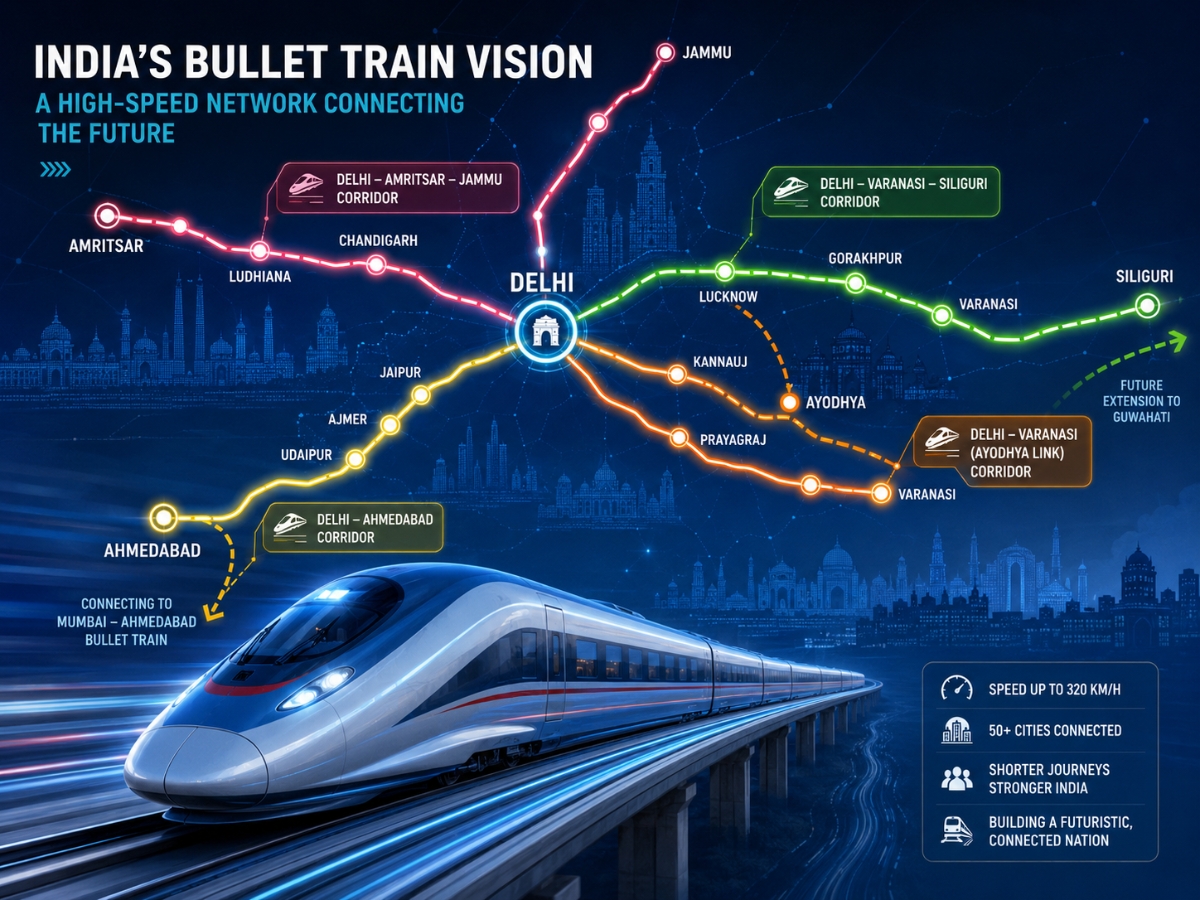
The ministry of railways is planning and developing four high-speed railway corridors in association with National High-Speed Rail Corporation Limited (NHSRCL), reports said. These include the ‘Delhi to Varanasi (Ayodhya link)’ route, the ‘Delhi to Varanasi to Siliguri’ route, the ‘Delhi to Ahmedabad’ route and the ‘Delhi to Amritsar to Jammu’ route.
The development of these ultra-high-speed train corridors, which will pass through UP, Bihar, West Bengal, Rajasthan, Gujarat, Punjab, Jammu and Kashmir, will boost India’s high-speed network.
Delhi-Varanasi Corridor To Be Hours Shorter As It Will slash Journey Time
The Delhi to Varanasi high-speed railway corridor is another highly talked-about railway project under planning; this corridor, which is around 865 kilometres long, is expected to cost roughly Rs 1.21 lakh crore. The journey between the two major North Indian cities, Delhi and Varanasi, would be trimmed to just over three hours and 50 minutes from the current 11-12 hours once it is completed. The stations planned on the Delhi-Varanasi high-speed line are Hazrat Nizamuddin, Noida, Jewar International Airport, Mathura, Agra, Firozabad, Etawah, Kannauj, Lucknow, Rae Bareli, Prayagraj, New Bhadohi and Varanasi, as quoted by NHSRCL on its proposal by NDTV.
The proposal also includes a 124-135 km link between Lucknow and Ayodhya, which is likely to improve access to one of the fastest-growing religious tourism destinations in the country. NHSRCL has invited tenders for the design of specific civil infrastructure.
Delhi To Siliguri In 6 Hours?
There is also the massive Delhi-Varanasi-Siliguri High Speed Rail Corridor, which could very well be the longest bullet train project in India. At 1,705 kilometres, it could cover 13.6% of India’s total network once completed! The proposed route is expected to reduce travel time from Delhi to Siliguri to just about 6 hours, compared to what takes close to 20 hours currently.
The corridor aims to connect the Delhi region to Uttar Pradesh, Bihar and West Bengal, with provisions to extend it to Guwahati in the future.
It would include 16 stations in cities like Noida, Agra, Lucknow, Patna and New Jalpaiguri. While a survey is already complete, feasibility reports are being drawn.
Delhi-Ahmedabad Route To Link Rajasthan And Gujarat
Another massive bullet train project that has been proposed is the one between Delhi and Ahmedabad that will run via Rajasthan and Gujarat. The proposed 886 km route will cover as many as 14-15 stations across Delhi, Gurgaon, Ajmer, Jaipur, Chittorgarh, Udaipur and Gujarat, including the cities of Ahmedabad, where it will be integrated with another bullet train line.
The best part about this corridor is the plan to connect it with the ongoing Mumbai-Ahmedabad Bullet Train project, enabling us to take a trip to Mumbai in a bullet train from the capital city without changing lines.
According to sources, the detailed project report for this corridor is ready, and all that’s left are financial approvals.
Delhi–Amritsar–Jammu Corridor Still At Survey Stage
Delhi-Amritsar-Jammu High-speed rail Corridor Another mega bullet train that is under consideration is the Delhi-Amritsar-Jammu corridor, which is expected to boost the regional rail network in northern parts of India. The length and exact number of stations of the corridor are yet to be confirmed, as no feasibility study has been done yet.
It will go through Rohtak, Jind, Kaithal, Chandigarh, Mohali, Ludhiana, Jalandhar and Amritsar before finally stretching to Pathankot, Jammu and Katra.
The project is in the first stage of the survey.
A corridor, if built, will reduce the travel time between Delhi and Amritsar to about two hours.
How Much Time Would These Bullet Trains Save Us?
If the proposed corridors become operational, some of the country’s busiest routes could see journey times slashed.
| Route | Estimated Travel Time |
|---|---|
| Delhi – Lucknow | Around 2 hours 10 minutes |
| Delhi to Varanasi | Around 3 hours 50 minutes |
| Delhi – Patna | Around 4 hours 41 minutes (proposed) |
| Delhi – Siliguri | Around 6 hours |
| Delhi – Amritsar | Around 2 hours |
These cuts can make high-speed rail competitive with air travel on a majority of routes. More so, travellers won’t need to use a different transport option to get to the city centre, as is the case with aeroplanes.
A Journey At 320 km/h
Trains that can touch speeds of 320 km/h will run on the proposed corridors.
This is similar to the plans for the upcoming Mumbai–Ahmedabad high-speed rail corridor.
For the train, a ‘Made-in-India’ project, B35, BEML is manufacturing it. This train has been designed to run at 280 km/h and to be upgradable to 350 km/h in future models, and it will run trials on parts of the Mumbai-Ahmedabad corridor once it is ready.
Where Do These Projects Stand Today?
The plans have generated a lot of interest, but none of the proposed corridors have yet been finalised.
Different projects are at different stages of progress, like route surveys, feasibility studies and preparation of DPR, at present. But this will require them to secure land, environmental permits, funding approvals and the centre’s final clearance before the actual construction starts. While the Mumbai-Ahmedabad High Speed Rail Corridor is currently the only bullet train project underway in India, the first stretch is expected to be completed by 2027.
What Do These Bullet Train Projects Mean To India?
Should these proposals ever pass, they could revolutionise how people travel across broad swaths of the country. Faster rail links would cut journey times and increase connectivity between business centres, tourist destinations and expanding urban centres. The corridors are mostly years away from construction but they are a sign of the government’s bigger objective of building a high-speed rail network across the country, far beyond the first bullet train route between Mumbai and Ahmedabad.
Also Read: India’s First Bullet Train: Launch Timeline, Key Features And Future Rail Corridors Explained
Priyanka Roshan is a business writer and assistant editor at the NewsX website who tracks everything from stock market swings and corporate earnings to personal finance trends and policy shifts. Known for turning fast-moving business developments into sharp, reader-friendly stories, she combines speed, accuracy, and a data-driven approach to break down complex financial news for everyday audiences.
With over 9.5 years of newsroom experience, Priyanka has worked with leading media organisations, including Bussiness, Times Now, and Ping Digital, covering diverse beats such as business, politics, technology, auto, travel, sports, and the world. From live breaking news desks to SEO-led digital storytelling, she specialises in creating engaging content that keeps readers informed without overwhelming them.
The post Delhi’s Bullet Train: 4 Proposed Corridors, 50 Cities To Be Connected, Routes, Travel Time Explained appeared first on NewsX.

Comments are closed.