
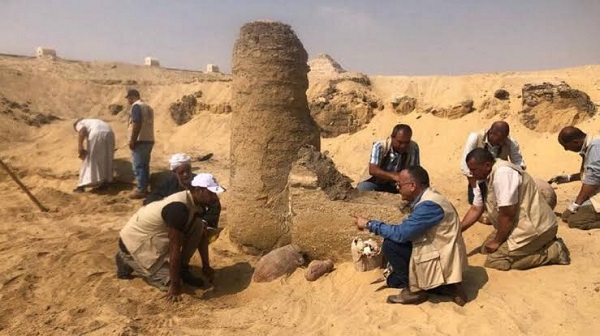
Centuries-old settlement, 18 ancient tombs and ‘golden tongue’ found in the Egyptian desert increased the curiosity of scientists.

New Delhi. Archaeologists have made two major historical discoveries in Egypt’s Western Desert region. These include a well-maintained ancient city from the Byzantine period and a group of 18 new tombs. Experts are considering it as one of the most important archaeological achievements of recent years. The Egyptian government believes that these discoveries will also give a new impetus to the country’s tourism sector.
Find these located near Alexandria Dakhla Oasis And Marina El-Alamein Have taken place at archaeological sites. According to the Ministry of Tourism and Antiquities, the ancient city has revealed important information about the social life, economic activities and urban development during the Byzantine rule in the fourth century.
Planned city of 4th century found
According to Mahmoud Massoud, head of the Egyptian Archaeological Mission, the city grew over a basilica church complex built in the mid-4th century. During the excavation, main roads, two watch towers built for external security and a fort-like structure with thick walls have been found.
Apart from this, many residential buildings have also been found, in which reception rooms and domed roofs were built. Archaeologists have also discovered kitchens, bread ovens and stone grain grinding equipment, which offer a glimpse of daily life at that time.
Coins and ancient documents were also found
Bronze coins with portraits of Byzantine emperors, Latin inscriptions and coins inscribed with Christian symbols have also been recovered during the excavations. Apart from this, gold coins from the reign of Roman Emperor Constantius II have also been found.
Antiquities Department head Dia Zahran said that about 200 pieces of pottery were also found, which were Ostraca It is said. These contain articles related to economic transactions, personal correspondence and daily life, which will help in understanding the administration and social system of that period.
18 new graves discovered
The second important discovery was made at the Marina el-Alamein archaeological site, where 18 new tombs were discovered. Of these, 11 graves were made by cutting rocks to a depth of about eight meters, while seven graves are made of limestone. After this discovery, the total number of graves found at this site has increased to 48.
Pottery, amphorae (ancient jugs), lamps, plates, worship altars and limestone basins have also been recovered from the graves.
Granite coffin and ‘Golden Tongue’ attraction
Mission chief Iman Abdel Khaliq said that during the excavation, a granite coffin about 2.5 meters long was found, in which the human skeleton was found in a safe condition. Along with this, remains of the Sphinx statue made of plaster have also been found.
The most interesting discovery is four small pieces of gold placed in the mouths of some of the dead, which ‘Golden Tongue’ It is said. It is believed that in ancient Egypt, as part of the religious beliefs of funeral rites, there was a tradition of placing a golden tongue in the mouth of the dead, so that they could speak before the gods in the afterlife.
Tourism will get a boost
Marina el-Alamein is a major archaeological site located on the northern coast of Egypt, discovered in 1986. Archaeologists believe it was once an ancient Greco-Roman port located along the Mediterranean Sea. Leucaspis Which was a prosperous trading center from the second to the fourth century.
The Egyptian government hopes that these new discoveries will further strengthen the country’s historical tourism. Tourism along the Suez Canal is a major source of foreign exchange for the Egyptian economy. According to official data, record in the year 2025 1.9 crores Tourists visited Egypt in 2024 compared to 21 percent more Was. Whereas in the first four months of 2026 61 lakhs Foreign tourists arrived in Egypt, while this number in the same period in 2025 57 lakhs Was.

Comments are closed.