

The Vietnam Textile and Apparel Association (VITAS) said exports of fibres, fabrics, accessories and nonwoven materials recorded solid growth of between 5.6% and 10.6% during the period. However, garment exports slipped 0.4% as consumer demand in key markets remained weak.
Based on data for the first five months of the year, the U.S. remained Vietnam’s largest export market, with shipments worth $6.81 billion, up 1.3% and accounting for about 45% of total exports. The E.U. was the brightest market, posting an 8.8% increase to $1.94 billion, while exports to Japan and the Republic of Korea fell 6.2% and 8.9%, respectively.
The industry maintained a trade surplus of nearly $10 billion in the first half of the year.
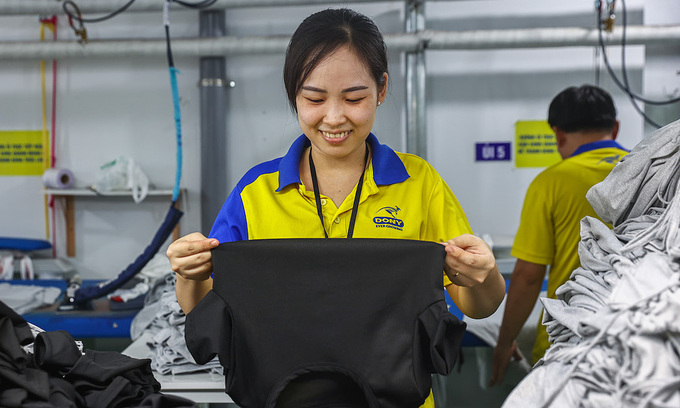
Workers seen at a garment factory in HCMC, August 2025. Photo by VnExpress/Quynh Tran |
Despite the good performance, VITAS said the industry continues to face major challenges, including sluggish demand in key markets, intense price competition, heavy dependence on imported raw materials, rising costs related to environmental, social and governance (ESG) standards and product traceability, as well as growing uncertainty over global trade policies.
VITAS Chairman Vu Duc Giang said the industry has little room left to expand simply by increasing production volume.
Instead, he said, future growth will depend on improving productivity, creating higher-value products, developing domestic sources of raw materials, diversifying export markets and accelerating digital and green transformation.
To support this shift, VITAS has approved the establishment of four specialised committees during its 2025–2030 term. The committees will focus on fashion and domestic market development, international business and supply chains, sustainable development, and technology, innovation and digital transformation.
The committees are expected to begin pilot operations in the third quarter of 2026.
With exports reaching $22.2 billion in the first half, the industry aims to maintain average monthly export revenue of more than $4 billion in the remaining months to achieve its full-year target of around $48 billion.
Key priorities include adapting to new purchasing strategies adopted by global brands, expanding domestic supplies of raw materials, diversifying markets and products, preparing for potential legal and trade risks, and increasing investment in technology, automation and digital transformation.

Comments are closed.