
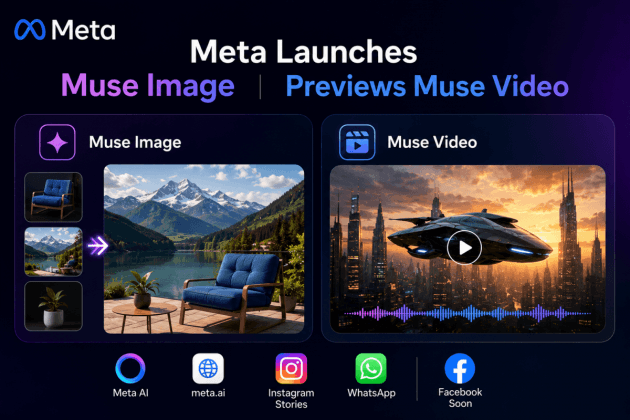

In a major new development, Meta has launched Muse Image and previewed Muse Video, marking the first media generation models developed by its Meta Superintelligence Labs.
Muse Image is described as Meta’s most advanced image generation model yet. It is designed to follow instructions accurately, edit images with precision, compose visuals using multiple reference images, and draw on Instagram for social context. Muse Video, built on the same pretraining foundation, promises high visual fidelity with native audio support.
How does Muse Image work?
Unlike traditional image generators that directly map prompts to images, Muse Image operates as an AI agent. It invokes search and coding tools to improve accuracy, self-refines its own generations, and scales its performance by using more compute at inference time.
On the coding front, the model learns to write and execute code during reinforcement learning to generate accurate plots and QR codes. It also conditions on rendered figures to improve the precision of its generated images.
Muse Image also integrates with Muse Spark, allowing the two models to combine code and media generation to create animated GIFs, websites with embedded images, and interactive visual games.
For factual accuracy, Muse Image can search the web to ground its generated images using real-time information and visual references. Meta says this significantly improves performance on knowledge-intensive prompts, particularly those involving current events and real-world facts.
The model also features an emerging self-refinement capability. If a small detail is incorrect, it can perform a local edit. If larger portions need correction, it can regenerate the image from scratch or switch to using external tools for more accurate output. According to Meta, this behaviour was not explicitly programmed but emerged naturally during reinforcement learning because it consistently produced better results.

Like large language models, Muse Image improves as more compute is allocated during inference. Instead of simply generating multiple images and selecting the best one—a technique known as Best-of-N—the model spends additional compute on reasoning, tool use and iterative refinement. Meta says this approach continues to improve image quality even as compute increases, whereas Best-of-N quickly reaches diminishing returns.
Availability
Muse Image is now available through the Meta AI app, on meta.ai, on Instagram Stories in the US, and on WhatsApp in select countries. Support for Facebook is expected to roll out soon.
Muse Video, meanwhile, is currently in preview and will be released to creators and Meta AI at a later date.
Meta has not announced any subscription fee for Muse Image. The model is being rolled out through Meta AI, which is generally free to use, although the company has not disclosed whether usage limits or premium tiers will apply.
Muse Image and Muse Video: Key features
Muse Image supports multi-reference image composition, allowing users to combine people, objects, clothing, styles and environments from multiple reference images into a single generation. It also supports interleaving text and images within prompts for more complex compositions and maintains coherence across multiple editing turns, enabling iterative image refinement.
Meta says it is continuing to improve Muse Video in areas where performance still lags, including audio-video synchronisation and physically accurate fast-motion rendering.
To improve transparency around AI-generated content, Muse Image introduces Content Seal, an invisible watermarking system. Images created using Muse Image in the Meta AI app and on meta.ai include a hidden provenance signal that Meta says survives cropping, compression, resizing and even screenshots.
The company plans to extend Content Seal to videos and is also previewing a detection tool that allows users to check whether an image contains a Content Seal watermark.

Comments are closed.