

The developments will be rolled out over the next three years, with the first hotel planned for Bangkok, followed by projects in Pattaya and Phuket, according to Forbes. Together, the three hotels will offer more than 2,000 rooms.
Hotel101 Global is a unit of DoubleDragon, the joint venture joint venture between Jollibee founder Tony Tan Caktiong, who has a net worth of $1.1 billion, and real estate magnate Edgar Sia II, who owns $310 million in wealth.
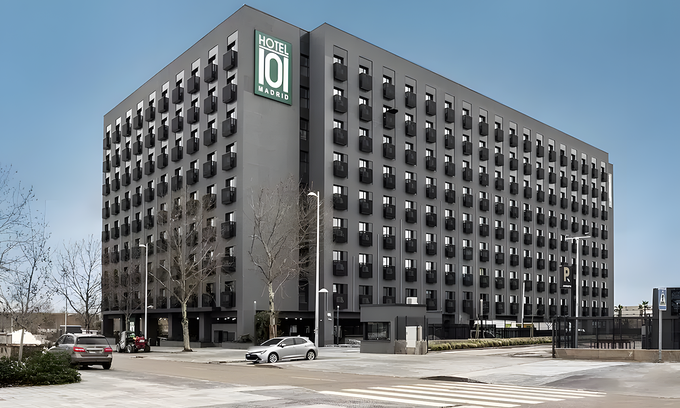
Hotel101 Madrid, Spain. Photo courtesy of Hotel101 Global |
Hotel101-Bangkok is expected to generate 1.9 billion baht ($57 million) in sales once all units are sold. Scheduled for completion by 2029, the hotel will occupy an 8,336-square-meter site on Phahon Yothin Road, near Don Mueang International Airport.
Planned amenities include meeting spaces, a conference center, modern rooms, all-day dining, a swimming pool, a full-size gym, a business center, a children’s pool, parking, and luggage storage, according to Hotel News Resources.
Hotel101, which opened its first property in the Philippines in 2016, was listed on Nasdaq in July last year. The listing is expected to help finance Sia’s goal of developing 1 million hotel rooms across 100 countries by 2050.
The company currently operates two hotels in the Philippines with a combined 1,124 rooms. As part of its international expansion, Hotel101 opened its first overseas property, the 680-room Hotel101-Madrid, in March. The 482-room Hotel101-Niseko in Hokkaido, Japan, is scheduled to open in December.
Later this year, Hotel101 will also open the 519-room Hotel101-Davao and the 548-room Hotel101 Cebu in the Philippines. According to the company, these additions, together with Hotel101-Niseko, will bring a record 2,229 new hotel rooms online in 2026.
Hotel101 is also developing projects in Los Angeles and Saudi Arabia, where it plans to build 10,000 rooms valued at $2.5 billion across Medina, Riyadh, Jeddah, Abha, and Alula.
The company is building a global hotel network centered on identical, standardized rooms across all of its properties to improve efficiency and affordability.
Under the “condotel” model, which gained popularity in the U.S. in the 1980s, hotel rooms are pre-sold during construction for an average price of up to $250,000 each. Investors receive a 30% share of gross hotel room revenue and are entitled to stay free for up to 10 days annually.
Comments are closed.