
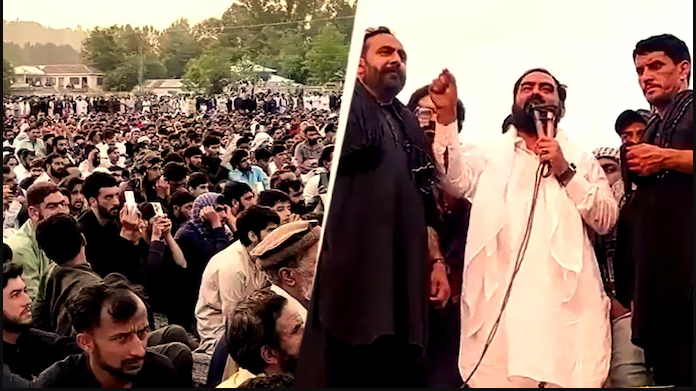

NEW DELHI, July 9: Tensions are once again mounting in Pakistan-occupied Jammu and Kashmir (PoK) with the Jammu Kashmir Joint Awami Action Committee (JAAC) issuing a 48-hour ultimatum to the Pakistani government warning it of a “grand and final” phase of protests if its 38-point charter of demands is not immediately addressed.
The immediate flashpoint is the regional elections scheduled for July 27. With the nominations beginning on Thursday, the JAAC has announced a massive protest march to Muzaffarabad, signaling what could become one of the biggest political confrontations the region has witnessed in recent years.
At the center of the protests is the demand to abolish 12 legislative assembly seats reserved for Kashmiri refugees settled in Pakistan. The JAAC argues that these seats allow Islamabad to retain disproportionate influence over PoK’s politics. According to experts, the 12 refugee seats represent around 4.36 lakh registered voters in Pakistan, while the remaining 33 directly elected seats represent nearly 33 lakh voters living in PoK. Critics argue that this gives refugee constituencies significantly greater electoral weight than those representing residents of the region.
Adding another layer to the controversy, the PoK Supreme Court ruled on June 7 that the 12 reserved seats are constitutionally protected and cannot be abolished through an executive order, requiring a constitutional amendment instead.
While the refugee-seat issue has become the immediate trigger, the JAAC’s charter reflects far deeper economic frustrations. Apart from seeking the abolition of the 12 reserved seats, the group has demanded a complete renegotiation of hydropower projects, higher subsidies on essential commodities such as flour to cushion soaring inflation, and lower electricity tariffs, arguing that residents should not have to pay high electricity prices generated in their own region.
The demands reflect growing resentment over what many residents see as political marginalization coupled with economic neglect. Formed in 2023, the JAAC has rapidly emerged as the most influential civil rights platform in PoK. The organization first came to prominence during the widespread protests of May 2024, when sit-ins, shutter-down strikes and wheel-jam protests brought large parts of the region to a standstill. The agitation was triggered by soaring inflation and demands for subsidies comparable to those available in other Pakistan-administered regions such as Gilgit-Baltistan.
Since then, the organization has repeatedly mobilized large protests, including another major agitation in September 2025. Pakistan describes the region as “Azad” (Free) Kashmir, but its constitutional and administrative structure presents a more complex picture.
Technically, PoK does not form part of Pakistan under Article 1 of the Pakistani Constitution, which lists the country’s provinces. As a result, the region has no representation in Pakistan’s national parliament. On paper, PoK has its own President, Prime Minister, Supreme Court and elected Assembly. However, substantial authority continues to rest with institutions controlled by Islamabad, particularly the Kashmir Council headed by the Prime Minister of Pakistan.
The PoK Constitution also bars any individual or political party from opposing the region’s accession to Pakistan. Election candidates are required to sign a declaration supporting accession before they can contest polls.
(Rohit Kumar)

Comments are closed.