
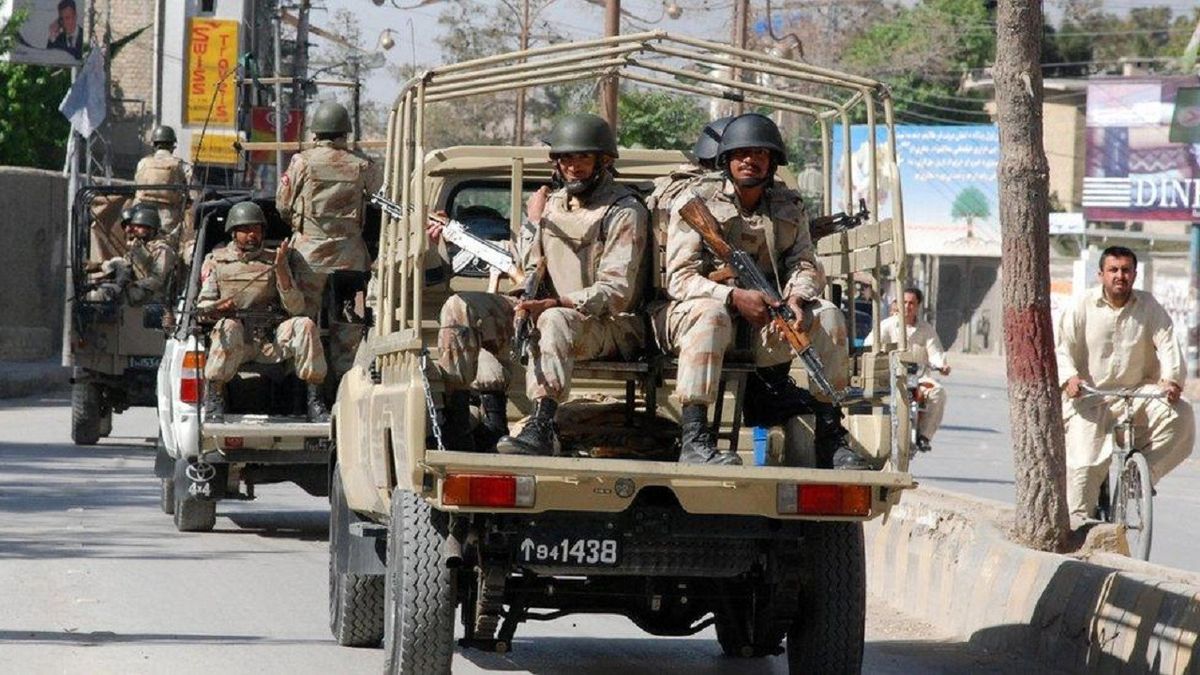

There is a version of the Gwadar story that treats every attack as an isolated security failure – a checkpoint that should have been better guarded, a patrol that should have been reinforced. That framing misses the more important pattern: Pakistan’s government has spent two decades responding to Baloch grievances almost exclusively with more security infrastructure, and rarely with the political engagement that might actually address why the insurgency keeps growing.
Friday’s suicide bombing of a Coast Guard camp in the Panwan area of Jiwani, which the Balochistan Liberation Army says killed more than 30 personnel, is not a security lapse in isolation. It’s the predictable output of a strategy that keeps choosing the same tool for a problem that the tool cannot solve.
A Grievance That Has Never Really Been Addressed
Baloch nationalists have consistently argued that CPEC and the port at Gwadar extract the province’s coastline and resources while returning little in local investment, employment, or political voice. That argument long predates the current wave of violence, and it has never been seriously negotiated by Islamabad in a way that reaches the communities making it.
Instead, the government’s answer has been to add checkpoints, stand up a dedicated Special Security Division, and expand the military and paramilitary footprint around CPEC assets. Each of those measures may be defensible as short-term protection. None of them addresses the underlying political complaint, and there is little evidence that Islamabad has treated that complaint as a problem requiring its own solution rather than a security nuisance to be contained.
The Result Is an Insurgency That Keeps Adapting
The consequences of that approach are visible in how the BLA’s campaign has evolved. The group has moved from land ambushes and pipeline sabotage to storming the Gwadar Port Authority complex and the Turbat naval base directly. Earlier this year it struck a Coast Guard patrol boat near Jiwani and announced a standing naval unit shortly after — evidence of organizational growth, not just tactical opportunism. A drone unit had already been added before that. Friday’s truck bombing of a fortified land camp extends the pattern to hardened static installations.
An insurgency responding only to military pressure, with no parallel political track offering an alternative, tends to professionalize rather than fade – and that is what appears to be happening here. Pakistani officials have generally described these escalations as the work of foreign-backed spoilers operating from Afghanistan or Iran, which may be true in part, but that framing has also functioned as a way to avoid engaging with the domestic political grievance driving recruitment inside Balochistan itself.
What This Means for the Port Itself
The practical effect on Gwadar is straightforward and cumulative. A port whose security camps get bombed, whose naval base gets stormed, and whose patrol boats get attacked is a port that insurers price accordingly – premiums climb, and shipping traffic quietly migrates toward calmer harbors rather than waiting for the underlying conflict to resolve. That dynamic doesn’t require any single attack to be catastrophic; it compounds over years of recurring incidents.
Combine that with CPEC’s already uneven delivery record – only about 38 of roughly 90 originally planned projects completed, a third never started – and Gwadar’s practical claim to being a reliable, functioning trade hub gets harder to sustain with each new incident, regardless of the genuine progress represented by newer initiatives like the 2026 Iran transit order.
Why International Confidence Is the Real Casualty
The deepest cost may not be to Gwadar’s infrastructure but to its credibility as an investment. International trust in a project like this depends on a reasonably predictable trajectory: that security incidents are transitional, that the underlying conflict is being managed toward resolution, and that today’s problems are not simply next year’s problems with a different date attached.
Two decades of recurring attacks, met consistently with more security spending and rarely with political outreach to the province at the center of the conflict, undercuts that predictability.
Foreign investors and shipping partners aren’t just weighing the risk of the next attack – they’re weighing whether the government sponsoring this project has a credible theory for how the conflict actually ends. On the available evidence, that theory has not yet been offered, let alone tested. Until it is, claims that Gwadar’s security problems are temporary will keep running up against a Baloch insurgency that has, if anything, grown more capable with each passing year.

Comments are closed.