
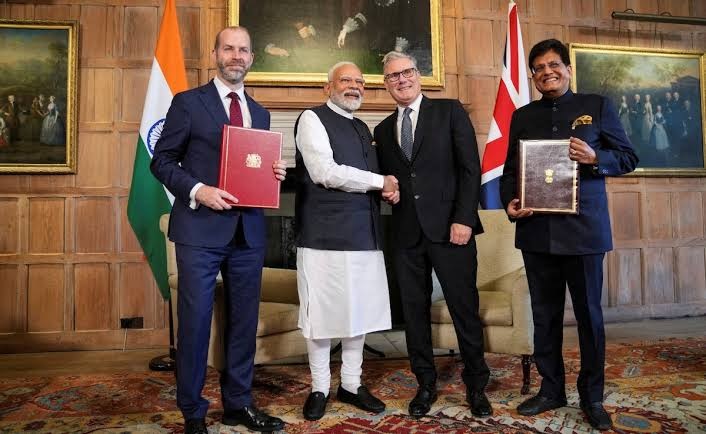
India-UK trade agreement comes into effect from July 15, GTRI said – not just CETA, quality improvement will give full benefit

New Delhi. The Comprehensive Economic and Trade Agreement (CETA) between India and Britain is going to be effective from July 15. This agreement is expected to provide better access to Indian products in the UK market. However, economic research organization Global Trade Research Initiative (GTRI) believes that duty relief alone will not automatically lead to a major increase in exports. For this, Indian industries will have to pay equal attention to quality, certification, logistics and global standards.
According to Ajay Srivastava, founder of GTRI, this agreement definitely opens up new opportunities for Indian exporters, but if the quality of products, supply chain and regulatory requirements are not improved, then these opportunities will not be taken full advantage of.
The biggest emphasis will be on quality and standards
The report said that mere reduction in duty is not enough in the international market. In many sectors quality standards, food safety regulations, international certification, trade protection measures and strong supply systems play an even more important role.
GTRI says that Indian companies will have to comply with UK regulatory standards as well as develop strong business networks with buyers.
These areas can get the most benefits
According to the report, sectors where India’s production capacity is strong and there is good demand in Britain are likely to benefit the most from this agreement. Mainly among these-
Garment and textile industry
leather and footwear
processed food products
marine products
some agricultural products
Vehicles, motorcycles and their parts
However, exporters of automobiles and auto parts have to comply with technical standards and conditions such as ‘Rules of Origin’.
Limited impact in steel, petroleum and liquor
GTRI assesses that the impact of this agreement will be relatively limited in sectors like steel, petroleum and liquor. The organization says that it will not be easy to gain competitive edge in these areas by merely reducing fees.
India’s share in Britain’s imports is still low
According to the report, in the year 2025, Britain will import goods worth $928.9 billion from around the world, while the value of imports from India was only $15.2 billion. That means India’s share in Britain’s total imports was only 1.6 percent.
Experts believe that this figure shows that India has enough potential to increase its share, but for this, special attention will have to be paid to the quality of products and production in line with global competition.
Different challenge for food and electronics sector
GTRI has suggested that exporters of food products will have to fully comply with the UK’s strict food safety standards. The machinery and electronics industry will need to achieve international quality certification as well as develop strong business relationships with foreign buyers.
The report concludes that India-UK CETA offers a significant opportunity to expand trade, but its real benefits will be realized only when Indian industries are prepared to compete with global quality standards, better logistics and stronger supply chain.

Comments are closed.