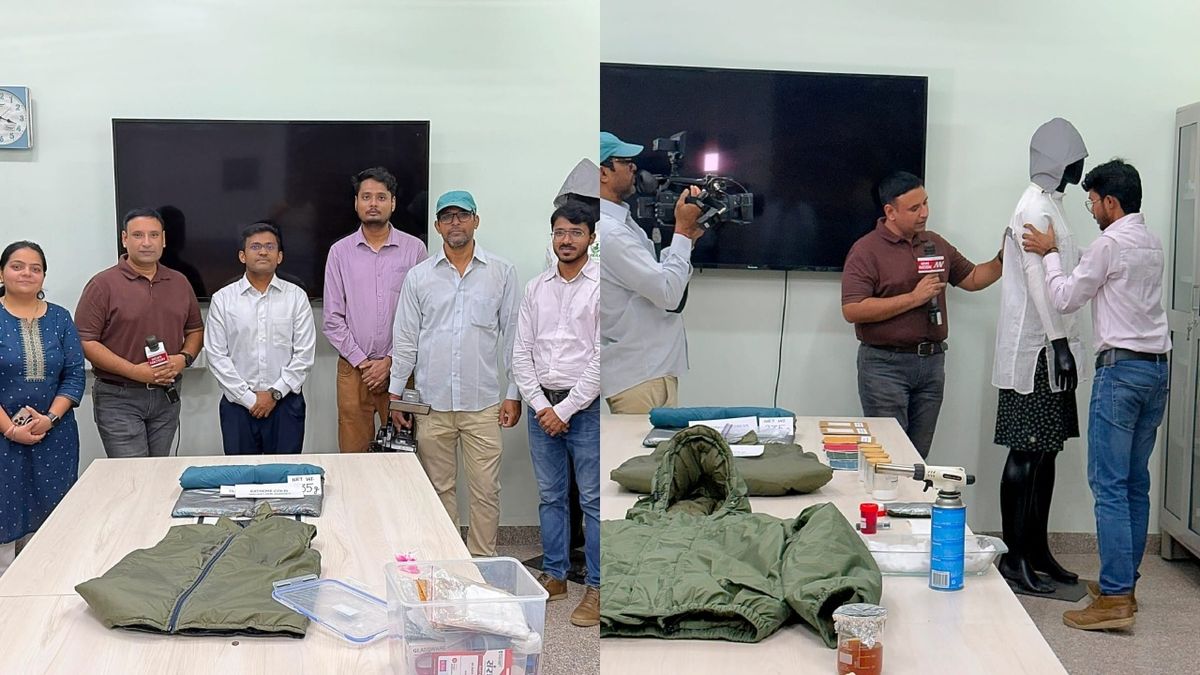
IIT Delhi Innovations: The country’s scientific capabilities aren’t limited to the space or defense sectors, but work is now rapidly underway to extend its direct benefits to farmers, soldiers, and ordinary citizens. In this regard, the Indian Institute of Technology (IIT) Delhi has developed three cutting-edge indigenous technologies that could revolutionize the country’s agriculture, defense, and healthcare systems in the future. These technologies include a smart kurta that naturally cools farmers working in the fields during the scorching heat. Another technology is a special fabric inspired by space research that can be used in extreme cold conditions like Siachen and for space missions. The third technology is a biological substance that can save lives by stopping bleeding within seconds in critical situations like gunshot wounds or road accidents.
Tezzbuzz spoke exclusively with Professor Haroon of IIT Delhi and the researchers involved in this project to gain a closer understanding of the workings, utility, and future prospects of these three technologies. After witnessing these innovations, it’s safe to say that scientific research is now moving directly toward improving the lives of ordinary people.
Kisan Shield: AC-like coolness in the scorching sun
First, let’s talk about the special “Kisan Shield,” which has been designed specifically for the needs of Indian farmers. Every year, millions of farmers in India work in the fields for many hours in extreme heat, heat waves, and scorching sun. Consequently, the risk of heat stress, dehydration, and skin diseases remains constant. This special kurta, developed by IIT Delhi, offers a solution to these challenges. According to researchers, wearing this kurta can reduce a farmer’s skin temperature by approximately five degrees Celsius. A special fabric has been used to reflect the sun’s ultraviolet rays and hot air from the heat waves before they reach the body.
Another feature of this kurta is its micro-engineered structure. The fabric’s fibers are so fine that mosquito bites are significantly reduced. This can also reduce the risk of dengue, malaria, and other mosquito-borne diseases. Keeping farmers’ safety in mind, it also features reflective strips to increase their visibility on the road while returning from the fields in the evening or at night, reducing the risk of accidents. It also features a special hood that protects against intense sunlight, heat, and rain. Most importantly, the fabric is designed to create natural cooling as sweat dries, providing the wearer with an air-conditioned feel.
Aerogel fabric: Protective armor for Siachen soldiers
IIT Delhi’s second technology is aerogel-based high-performance textiles, which scientists consider to be among the most advanced insulating materials in the world. Aerogel technology was initially used by the US space agency NASA in its space missions, but IIT Delhi has now developed an indigenous version. This technology is considered crucial for India’s defense and space programs.
According to the researchers, this fabric could be used to create a jacket that could provide adequate protection to soldiers in places like Siachen, even in temperatures as low as minus 55 degrees Celsius. Its most significant feature is that it is approximately 30 percent lighter than existing jackets, reducing the burden of additional weight on soldiers. This technology could also be useful in the safe transportation of helium, oxygen, and other cryogenic gases, as its structure is so dense that even extremely fine gases, from water to hydrogen, cannot penetrate it.
Researchers say this technology could be used in future spacesuits for Indian astronauts and human space missions. Its fire-resistant properties are also impressive. It withstands temperatures of approximately 1600 degrees Celsius and cools to the touch within seconds. IIT Delhi claims this indigenous technology has been developed at a cost approximately ten times lower than foreign alternatives, potentially helping India reduce its dependence on imports in the defense and space sectors.
Blood clotting material: Will save precious lives in accidents
The third, and perhaps most important, technology is a mycobacteria-based blood clotting material. This is a special biological material developed to control bleeding within seconds in the event of a serious injury or gunshot wound. Many soldiers die on the battlefield due to excessive bleeding. Stopping bleeding within the first few minutes could save a significant number of lives. This is the objective behind this technology.
According to scientists at IIT Delhi, this material can stop bleeding within just ten to thirty seconds. Its cost is said to be approximately six times lower than similar products currently available. It is not limited to the military, but can also prove extremely useful in road accidents, industrial accidents, and emergency medical services. Another important feature is that it can reduce the risk of infection by approximately 90 percent. Given the difficulty in wound healing in diabetic patients, this technology is also considered extremely useful for them. This material, weighing a few milligrams, has the ability to clot approximately two thousand times its weight.
These three technologies developed at IIT Delhi are proof that Indian scientists are no longer confined to laboratory research, but are developing technologies that can directly impact the lives of millions of people in the country. Whether it’s farmers working in the fields, soldiers deployed on the country’s borders, or ordinary citizens injured in accidents, these innovations can prove to be important steps towards making life safer, more convenient, and better. This is why this initiative by IIT Delhi truly embodies the mantra of “Jai Jawan, Jai Kisan, Jai Vigyan” with renewed scientific energy.