


But after two years away from the workplace, he realized that having enough money did not necessarily bring lasting fulfillment.
Now 42, Phat spent nearly two decades working as a systems consultant for Japanese companies, driven by a single ambition: earn aggressively while young so he could retire early.
His work schedule was relentless. He often sat at his computer for hours without drinking water, skipped meals and spent holidays answering emails or finishing project plans. “I was doing two or three jobs at the same time. Back then I had only one goal, accumulate fast and invest early,” he says.
In 2023, when he turned 40, he had a house on the outskirts of Ho Chi Minh City, a car, one billion dong in cash, and several plots of land. A row of rental rooms brought in passive cash flow of VND35-40 million a month. His assets were worth around VND20 billion.
Feeling financially secure, he handed in his resignation and embarked on the FIRE path (financial independence, retire early).
“I didn’t hate working; I just thought that if I worked fast enough and hard enough while I was young, there would come a day when I could live the way I wanted,” he says.
FIRE began gaining traction in Vietnam around 2020.
A Read survey of nearly 20,000 readers found that only 11% want to work until the official retirement age. Some 55% want to retire from 50, 29% between 40 and 50, and 5% before the age of 40.
Phat Nguyen, 43, takes up gardening and raising ornamental fish after retiring early. Photo courtesy of Phat |
The honeymoon of freedom
In the first two years after leaving the office, Phat’s life unfolded just as he had hoped. He would wake up, have coffee and breakfast with his family, tend his plants, and feed his fish. At 9 a.m., he would do a few small freelance projects to keep his skills honed. Afternoons were for badminton, evenings were for family.
The free time allowed him to pursue hobbies long set aside. He renovated his living space. On a 40-square-meter west-facing rooftop, he designed an automatic irrigation system and planted drought-resistant varieties.
Balconies and the air well were filled with tropical foliage. Interspersed among them were five water features for ornamental fish.
It was also the first time he had the chance to truly be present for his two children, then in grades six and nine. He taught them life skills, cultivated their independence, and was there for them as they entered adolescence.
Weekends were often spent playing sport together or visiting the family’s hometown; longer holidays were mapped out as exploration trips.
“The amount I did for myself and my family in those two years was more than in the previous 10 years put together,” he says.
But not long afterward, freedom revealed its dark side: Every morning, with his wife at work, children at school, and friends busy making ends meet, Phat found himself out of sync with the world around him.
A life without deadlines, KPIs, or pressure suddenly became a dull loop.
“After I’d done everything I wanted to do and played everything I wanted to play, I didn’t know what to wake up for each morning,” he says.
Then there was an epiphany during a hospital visit to see a relative.
Watching elderly patients waiting to be seen, he asked himself: “I’m barely past 40, why am I already living like someone waiting to meet their ancestors?”
It was then that he understood why so many Japanese managers in their 60s and 70s still come to Vietnam to work, he says.
According to Dr. Gian Tu Trung, chairman of the PACE Management Academy, people who retire early often fall into a state of emptiness because they have not identified their purpose in life or confuse making a living with the meaning of life itself.
He says work is how people create value and maintain social connection. Financial freedom is a privilege that allows you to do what you love, not a full stop on your career.
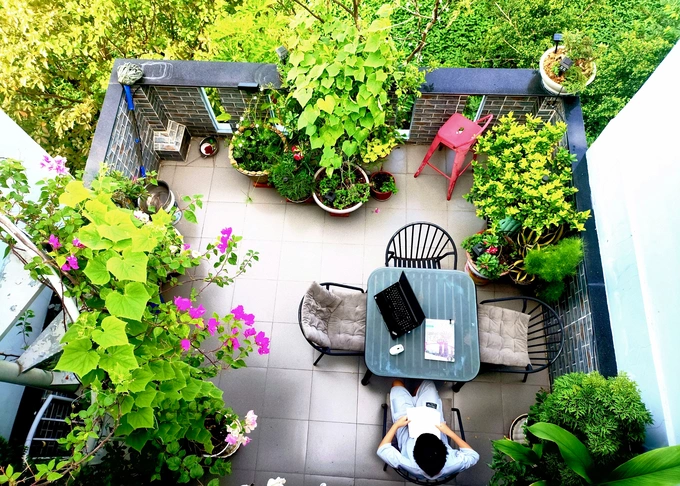 |
A corner of Phat’s balcony overlooks the small park in front of his home. Photo courtesy of Phat |
Redefining freedom
At the start of 2025, Phat returned to full-time work, but is selective about the projects he takes on, prioritizing those that feel meaningful. He is currently leading a new product development project and oversees the relocation of an electronics manufacturing line from overseas to Vietnam.
In office, work fills the gaps in his day and gives Phat the thrill of solving hard problems alongside teammates or learning something new.
The extra income goes toward upgrading his gardening equipment and taking the family on trips. In the eyes of his children, he has rebuilt his image as a driven, purposeful father.
Looking back, he does not see the two FIRE years as wasted.
“If I hadn’t had those two years, I would still think having enough money is enough for happiness. Only after living it did I understand that money only buys time, the meaning of life is something no one else can create for you.”
Comments are closed.