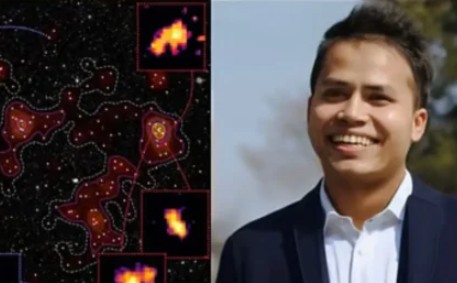
Dr Ronaldo Laishram Biography: A moment of national pride emerged when Dr Ronaldo Laishram, a young astrophysicist from Manipur, along with his international research team, discovered a crucial astronomical structure dating back to the early universe. Through this discovery, they identified a massive cluster of young galaxies—approximately 12.6 billion years old—which has been named the ‘Loktak Protocluster.’ This discovery represents more than just the identification of a new astronomical structure; it is considered a major milestone in understanding the formation of the universe and galaxies, as well as the structure of the early cosmos. This achievement has brought recognition to the scientific community in India, particularly in the Northeast.
Who is Dr Ronaldo Laishram?
Dr Ronaldo Laishram hails from Khangabok village in Manipur’s Thoubal district. He harboured a keen interest in science, mathematics, and the cosmos from childhood. Despite limited resources, he carved a distinct niche for himself in the international research community through hard work, dedication, and a scientific mindset. He is currently conducting research at the prestigious NAOJ (National Astronomical Observatory of Japan) and making significant contributions to astrophysics.
Educational Journey
Dr Laishram’s educational journey has been truly inspiring. After completing his early education in Manipur, he moved to Mysuru to pursue engineering. He obtained a Bachelor of Engineering (BE) degree in Computer Science and Engineering from Sri Jayachamarajendra College of Engineering (now JSS Science and Technology University, Mysuru).
Following his engineering studies, his interest in space science deepened. Consequently, he enrolled at the renowned Tohoku University in Japan, where he completed his Master’s degree and subsequently his PhD in Astronomy and Astrophysics. His research journey has placed him at the forefront of modern astronomy.
What is the ‘Loktak Protocluster’?
The ‘Loktak Protocluster’ is a massive, extremely dense cluster of young galaxies that existed in the early universe. According to scientists, this structure is approximately 12.6 billion years old. At that time, the universe was only about 1.2 billion years old. This discovery helps scientists understand how galaxies were evolving shortly after the Big Bang. In this study, scientists identified four interconnected young galaxies that could potentially evolve into a massive galaxy cluster in the future.
How was the discovery made?
This significant research was led by Dr Ronaldo Laishram, working alongside an international team of scientists. Two of the world’s most advanced telescopes were utilised during the study: the Subaru Telescope (Hawaii, USA) and the James Webb Space Telescope (JWST).
By analysing high-quality data obtained from these observatories, scientists identified this massive protocluster located in a very distant region of the universe. The James Webb Space Telescope, in particular, played a crucial role in observing these extremely faint and distant galaxies.
Scientific significance of the discovery
This discovery is considered highly significant for several reasons. It will help scientists understand how galaxies formed in the early universe and facilitate the study of galaxy cluster formation. It will provide new insights into dark matter and the evolution of cosmic structures, while enabling a more precise study of the early stages of the universe’s evolution following the Big Bang. This discovery will serve as a vital foundation for future space research.
Why was it named ‘Loktak’?
Dr Ronaldo Laishram named this protocluster ‘Loktak’ after the famous Loktak Lake in his home state of Manipur. Loktak Lake is renowned worldwide for its unique ‘Phumdis’—floating natural islands that appear in various shapes and sizes on the lake’s surface. When Dr Laishram and his team observed the multi-component structure of these young galaxies in space, they were reminded of the floating *phumdis* (floating islands of vegetation) of Loktak Lake.
Just as numerous small floating islands in the lake come together to create a beautiful natural landscape, these young galaxies in space were forming a massive, unified structure. To honour his homeland and reflect his cultural connection, he named this astronomical structure the ‘Loktak Protocluster.’
A Moment of Pride for Manipur
This achievement has brought pride not only to India but to the entire Northeast region. Making such a significant scientific discovery on the international stage, while hailing from a state like Manipur, proves that talent is not bound by location or resources. Today, Dr. Laishram has become an inspiration for thousands of students and young researchers.
Working for Science Education
Dr. Ronaldo Laishram’s contributions extend beyond scientific research. He aspires to see more students from Northeast India step forward in the fields of science and space research. With this objective in mind, he established the Manipur Astronomical Society (MAS) and serves as its Founder Coordinator.
Objective of the Manipur Astronomical Society (MAS)
The primary aim of this organisation is to cultivate an interest in astronomy among students. It also seeks to bring science education to rural and remote areas, raise awareness of space science, and organise science exhibitions, workshops, and astronomical observation programmes. Furthermore, it aims to inspire youth to pursue scientific research and to foster scientific temper and innovation in Northeast India. Through MAS, many students have had the opportunity to observe planets, stars, and the moon through a telescope for the first time.
Inspiration for the Youth
Dr Ronaldo Laishram’s story demonstrates that with determination, hard work, and the right direction, one can rise from a small village to achieve global recognition. His achievement serves as a source of inspiration for millions of students across the country who aspire to build a future in science and research.
Conclusion
The ‘Loktak Protocluster’ discovered by Dr. Ronaldo Laishram is considered one of the significant achievements of modern astronomy. The discovery of this massive galaxy cluster—dating back approximately 12.6 billion years—will provide new insights into the early history of the universe. At the same time, this achievement stands as a powerful testament to India’s scientific prowess, the talent of Northeast India, and the growing global contribution of young scientists.