

In fact, it accounted for nearly a quarter of Vietnam’s $5.7 billion worth of seafood exports, up 11.4%, according to the Ministry of Agriculture and Environment. The U.S.’s imports were worth $898 million and third-placed Japan’s, $788 million.
Seafood exporter Nam Viet Jsc said as shipping costs have become high, China became a more attractive option thanks to its proximity.
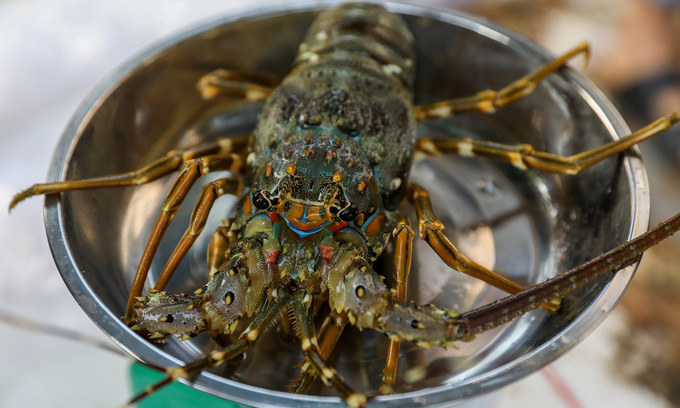
A lobster in HCMC. Photo by VnExpress/Quynh Tran |
Le Hang, deputy general secretary of the Vietnam Association of Seafood Exporters and Producers, said as the U.S. and Europe exacerbated non-tariff barriers, many businesses have gravitated toward China.
She said the U.S. now requires businesses to provide additional admissibility certificates, and has a complicated application process that has particularly affected tuna products. Shrimp exports continue to face high anti-dumping duties, she added.
Frontloading shipments to the U.S. before its new import tariffs kicked in has caused large inventories for importers there at a time when consumers have tended to tighten spending and prioritize lower-priced products, she explained.
Referring to overall exports, Hang said the growth in the first half not only reflected recovering global demand but also Vietnamese businesses’ ability to adapt by adjusting markets and product structures.
Shrimp remained the largest export, worth $2.3 billion, up 13.6%, and accounting for more than 40% of the overall value. Growth was mainly driven by demand from mainland China and Hong Kong. Among products, lobsters saw a strong increase in purchases by both markets.
Pangasius exports jumped by 12.1% to US$1.1 billion, benefiting from Vietnam’s competitive prices and stable demand for white-flesh fish in many markets.
But the outlook for exports seems uncertain for the second half. Hang said businesses continue to face the threat of the U.S.’s protectionist measures and trade barriers ranging from regulations related to “forced labor” to the application of quotas on products.
Amid the rapidly changing trade landscape, businesses have no choice but to constantly keep abreast, adjust export plans, diversify markets, and increase the share of deeply processed products to reduce risks and maintain growth, she added.

Comments are closed.