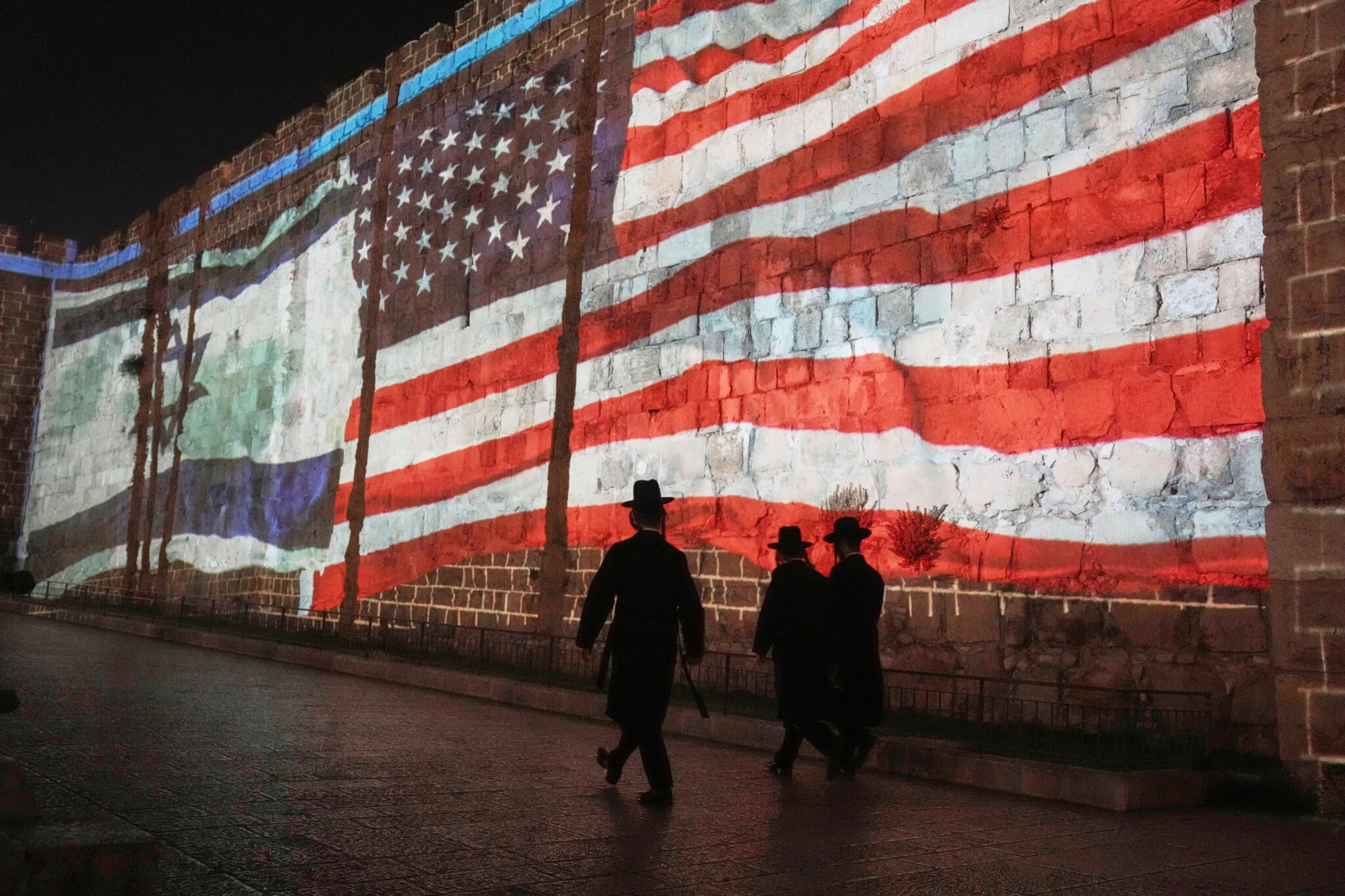
Poll Shows Israel Becoming Less Central to Young American Jews/ TezzBuzz/ WASHINGTON/ J. Mansour/ Israelis across political and religious lines are concerned that younger Jewish Americans feel less connected to Israel than older generations. An AP-NORC poll found that only about 4 in 10 religious Jewish adults under 45 consider supporting Israel highly important to their Jewish identity. Israeli government officials and religious organizations are expanding travel, cultural and exchange programs in an effort to rebuild those relationships.
Quick Look
- Israelis are concerned about weakening ties with young American Jews.
- The concern crosses political and religious divisions.
- About 4 in 10 religious Jewish adults under 45 strongly link supporting Israel to Jewish identity.
- Approximately half of older religious Jewish adults say the same.
- About half of religious Jewish adults consider Israel’s Gaza operations justified.
- Only 2 in 10 culturally or ethnically Jewish, religiously unaffiliated adults agree.
- About 6 in 10 Jewish adults view antisemitism as a very serious U.S. problem.
- The AP-NORC survey included 1,022 Jewish adults.
- Birthright Israel has brought 1 million young Jewish adults to Israel since 2000.
- Participation has declined since 2023.
- Israel is increasing outreach to secular and Reform Jews.
- Orthodox Jews generally maintain stronger connections to Israel.
- Jewish summer camps remain central to exchange efforts.
- Israeli confidence in Trump’s focus on the country’s security fell sharply.
- The Israel Democracy Institute measured a decline from 64% in March to 26% in June.
Deep Look
Israelis fear weakening diaspora relationship
JERUSALEM — Israelis across the country’s political and religious spectrum are expressing concern that younger Jewish Americans feel less connected to Israel than previous generations.
A recent poll by The Associated Press-NORC Center for Public Affairs Research found that younger American Jews are less likely than older adults to consider support for Israel an essential part of their Jewish identity.
Israeli officials, religious leaders and community organizers view the trend as a challenge to the country’s relationship with Jewish communities abroad.
They are responding by expanding travel, education and cultural programs designed to create personal connections between young Jews and Israelis.
Israel sees itself as home for all Jews
Itai Nixon leads the diaspora department at Israel’s Ministry of Diaspora Affairs.
He said maintaining the connection with Jewish communities outside Israel is a national priority.
“It’s extremely important to us,” said Itai Nixon, who leads the diaspora department for Israel’s Ministry of Diaspora Affairs. “We’re the state of the Jewish people, not just Israelis.”
His statement reflects Israel’s founding principle that the country serves not only its citizens but also the wider Jewish population.
A weakening relationship with diaspora communities could therefore challenge a central element of the country’s identity.
Government critic also values diaspora ties
Concern extends beyond supporters of Israel’s current government.
Lesley Sachs has participated in protests against the government and chairs the Israel Movement for Progressive and Reform Judaism.
She described the relationship between Israel and Jews abroad as a “strategic asset” for both sides.
Sachs worries that younger diaspora Jews are losing the belief that Israel can serve as a home or refuge for them.
That concern has become more urgent as Jewish communities report rising antisemitism regardless of their political or religious views.
Holocaust-era connection fades
Sachs said the memory of the Holocaust helped earlier generations understand why a Jewish state could be essential during a crisis.
“That was always really, really important that everybody around the world, especially after the Holocaust, knows that there is a country that will always take them,” Sachs said in her synagogue in Tel Aviv. “This is already a few generations after, and this is less prominent in their DNA. And I think that this is really a failure on the part of both Israel and world Jewry, that we have not managed to keep that prominent.”
Younger Jewish Americans are more removed from the events that shaped older generations’ emotional attachment to Israel.
Birthright has brought 1 million visitors
Taglit-Birthright Israel has provided free educational trips to Jewish young adults since 2000.
The organization says it has brought approximately 1 million participants from the United States and other countries on 10-day visits.
The trips are intended to introduce young Jews to Israeli history, culture and contemporary society.
Birthright CEO Gidi Mark believes the program is increasingly important because political controversy may dominate what young people hear about the country.
The organization wants participants to develop a personal understanding of Israel rather than encounter it only through news and political debate.
Program seeks to show what could be lost
Mark said the weakening relationship gives Birthright a greater responsibility.
“That really increases the importance of my job to expose people to what they give up on,” said Gidi Mark. “What we give them is a mirror.”
The trips allow participants to consider how Israel relates to their own identity.
Supporters argue that visiting the country can create emotional connections that cannot be developed through classroom lessons or social media.
Critics of such programs have sometimes questioned whether short, organized tours present a sufficiently broad view of the region’s political realities.
U.S.-Israel alliance shows strain
The United States and Israel have maintained a close political, military and diplomatic alliance for decades.
Trump and Israeli Prime Minister Benjamin Netanyahu met in Washington earlier in the week.
Their talks included the war against Iran that the two countries launched jointly five months earlier.
“The United States is perceived as the best friend of Israel in the entire world, and that’s still the case,” said Tamar Hermann, who directs the Israel Democracy Institute’s Viterbi Center for Public Opinion and Policy Research in Jerusalem.
Despite the continuing alliance, public confidence in aspects of the relationship has weakened.
Israeli confidence in Trump declines
Disagreements surrounding efforts to secure an Iran ceasefire have changed Jewish Israelis’ assessment of Trump.
The share who believe he prioritizes Israel’s security fell from 64% in March to 26% in June, according to the Israel Democracy Institute.
The decline suggests that even a strongly pro-Israel American president can face skepticism when U.S. and Israeli strategic interests diverge.
Those diplomatic strains give American Jewish political advocacy renewed importance.
Historically, Jewish American organizations have supported U.S. military, political and financial assistance for Israel.
Progressive opposition creates concern
Israeli observers worry that younger progressive Americans, including many Jews, increasingly view support for Israel as incompatible with their social and political values.
Criticism intensified after the Oct. 7, 2023, attack and Israel’s subsequent military campaign in Gaza.
Protests spread across the United States, particularly on university campuses.
Many participants condemned Palestinian civilian deaths, displacement and destruction.
Israelis fear that criticism of a particular government or military campaign is developing into a more permanent rejection of the country itself.
Oct. 7 reshaped relationship
Hamas-led fighters attacked southern Israel on Oct. 7, killing approximately 1,200 people, most of them civilians.
The attackers took 251 hostages into Gaza.
Israel responded with an extensive military campaign against Hamas.
The Gaza Health Ministry says more than 73,000 Palestinians have been killed.
The ministry belonged to the recently dissolved Hamas-run government but maintains detailed records viewed as generally reliable by United Nations agencies and international organizations.
Gaza toll drives U.S. protests
The Gaza Health Ministry does not distinguish between civilians and militants in its total.
It says women and children represent approximately half of those killed.
Images and reports of destruction and civilian suffering drove protests across American cities and college campuses.
Those demonstrations sometimes included young Jewish participants who opposed Israel’s military actions.
The divide has challenged the assumption that American Jewish identity naturally produces strong political support for Israel.
Younger Jews evaluate Israel through values
Sachs said younger Jewish Americans lack the emotional memories that shaped their parents and grandparents.
“Holocaust, refugees, the importance of Israel in times of need abroad, and the fact that Israel is a small country fighting for its existence … that’s history they read in a book,” Sachs said of younger Jewish Americans. “They weren’t emotionally part of it in any way or any form. And so they look at their values and the things that they believe in. And they don’t see it in Israel.”
Progressive young Jews may judge Israel primarily through issues such as human rights, equality and social justice.
When they believe Israeli policy conflicts with those values, their broader connection to the country may weaken.
Poll shows generational divide
Only about 4 in 10 religious Jewish adults younger than 45 say supporting Israel is “extremely” or “very” important to their Jewish identity.
Approximately half of older religious Jewish adults say the same.
The difference is meaningful but also shows that support for Israel is not universal even among older respondents.
The poll reflects a complicated relationship rather than a complete generational break.
Many young Jewish adults may feel culturally, spiritually or personally connected to Israel while opposing its government or military policies.
Religious identity affects views
The AP-NORC survey included 1,022 Jewish adults.
That group included people who identify as Jewish by religion and religiously unaffiliated adults who identify as Jewish through culture, ethnicity or family background.
Approximately half of religious Jewish adults said Israel’s ongoing Gaza operations were justified.
Only about 2 in 10 religiously unaffiliated Jewish adults agreed.
The results suggest that religious identification is associated with greater support for Israel’s military actions.
Antisemitism remains major concern
Approximately 6 in 10 Jewish adults describe prejudice against Jewish people as an “extremely” or “very” serious problem in the United States.
Israeli officials and community leaders believe rising antisemitism should reinforce the importance of a Jewish homeland.
They worry that younger Jews may face discrimination while feeling little connection to Israel as either a refuge or ally.
Critics may respond that concern about antisemitism does not require agreement with Israeli government policy.
The challenge is maintaining solidarity without demanding uniform political views.
Former diplomat defends Jewish homeland
Asaf Zamir, a deputy mayor of Tel Aviv and former Israeli consul general in New York, said antisemitism illustrates the continuing need for Israel.
“Antisemitism sadly helps us to explain why a Jewish homeland is not a bad idea,” said Asaf Zamir, a deputy mayor of Tel Aviv who served as consul general in New York. “Opposing the government is fine, but you cannot understand your history as a Jew without understanding the part of Israel in it.”
Zamir distinguished criticism of the government from rejection of Israel’s place in Jewish history.
That distinction has become central to outreach efforts.
Israel expands exchange programs
Israeli government agencies and religious organizations are strengthening programs connecting Israelis with diaspora Jews.
Young Israelis have worked at Jewish summer camps throughout North America for decades.
Jewish youths from other countries can participate in free or subsidized trips to Israel.
The programs rely on personal relationships rather than political arguments.
“To see Israel and meet Israelis is the gold standard,” Itai Nixon said of programs bringing teens to the country.
Organizers believe direct interaction can reduce stereotypes and create lasting connections.
Birthright participation falls after 2023
Birthright has experienced lower participation since the outbreak of multiple wars in 2023.
Safety concerns, political objections and travel disruptions may all contribute to the decline.
Mark said participants’ reactions have also changed.
He recalled one visitor standing outside a hotel and shouting “Israel! Israel!” simply because he felt safe expressing that part of his identity.
The incident suggested that some Jewish youths feel uncomfortable displaying their connection to Israel in their home communities.
Participants seek space for identity
“These people don’t feel free to experience who they are in the places that they are coming from,” Mark said.
Birthright presents Israel as a location where young Jews can explore their identity without fear of hostility.
That message may appeal to participants concerned about antisemitism.
It also risks becoming complicated when those same individuals oppose Israeli policies or feel uncomfortable with the country’s political direction.
Successful outreach must make room for criticism rather than treating support as an all-or-nothing choice.
Outreach focuses on liberal Jews
Many new initiatives are directed toward secular Jews and members of Reform Judaism.
Reform Judaism is the largest Jewish denomination in North America.
It places strong emphasis on progressive principles, including social justice.
Those values can create both a pathway to connection and a source of conflict with Israeli policy.
Israeli Reform leaders argue that shared religious and political commitments can help young diaspora Jews see allies inside Israel rather than viewing the country as politically uniform.
Orthodox Jews maintain stronger ties
Orthodox Jews outside Israel generally report stronger relationships with the country.
Hermann said Orthodox Israelis also tend to feel closer to diaspora Jews than secular Israelis do.
Religious tradition, community institutions and regular travel can reinforce those connections.
Secular Jews may have fewer formal structures linking them to Israel.
That difference helps explain why outreach programs increasingly target groups whose attachment cannot be assumed.
Reform movement sends Israelis abroad
Israel’s Reform movement represents a relatively small share of Judaism inside the country.
It is working to send more young Israelis to the United States as camp counselors and community representatives.
The goal is to create individual relationships with Jewish Americans who may feel alienated from the Israeli government.
“That kind of action is important, that one-on-one connection saying, ‘You know what, we believe in the same things you do. Really, we have the same ideology in general, and we feel we need to change Israel together,’” Sachs said. “We need to be partners in making Israel the country that we all need.”
Her approach invites diaspora Jews to participate in changing Israel rather than withdrawing from it.
Israeli counselor learns diaspora perspective
Alma Edry, 18, is spending two months working as a counselor at a progressive Jewish summer camp in Ontario.
The camp serves teenagers and young adults from Canada and the United States.
Edry said her greatest surprise was “that Israel is such a big deal for people outside the country.”
For Israelis, the country is part of ordinary daily life.
For diaspora Jews, it may be a source of identity, controversy, pride, anxiety or conflict with friends.
Camps offer space to celebrate connection
Edry said many campers are surrounded by people who oppose Israel.
“Most of their friends are anti-Israel,” she said of the campers. “This is their chance to celebrate their connection.”
Summer camps can provide an environment where young Jews discuss Israel without feeling isolated.
They also create opportunities to meet Israelis personally and distinguish the country’s diverse population from the policies of its government.
Such relationships may prove more effective than official messaging in preserving long-term ties.
Future relationship depends on openness
Israelis concerned about the generational divide are increasingly recognizing that traditional historical arguments may not be enough.
Young Jewish Americans often approach Israel through contemporary questions about war, equality, democracy and human rights.
Exchange programs can strengthen attachment, but they must also address disagreement and criticism honestly.
The relationship’s future may depend on whether Israel and diaspora institutions create space for young Jews who want connection without unconditional political support.
More on US News