
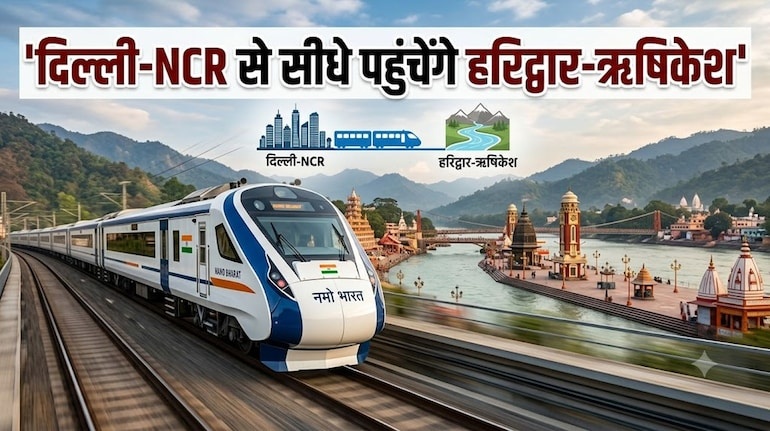
Delhi-Haridwar RRTS: It will be very easy to go from Delhi to Haridwar-Rishikesh, Center has approved the Meerut-Rishikesh ‘Namo Bharat’ corridor; See full route map

A wonderful and big good news has emerged for the devotees visiting major religious and tourist places of Uttarakhand and the travelers of Delhi-NCR. The Central Government has given its official approval to the much-awaited Meerut-Haridwar-Rishikesh Namo Bharat (RRTS) corridor. The work of preparing the Detailed Project Report (DPR) of this new corridor, about 150 kilometers long, has started on a war footing. Once this corridor is completed, it will be directly connected to the existing NaMo Bharat network of Delhi-Ghaziabad-Meerut, which will make the travel of tourists, devotees and daily commuters very high-speed and comfortable. According to the report of NDTV, after this ambitious project comes on the ground, a new chapter of connectivity between Delhi, NCR, Uttar Pradesh and Uttarakhand will begin. With seamless and fast travel possible to world famous tourist destinations like Haridwar and Rishikesh, the local economy and tourism industry of Uttarakhand is expected to get a tremendous boost. How will the 150 KM long route be divided between the two states? This new semi-high speed corridor will be about 150 kilometers long, which will be extended from Modipuram (Meerut), the last station of the Delhi-Meerut Namo Bharat Route: Part in Uttar Pradesh: The total length of this corridor within UP will be 72 kilometers. This part will mainly cover Meerut and Muzaffarnagar districts. Part in Uttarakhand: Its length within Uttarakhand will be 78 kilometers. Under this, major cities like Roorkee, Haridwar and Rishikesh will be connected to the rapid rail network. Your rapid rail will pass through these major stations. Moving forward from Modipuram, Namo Bharat train will connect these major stations of Uttar Pradesh and Uttarakhand: Modipuram (Meerut) Daurala Khatauli Muzaffarnagar Purkaji Roorkee Haridwar (near Har Ki Pauri) Rishikesh (near Laxman Jhula) UP-Uttarakhand government and NCRTC will work together Uttarakhand Chief Minister Pushkar Singh Dhami and Central This big proposal was given the green signal in a high level meeting held between Housing and Urban Affairs Minister Manohar Lal Khattar. This corridor will be jointly constructed and operated by the National Capital Region Transport Corporation (NCRTC), Government of Uttar Pradesh and Government of Uttarakhand. To expedite the project work and complete the land acquisition and route survey on time, the Uttarakhand government has appointed Additional Secretary Reena Joshi as the nodal officer. Besides, NCRTC and UP government have also deployed their coordination officers in the field. How will this corridor connect with Delhi-NCR and Jewar Airport? This new route will merge with the 82.15 km long Delhi-Ghaziabad-Meerut corridor already under construction at Modipuram. With its addition, passengers will get the following major benefits: Direct entry from NCR: Passengers will be able to travel directly to Haridwar-Rishikesh from major stations like Sahibabad, Duhai, Guldhar, Anand Vihar and Sarai Kale Khan without changing trains or any hassle. For the people of Noida and Ghaziabad, the distance to Uttarakhand will be only a few hours. Sarai Kale Khan will become a mega-hub: Delhi’s Sarai Kale Khan station is going to become the country’s largest interchange hub. From here, passengers will be able to directly change trains for Delhi-Gurugram-Shahjahanpur-Neemrana-Alwar corridor. That means a person traveling from Rishikesh will be able to reach Gurugram or Alwar directly. Panipat and Jewar Airport Connectivity: Passengers from Sarai Kale Khan or Hazrat Nizamuddin will also be able to connect to Delhi-Sonipat-Panipat corridor. Apart from this, passengers will be able to directly reach Jewar Airport at superfast speed through the proposed Ghaziabad-Noida International Airport corridor via Ghaziabad. Direct Metro-Railway connectivity at Anand Vihar: By alighting from Namo Bharat at Anand Vihar station, passengers will be able to directly reach the Blue and Pink Lines of Delhi Metro, Anand Vihar Railway Terminal and Anand Vihar ISBT (ISBT Bus Stand) without having to face the sun or traffic. After the complete completion of this corridor, not only will the valuable time of the passengers be saved, but access to the holy and commercial cities of Uttarakhand will become very easy, which will give a new pace to the development of the entire region in the coming times.

Comments are closed.