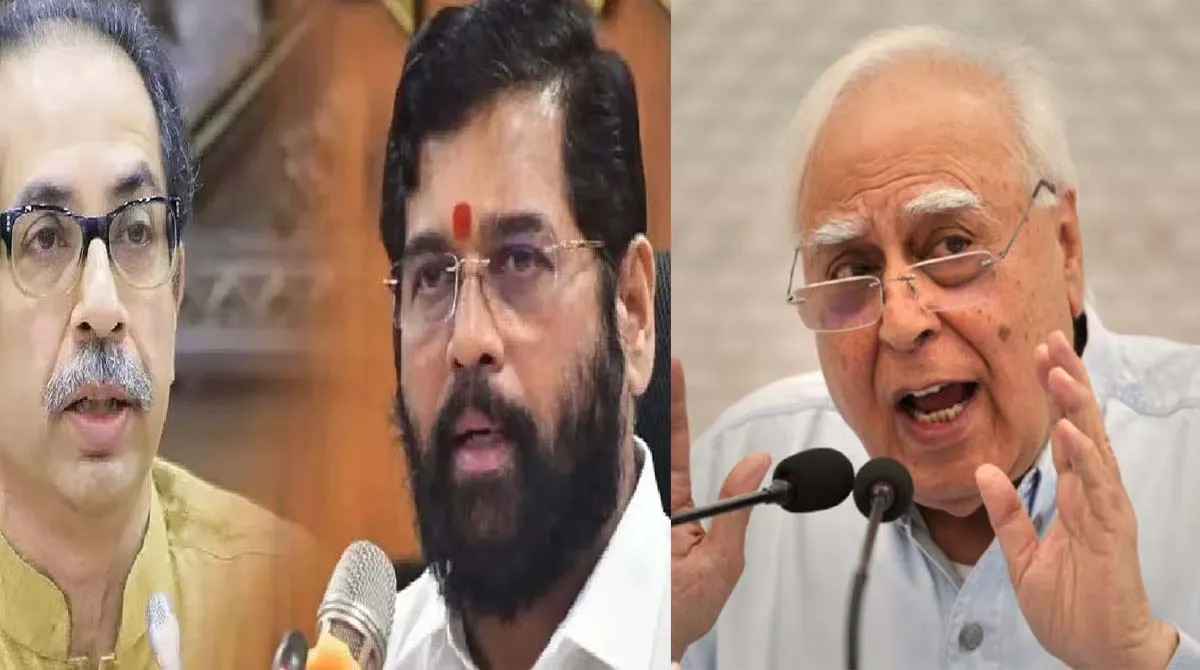
“Fight the boat on someone else’s symbol… and form the government on someone else’s! If this trend continues, what will become of this country’s parliamentary democracy?” This sharp and direct question has resonated at the doorstep of the country’s highest court, the Supreme Court. The person raising this question is renowned senior lawyer Kapil Sibal, and the occasion is the biggest and most high-profile legal battle related to Maharashtra politics, the heat of which has once again reached the Supreme Court.
Recently, six Shiv Sena (Uddhav Thackeray) MPs joined the Eknath Shinde-led Shiv Sena, and Lok Sabha Speaker Om Birla himself officially recognized this merger. The Uddhav Thackeray faction has now approached the Supreme Court to challenge this decision. The case is being heard by a special bench of three Supreme Court judges, headed by Chief Justice Surya Kant, and also comprising Justices Joymalya Bagchi and V. Mohana. During the recent hearing, advocate Kapil Sibal raised several questions about his claim to the Shiv Sena, the allocation of election symbols, the role of the then Governor, and the decisions of the Election Commission.
The complete story of Shiv Sena’s history and rebellion
Opening his arguments, senior advocate Kapil Sibal recounted the party’s entire organizational history after the death of Shiv Sena founder Bal Thackeray in 2012. He informed the court that Uddhav Thackeray took over the party’s leadership after Balasaheb Thackeray’s death, and under his leadership, nearly 40 elections were fought, including those with Eknath Shinde. Subsequently, in 2018, the party held a major organizational election, in which Uddhav Thackeray was formally elected as the party’s national president.
Sibal further told the court that Eknath Shinde became a minister in the Maha Vikas Aghadi government in 2019. However, real suspicions arose when some party MLAs cross-voted against their own party during the Maharashtra Legislative Council (MLC) elections. Then, one day, 31 MLAs suddenly left Maharashtra and arrived in Guwahati. These rebel MLAs passed a resolution removing the then-party whip, Sunil Prabhu, from his post and appointing Bharat Gogavale as the new whip.
Can MLAs claim themselves to be a political party?
Sibal raised a crucial constitutional question before the court: can members of a legislative party alone claim to be a full-fledged political party? He emphasized that the resolution passed by only 31 MLAs was not an official decision of any political party. The resolution was sent to the Assembly Speaker, who then forwarded it to the Governor, who subsequently ordered a floor test. Sibal questioned how it was possible for a few MLAs to become the ultimate authority in a party when the party’s Panch Pramukh remains Uddhav Thackeray.
This tendency of MLAs is like ‘constitutional suicide’
Sibal further argued that this entire matter directly violates the fundamental principles of the Tenth Schedule of the Constitution, which provides for disqualification based on defection. He said that MLAs who voluntarily leave the original party under whose symbol they were elected should be immediately disqualified. The situation today is such that people win elections on the ‘A’ symbol and later claim to belong to the faction with the ‘B’ symbol. This could have very serious consequences for parliamentary democracy.
The senior advocate also argued that these petitions have been pending in court for years, and that a timely hearing might have led to a different political outcome in Maharashtra. He claimed that if the case had been heard on time, the Shinde government might not have been formed. However, the Chief Justice questioned Sibal’s argument regarding the delay and asked why the petitioners themselves had sought adjournments from the court at various stages. Justice Joymalya Bagchi also remarked that the claim of a government not being formed hinges on the petitioners’ final verdict. In response, Sibal stated that the law is clear and the verdict must be in their favor under the Tenth Schedule. He termed this trend of defections by elected representatives as “constitutional suicide.”
The decision of the Election Commission was also challenged
During the hearing, Kapil Sibal also strongly criticized the Election Commission’s (ECI) decision recognizing the Shinde faction as the “real Shiv Sena.” He argued that the Election Commission completely ignored the disputes surrounding the party’s internal organizational structure and relied primarily on legislative power when adjudicating on rival claims. Sibal questioned how the Election Commission could conclude that the Shinde faction represents the majority of the party based solely on the number of MLAs. This decision ultimately cost the Uddhav faction its party name and the bow-and-arrow symbol. The next hearing in this high-profile case will now resume in the Supreme Court on August 4th, with the entire nation watching.