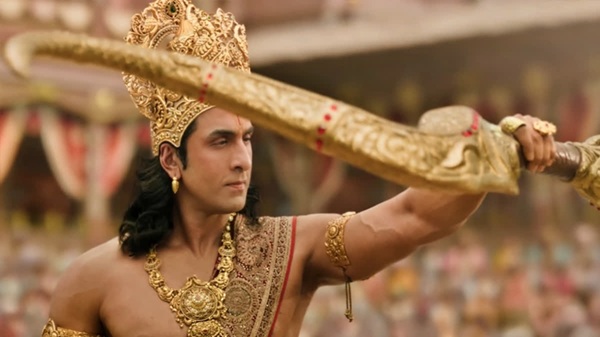
New Delhi. It’s been two days since the trailer for the film Ramayan (Ramayana) was released. Producer Namit Malhotra and director Nitesh Tiwari’s much-awaited film has generated considerable public buzz regarding its first look and impressions. The trailer is receiving mixed reviews, and the characters glimpsed in it are being widely discussed, including their screen presence, costumes, dialogue delivery, actions, and expressions.
Amidst all these discussions, one thing catches our attention. In one part of the trailer, Ranbir Kapoor, playing Lord Ram, angrily raises his bow and vows to kill Ravana in front of all three worlds. After watching this scene, discussions have erupted on social media as to when Lord Ram vowed to kill Ravana. Did he ever say something like this in anger? Is there any mention of such a thing in mythological texts or books?
In the Ramayana, the Ramcharitmanas, and other mythological texts, Shri Ram is described as unwavering even in battle, possessing a smile that captivates the world, speaking softly and gently, possessing a great hero and mastery of every skill, yet being extremely humble and compassionate. In fact, he never killed even the most formidable demons in anger. He always tried to give them a chance until the very last moment.
Even during the killing of Tadka, Shri Ram’s anger was not visible.
Shri Ram first killed Tadka. Even during this killing, there is no mention of his anger, his arms flailing and roaring. In the Ramcharit Manas, Saint Tulsi writes that when Tadka ran to attack on the forest path, at Vishwamitra’s behest, Shri Ram took her life with a single arrow and then, before dying, humbled her and showed her his divine form.
While the sage was going, he showed him. Hearing this, Tadka ran in anger.
With a single arrow, Lord Hari took his life. Knowing him to be poor, he gave him his own feet. (Tadka Vadh, Balakanda)
Maharishi Valmiki writes the same thing in the verse that
She struck him with arrows that pierced the heart
Tadaka fell to the ground devoid of life
Meaning: Being struck by the penetrating arrows of Shri Ram, Tadka fell on the ground and breathed her last.
This means that while killing the demons, Shri Ram never displayed anger, rage, unnecessary displays of force, roared, etc. He certainly warned people, but he never vowed to kill anyone, and there is no mention of him vowing to kill Ravana.
Shri Ram took this vow out of compassion, not anger.
There’s a mention in the Aranya Kand where Shri Ram vows to rid the earth of demons and sinners. But even here, the word “kill” doesn’t appear. When Shri Ram sees bones and skeletons scattered across the forest and asks whose bones they are, the frightened sages and saints explain that these are the skeletons of the sages devoured by the demons. Seeing this, Shri Ram is filled with compassion. Saint Tulsi then recounts his vow in a couplet:
“I will make this earth free from demons by raising my arms.
I will go to the ashrams of all the sages and give them happiness.” (Aranya Kand)
Meaning: Raising his arm, Lord Rama vowed to rid the earth of demons. Then, he visited the ashrams of all the sages and offered them the pleasure of meeting and conversing with them.
Similarly, in the Valmiki Ramayana, there is no explicit mention of Shri Ram directly talking about killing Ravana. However, he did promise to protect those who sought refuge in him in every way and to safeguard the community of sages, saints, and saints in every way.
For example, when he learns of Vibhishana’s arrival, he clearly states, “I grant protection to anyone who comes to me for refuge. This is my vow.” Then, in the next verse, he says, “O Sugreeva, bring him here. Whether it be Vibhishana or Ravana himself, I have granted him protection.”
Once he has surrendered to him he begs him to say ‘I am yours’
I grant safety to all beings This is my vow.
(Yuddhakanda, verse 18, verse 33 – Gita Press)
Bring him, O best of monkeys, I have given him safety.
O Vibhishana or Sugriva or even Ravana himself (Yuddhakanda, verse 18, verse 34 – Gita Press)
Both the Machhar Manas and the Ramayana mention Sugreeva losing his temper and becoming enraged.
Sugreeva, in a fit of rage, declares that he will kill Ravana or destroy the entire demon race. In fact, upon first seeing Ravana, Sugreev loses his temper and attacks him without even declaring war. Lord Rama then condemns this as a violation of decorum and tells him not to repeat it in the future.
In Valmiki Ramayana, Sugreeva, while befriending Shri Ram, takes a vow and says, “O Raghunandan! With your blessings, I will bring back the abducted Mother Sita, just as the lost Vedas were brought back. I will fully support you in destroying Ravana, the thorn who is troubling the entire world, along with his entire army (dynasty).”
I am that, O Raghu.
Just as the Vedas have been lost I shall bring back Sita
By your grace, O Rama.
I shall kill Ravana and his host who are the thorn of the world
In the Kishkindha Kand of Ramcharit Manas, Sugreev says the same thing like this –
Sugreev says listen Raghuveera. Leave your thoughts and be patient.
I will serve you in every way. In whatever way I meet Janaki.
Meaning: Sugreeva said, “O Raghuveer! Listen, give up your grief and be patient. I will serve you in every way and will do everything possible to bring back Janaki (Mother Sita) to you.”
The bottom line is that the vow that Ranbir Kapoor, as Shri Ram, takes in the trailer doesn’t appear to be accurately mentioned or described in the popular text. While there are many versions of the Ramayana, authors have taken creative liberties in each. It’s difficult to pinpoint exactly which version Namit Malhotra and Nitesh Tiwari chose this scene from.