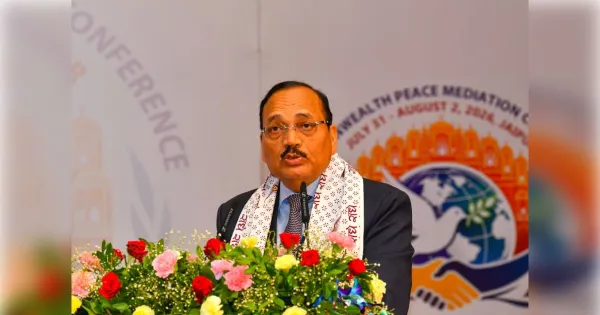
CJI Surya Kant said that if the real needs of a person are known in the beginning itself, then disputes do not arise. Many times the solution lies not in determining rights, but in understanding the real need.
The law never says that every dispute should end in court. The objective of the law is to ensure that every citizen gets affordable, respectable and accessible justice.
The CJI expressed these views in the session organized on the second day of the three-day conference on the topic of Peace Mediation and Rule of Law.
The CJI while narrating a story said that two sisters were fighting over the same orange. During this time it was revealed that one sister wanted only the peel and the other wanted its juice.
A lawsuit decides who owns the orange, while mediation attempts to figure out who deserves what. He said that Indian justice culture always gives importance to dialogue and compromise before confrontation.
Citing the example of Mahatma Gandhi, the CJI said that his satisfying moment was when he brokered a compromise between the parties in the court.
On this occasion, Supreme Court Judge Vijay Bishnoi said that even though mediation has been formally recognized in recent years, it has been present in the villages and panchayats of India for centuries.
Every case is not just a legal dispute, but behind it there are people who are waiting for justice, respect and mental peace.
Addressing the conference, Justice Pushpendra Singh Bhati said that when mediation was first started in the state, it was not considered practical, but with the passage of time, it has now become a means of resolving many big disputes.
Whereas Acting CJ SP Sharma said in a light-hearted manner that the first mediator is the mother, who resolves the dispute between two children of the family, when she fails, the father comes forward as the second mediator. The conference was also addressed by Deputy Chief Minister Premchand Bairwa and Advocate General Rajendra Prasad.