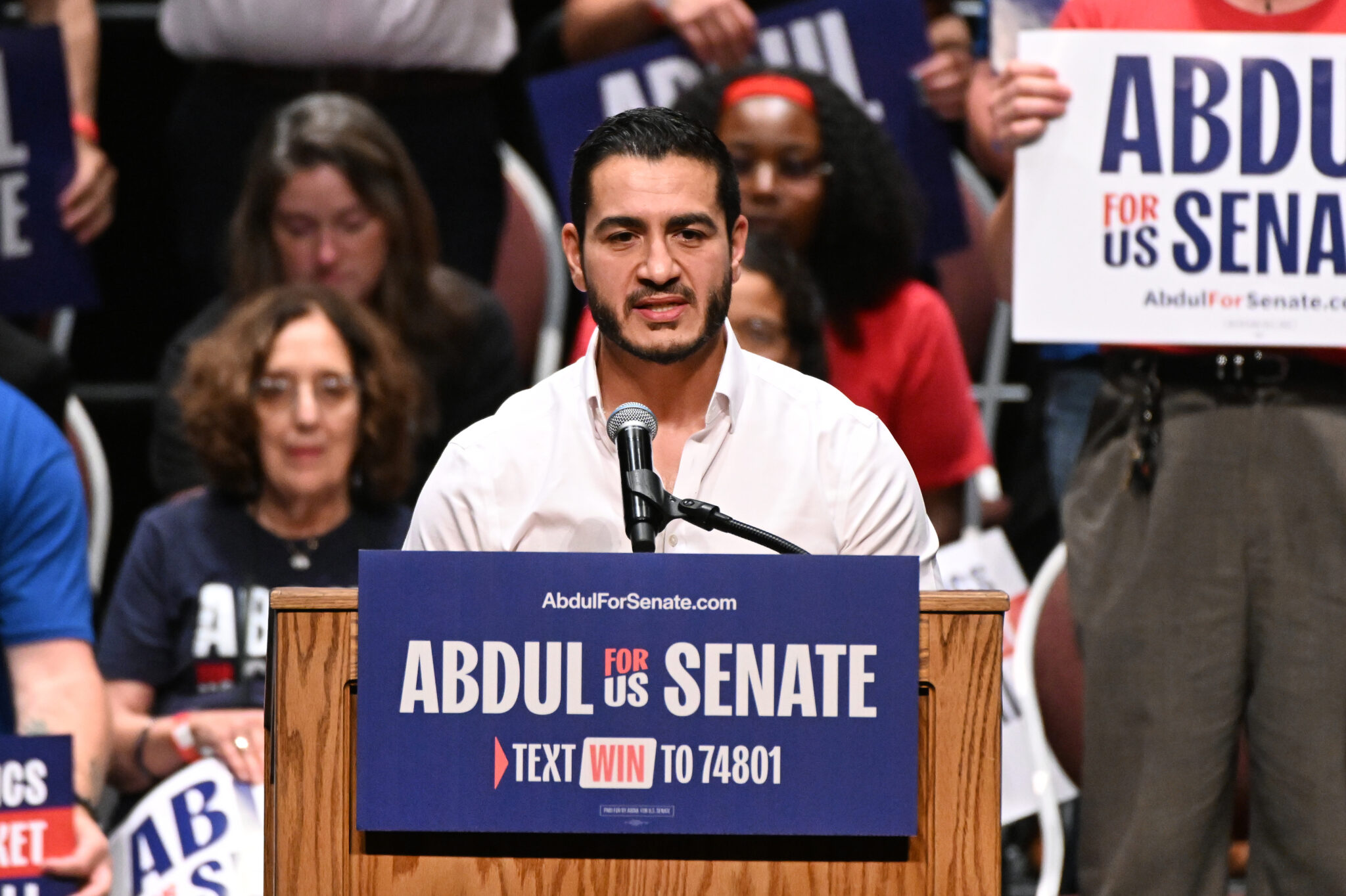
Abdul El-Sayed Takes Polling Lead Over Haley Stevens Before Michigan Primary/ TezzBuzz/ WASHINGTON/ J. Mansour/ Abdul El-Sayed holds a double-digit projected advantage over Rep. Haley Stevens days before Michigan’s Aug. 4 Democratic Senate primary. Several recent polls and prediction markets favor El-Sayed, although turnout among older voters could narrow his lead or improve Stevens’ chances. The winner is expected to face Republican Mike Rogers in a competitive race for the open Senate seat being vacated by Gary Peters.
Quick Look
- Michigan’s Democratic Senate primary is scheduled for Aug. 4.
- The Public Sentiment Institute projects El-Sayed winning 54.8% to 45.2%.
- Before undecided voters were allocated, El-Sayed led 47.6% to 39.5%.
- The TPSI survey included 762 voters and had a 4-point margin of error.
- Emerson College found El-Sayed leading 54% to 39%.
- RealClearPolling showed El-Sayed ahead by an average of 10.2 points.
- Polymarket and Kalshi priced his chance of winning at 97%.
- Older voters remain Stevens’ strongest constituency.
- Voters younger than 50 strongly favored El-Sayed in the Emerson survey.
- Stevens led an earlier July poll, showing uncertainty remains.
- Outside groups supporting Stevens reportedly spent more than $60 million.
- Groups supporting El-Sayed reportedly spent approximately $4.6 million.
- An AIPAC-affiliated group reportedly spent more than $30 million supporting Stevens.
- Republican Mike Rogers is the presumptive GOP nominee.
- Republicans have not won a Michigan Senate election since 1994.

Deep Look
El-Sayed enters final weekend with polling advantage
Abdul El-Sayed is entering the final weekend before Michigan’s Democratic Senate primary with a double-digit projected lead over Rep. Haley Stevens.
The Public Sentiment Institute estimates that El-Sayed will receive 54.8% of the vote Tuesday, compared with 45.2% for Stevens, after allocating voters who initially said they were undecided.
The result adds to several recent indications that the progressive candidate has built momentum during the closing days of the campaign.
Younger voters and progressives appear to be driving El-Sayed’s advantage, while Stevens continues to perform best with older Democrats who are traditionally more reliable participants in primary elections.
Winner expected to face Mike Rogers
The Democratic nominee is expected to face former Republican Rep. Mike Rogers in November.
Rogers is considered the presumptive Republican candidate for the seat being vacated by retiring Democratic Sen. Gary Peters.
The race is one of the most competitive Senate contests of the 2026 midterms.
President Donald Trump carried Michigan in the 2024 presidential election, giving Republicans confidence that they can win the open seat. However, the GOP has not won a Michigan election for the U.S. Senate since 1994.
Ballotpedia currently classifies the general election as a toss-up.
General election poll produces mixed results
A Glengariff Group poll commissioned by the Michigan Education Association and Business Leaders for Michigan showed different potential outcomes depending on the Democratic nominee.
The July 22-24 survey of 600 likely general election voters found Stevens essentially tied with Rogers.
Stevens received 45.5%, while Rogers had 44.7%.
In a hypothetical matchup with El-Sayed, Rogers led 49% to 38.7%.
The poll had a margin of error of plus or minus 4 percentage points.
Stevens and her allies have used general election polling to argue that she would be the safer Democratic nominee in a state that remains closely divided between the parties.
Republicans view Michigan as pickup opportunity
Republicans believe the open seat and competitive Democratic primary provide a strong opportunity for Rogers.
A Republican official told Newsweek that the party is “very bullish on the Senate” and described Michigan as “a very good pickup opportunity.”
The GOP expects a prolonged primary fight to consume Democratic resources and potentially leave divisions that will continue into the general election.
Democrats argue that Trump’s policies and low approval ratings have created a favorable environment for their candidates.
DNC points to economic dissatisfaction
Democratic National Committee spokesperson Jaelin O’Halloran told Newsweek that Trump and congressional Republicans had created a “toxic midterm environment” by increasing costs.
O’Halloran said Democratic candidates were “on the ground, showing up and listening to voters.”
A DNC official also cited Democratic performances in special elections and state legislative contests as evidence that the party’s voters are motivated ahead of November.
Newsweek contacted the El-Sayed, Stevens and Rogers campaigns for comment Saturday morning outside normal business hours.
TPSI poll shows lead before allocating undecided voters
The Public Sentiment Institute conducted its survey from July 25 through July 29.
Among likely Democratic primary voters, El-Sayed led Stevens 47.6% to 39.5% before undecided voters were assigned to a candidate.
After the allocation, the projected result expanded to 54.8% for El-Sayed and 45.2% for Stevens.
The survey included 762 text-message and online interviews matched with the Michigan voter file. Its margin of error was plus or minus 4 percentage points.
TPSI estimated that El-Sayed had a 96% probability of holding the lead, although the pollster cautioned that the precise margin remained uncertain.
Emerson survey gives El-Sayed wider advantage
A separate Emerson College Polling survey conducted for WLNS and WOOD-TV also showed El-Sayed with a substantial advantage.
The July 26-27 poll of 700 likely Democratic primary voters found him leading Stevens 54% to 39%, with 6% undecided.
When respondents leaning toward a candidate were included, El-Sayed’s lead increased to 57% against Stevens’ 41%.
The Emerson survey had a margin of error of plus or minus 3.7 percentage points.
Its findings reinforced the broader trend in late polling toward El-Sayed.
Polling average moves toward El-Sayed
RealClearPolling’s average of Michigan Democratic primary surveys showed El-Sayed ahead by 10.2 percentage points.
Across polls conducted from July 8 through July 29, El-Sayed averaged 50.5%, compared with 40.3% for Stevens.
That advantage represents a significant change from earlier in July, when Stevens led at least one major public survey.
The trend suggests that El-Sayed has gained support as undecided voters have made their choices.
Primary turnout remains major uncertainty
The Public Sentiment Institute poll also contained a caution for El-Sayed.
Among all registered Democratic voters in the survey, he led Stevens 49.7% to 36%.
Among those considered likely to vote, his lead narrowed to 47.6% against 39.5%.
The difference suggests that El-Sayed has broader support among Democrats generally, while Stevens benefits when the electorate is limited to those most likely to participate in an August primary.
That turnout question could determine whether El-Sayed wins comfortably or faces a much closer result.
Older electorate would benefit Stevens
Age is one of the clearest divisions in the primary.
Voters aged 65 and older made up 39.8% of the registered Democratic voters in the TPSI survey but represented 48.9% of its projected likely electorate.
Older Democrats are Stevens’ strongest voting group.
If senior citizens account for a larger-than-expected share of Tuesday’s turnout, Stevens could significantly narrow El-Sayed’s advantage.
TPSI estimated that the final margin could range from approximately five to 15 percentage points, depending in part on the age composition of the electorate.
Younger voters strongly support El-Sayed
Emerson College also found a substantial generational divide.
Spencer Kimball, executive director of Emerson College Polling, said El-Sayed led Stevens among voters younger than 50 by 42 percentage points.
Voters older than 60 supported Stevens by 14 points.
The split highlights the competing electoral strategies represented by the candidates.
El-Sayed is relying on younger voters, progressives and people dissatisfied with established party leadership. Stevens is depending more heavily on experienced primary voters and Democrats who prioritize electability in November.
Earlier survey showed Stevens ahead
The primary should not be considered decided because an earlier poll produced a different result.
A Detroit News and WDIV-TV survey conducted by the Glengariff Group from July 8 through July 11 found Stevens leading El-Sayed 48.2% to 41.4%.
That poll had a margin of error of plus or minus 4.4 percentage points.
Most surveys released after that poll have moved toward El-Sayed, while the number of undecided voters has declined.
The contrasting findings leave open the possibility of polling error or a turnout pattern that differs from pollsters’ assumptions.
Race tests competing Democratic strategies
The Michigan contest has become a test of two arguments about how Democrats should compete in a politically divided state.
Stevens’ supporters point to her congressional experience, establishment endorsements and stronger performance in some general election polling.
They argue that she is better positioned to defeat Rogers and protect the Democratic-held seat.
El-Sayed’s supporters say the party needs a candidate capable of motivating younger voters, progressives and Democrats frustrated by the influence of large political donors.
His polling surge suggests that argument has gained traction with primary voters.
Prediction markets heavily favor El-Sayed
Prediction markets have moved sharply toward El-Sayed during the final days of the campaign.
Polymarket and Kalshi each placed his likelihood of winning at 97% at the time of the report.
Those percentages are not polling results. They reflect the expectations of traders buying and selling contracts based on the anticipated outcome.
Prediction markets can shift rapidly after new surveys or campaign developments.
Their movement nevertheless shows that political observers and traders increasingly expect El-Sayed to win.
Outside spending shapes closing debate
Outside political spending has become a major issue in the primary.
Mother Jones, citing federal campaign records, reported that organizations supporting Stevens accounted for more than $60 million in outside spending.
Groups benefiting El-Sayed had received approximately $4.6 million in comparable spending.
The large disparity has allowed El-Sayed to present himself as the candidate facing an establishment-backed financial operation.
His supporters argue that the spending gap reinforces their criticism of outside influence in Democratic primaries.
AIPAC-linked spending draws scrutiny
Mother Jones reported that United Democracy Project, a political group affiliated with the American Israel Public Affairs Committee, spent more than $30 million supporting Stevens.
TPSI found that such financial support could be a liability among many Democratic primary voters.
In the poll, 41% of likely voters said accepting contributions from a pro-Israel political action committee would make them much less likely to support a candidate.
An additional 14.8% said it would make them somewhat less likely to provide support.
More than one-third said the donations made no difference or that they had no opinion.
The findings do not mean that Israel or AIPAC is the only issue shaping the race, but voters who were influenced by the spending reacted predominantly negatively.
Stevens needs late shift or polling miss
The recent surveys indicate that Stevens would likely need one of several developments to win:
- Older voters accounting for an unusually large share of turnout
- Undecided voters moving heavily in her direction
- El-Sayed’s younger supporters failing to vote
- Public polling significantly overstating El-Sayed’s support
Stevens’ general election argument could also persuade late-deciding Democrats who believe defeating Rogers should outweigh ideological preferences.
El-Sayed, meanwhile, must convert enthusiasm among younger and progressive voters into actual participation during an August primary.
Michigan primary will shape national Democratic debate
Tuesday’s result will determine more than the identity of Michigan’s Democratic Senate nominee.
An El-Sayed victory would demonstrate that progressive organizing and younger-voter enthusiasm can overcome establishment endorsements and a substantial outside-spending disadvantage.
A Stevens victory would reinforce the importance of older, consistent primary voters and electability arguments in a closely divided state.
The winner will immediately enter a competitive general election against Rogers, with control of the Senate potentially depending on the outcome.
More on US News