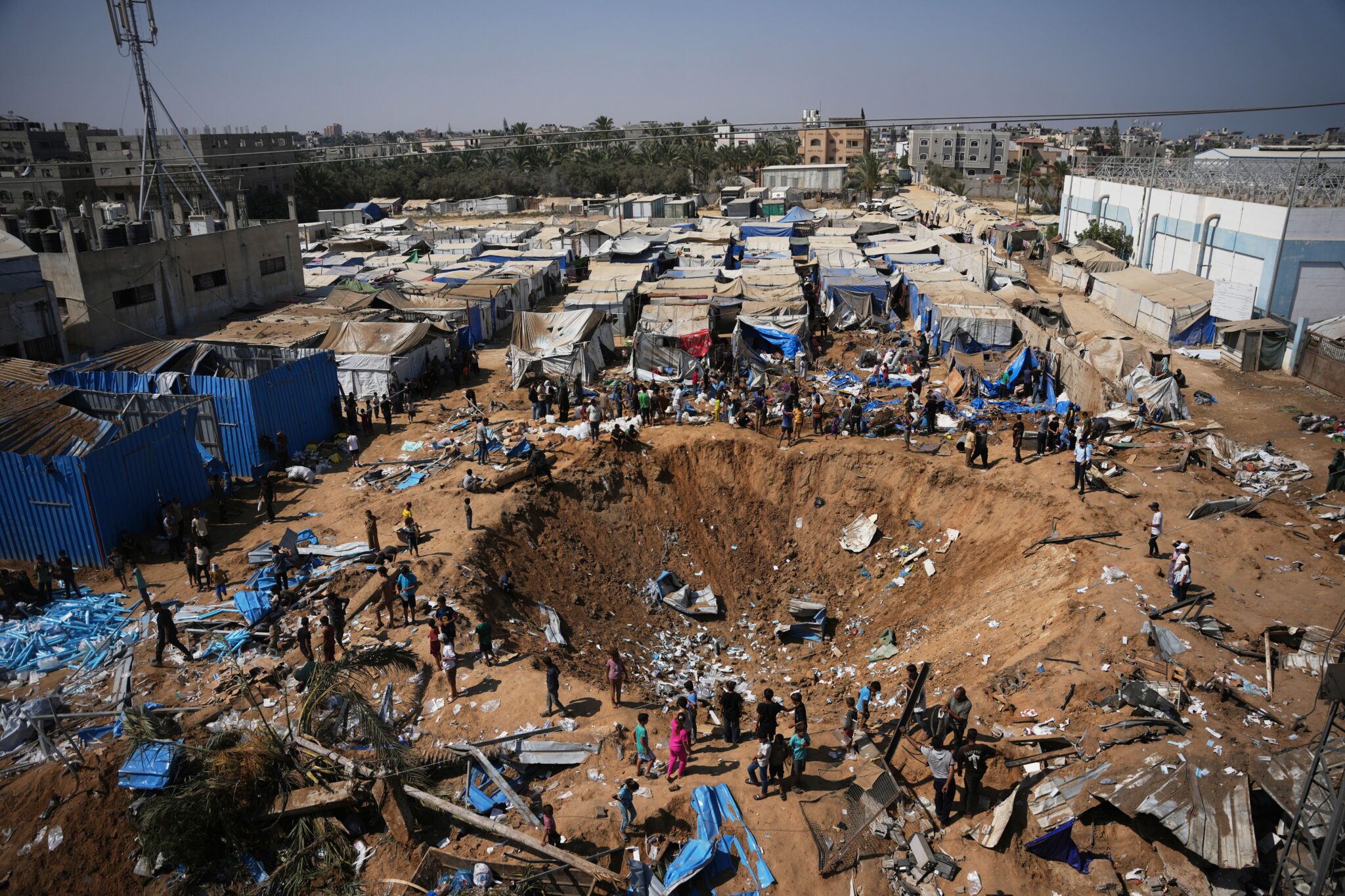
Trump’s Gaza Road Map Brings Hope and Skepticism as Israeli Strikes Continue/ TezzBuzz/ WASHINGTON/ J. Mansour/ Palestinians in Gaza see Hamas’ agreement to disarm as a possible step toward ending Israeli attacks, but many doubt either side will honor the road map. Israeli strikes have continued, while most of Gaza’s 2 million residents remain displaced or live in overcrowded tent camps with limited food and medicine. Israel has not formally accepted the road map, and its officials have indicated that the military will not withdraw from territory east of the Yellow Line.

Quick Look
- Hamas confirmed its agreement to a U.S.-backed disarmament road map.
- The plan requires Hamas and allied groups to surrender specified weapons.
- Israel would not participate directly in decommissioning Hamas’ weapons.
- The road map calls for Israel to halt military operations during the transition.
- Israel has not publicly accepted the plan.
- Israeli officials have indicated they will not withdraw from the Yellow Line.
- Most of Gaza’s 2 million Palestinians remain displaced.
- Overcrowded camps face rodent infestations and infectious disease outbreaks.
- More than 1,200 Palestinians have been killed in Gaza since the October ceasefire.
- Five Israeli soldiers have been killed in militant attacks during that period.
- Gaza’s Health Ministry reports more than 73,300 Palestinian deaths since October 2023.
- Israel currently controls large sections of Gaza.
- Displaced residents remain uncertain whether their homes still exist.
- Many Palestinians want Hamas to disarm but do not expect the process to happen quickly.

Deep Look
Gaza road map offers limited hope
CAIRO — President Donald Trump’s announcement that Hamas had agreed to disarm offered Palestinians in Gaza a small measure of hope that Israeli attacks might end and displaced families could begin rebuilding their lives.
That hope remains overshadowed by the conditions inside the Palestinian territory.
Israeli strikes have continued since Trump announced the agreement Thursday night in Washington. Few concrete steps have been taken to implement the wider ceasefire agreement that formally took effect in October.
Many Palestinians say they have heard repeated promises of peace without seeing meaningful improvements in their daily lives.
Displaced Palestinians prioritize food and medicine
Most of Gaza’s approximately 2 million residents remain displaced or live in temporary tent camps.
Overcrowding, damaged sanitation systems and shortages of essential supplies have contributed to rodent infestations and outbreaks of infectious diseases, including chickenpox.
For residents struggling to obtain food, shelter and medical treatment, the political details of disarmament and military withdrawal can feel distant from their immediate needs.
“They can talk about withdrawal and disarmament,” said Abdel Moneim Aboul-Roos, a 24-year-old tuk-tuk driver who lost a leg in an Israeli airstrike. “I don’t care about any of it as long as there is no food or medicine.”
Earlier ceasefire failed to resolve major disputes
Israel and Hamas signed a U.S.-supported ceasefire plan last year that ended large-scale combat operations.
The agreement secured the return of Israeli hostages and allowed more humanitarian assistance to enter Gaza.
It also called for several longer-term steps:
- A gradual Israeli military withdrawal
- Creation of an international stabilization force
- Establishment of a new governing authority
- Decommissioning of weapons held by Hamas
Implementation stalled as Israel and Hamas accused each other of violating the agreement.
Hamas retained its weapons, while the Israeli military refused to withdraw and expanded the amount of Gaza under its control.
Violence continued after ceasefire
Israel has killed more than 1,200 Palestinians in Gaza since the October ceasefire, according to the figures cited in the report.
Five Israeli soldiers have been killed in attacks by militants during the same period.
The continuing deaths and territorial changes have deepened doubts that the latest road map will produce a lasting end to hostilities.
Palestinians say the ceasefire did not restore normal life because strikes continued, access remained restricted and displaced families were unable to return to many communities.
New road map provides more disarmament details
The road map announced by Trump and confirmed by Hamas provides more specific information about the weapons that Hamas and allied militant organizations would be required to surrender.
Those weapons would be transferred to a new Palestinian technocratic administration.
The document states that Israel would not participate directly in decommissioning Hamas’ arsenal.
It also calls on Israel to stop military operations in Gaza so that the transfer of authority, disarmament process and reconstruction can proceed.
The road map links progress on Hamas’ weapons to Israeli military withdrawal, making cooperation by both parties essential.
Palestinians remain skeptical of both sides
Many Gaza residents welcomed the road map as a potentially positive development but expressed little confidence that Israel or Hamas would comply.
Repeated failed negotiations and unfulfilled promises have damaged public trust in both parties.
“This is enough. We need improvement in our lives,” said Ayman Ahmed, a displaced Palestinian living in southern Gaza.
Ahmed said he hopes Hamas will surrender its weapons but does not expect that to happen soon.
“They don’t care about Palestinians’ lives,” he said.
For many civilians, the central test is whether the agreement produces measurable improvements, including an end to attacks, greater access to aid and permission to return home.
War began with Oct. 7 Hamas attack
The war began after Hamas-led militants attacked southern Israel on Oct. 7, 2023.
Approximately 1,200 people were killed, and 251 others were taken into Gaza as hostages.
Israel launched a retaliatory offensive that has killed more than 73,300 Palestinians, according to Gaza’s Health Ministry, which was part of the Hamas-run government.
The ministry does not distinguish between civilians and militants in its death toll but says women and children account for approximately half of those killed.
Its detailed records are generally considered reliable by United Nations agencies and international organizations.
Residents doubt Israel will make concessions
The scale of destruction and the continuing attacks have convinced some Palestinians that Israel will not make the concessions required under the road map.
Ghazal Astal lives among the rubble in southern Gaza, where she described near-constant Israeli gunfire.
She said the territory has become an “indescribable battlefield.”
Ammar Kaskeen, 30, said he does not believe the road map will compel Israeli forces to leave Gaza.
Kaskeen said he believes Israel’s objective extends beyond disarming Hamas and includes pushing Palestinians out of the territory.
“They will make us suffer,” he said.
Israel has not publicly accepted road map
Israel has not issued a public response formally accepting the U.S.-backed road map.
Israeli officials speaking anonymously have indicated that its provisions do not align with the country’s interests.
The officials reiterated that Israel would not withdraw from the Yellow Line, which separates Israeli-controlled territory in eastern Gaza from the western portion of the enclave.
That position could create a fundamental conflict with a road map linking Hamas’ disarmament to a phased Israeli withdrawal.
Israeli military reinforces Yellow Line
The Israeli military has constructed a large earthen barrier roughly following the Yellow Line.
Israel describes the area adjacent to the barrier as a “security zone” equipped with intelligence and technological systems.
The military has also conducted controlled demolitions and clearing operations throughout much of the territory it controls.
Palestinians previously living in those areas have not been permitted to return. Many do not know whether their houses or neighborhoods remain standing.
Israel’s continued reinforcement of the line has contributed to fears that its presence may become permanent.
Displaced families still dream of returning
Despite the destruction, many displaced Palestinians say they want to return to their communities even if their homes no longer exist.
Anas Nakla fled Rafah in southern Gaza during the war.
He knows that his family’s house has been destroyed but still wants to return with his wife and children.
“It doesn’t exist anymore,” he said. “But we can return and rebuild.”
For Nakla, returning is not dependent on finding an intact home. It represents the opportunity to reclaim his community and begin again.
Even limited returns could restore hope
Mohamed Hamad was displaced from his home in northern Gaza.
He hopes the U.S.-backed road map will place enough pressure on Israel to withdraw from at least some of the territory it controls.
Hamad believes that allowing even a limited number of displaced residents to return could change the outlook for people across Gaza.
If some Palestinians can go home, he said, “it will give hope to the rest that some day they may also return.”
For Gaza residents, the road map’s credibility will depend less on announcements than on visible changes: an end to Israeli strikes, the surrender of Hamas’ weapons, the entry of food and medicine and the ability of families to return to their land.
For more world news