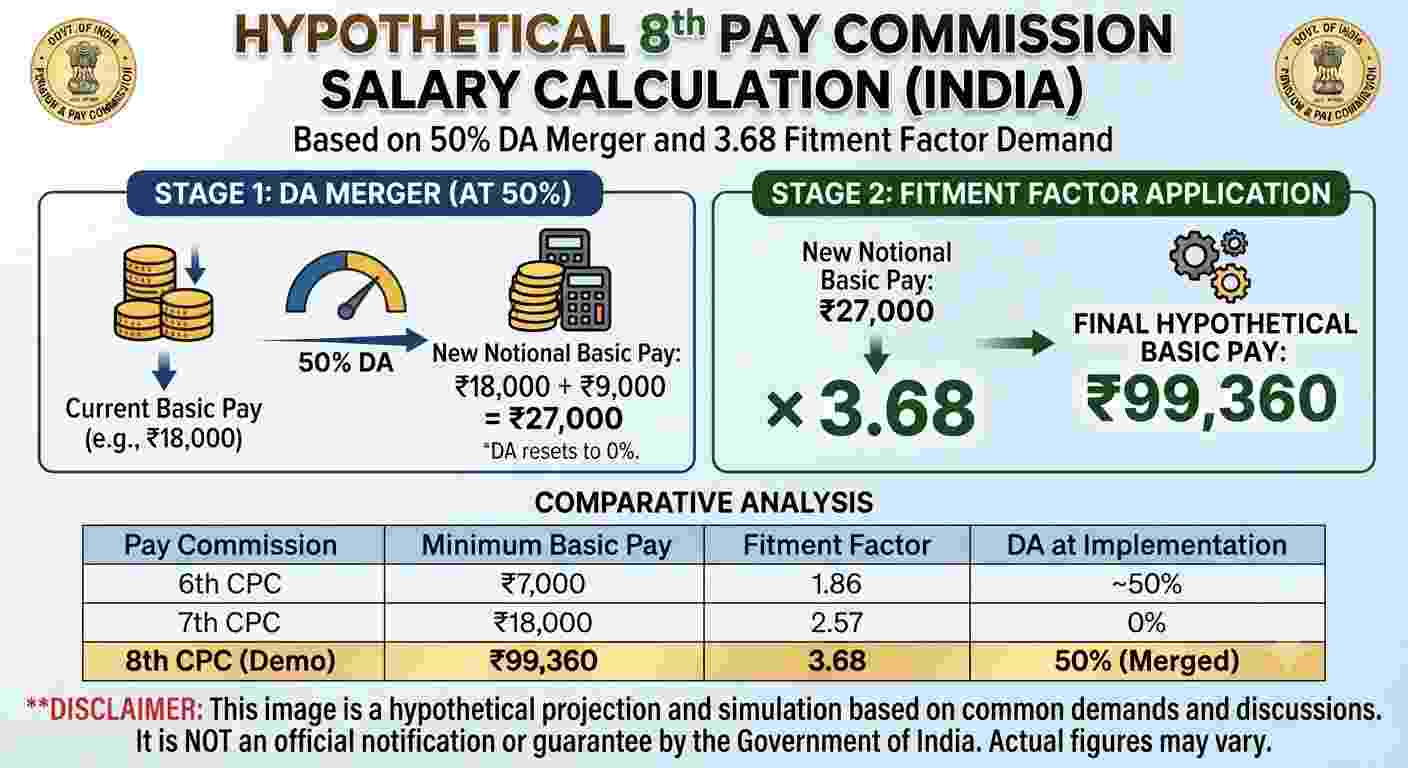
New Delhi: The 8th Central Pay Commission has become a major topic of discussion for central government employees and pensioners. As the Dearness Allowance (DA) has crossed the 50% mark, the biggest question on employees’ minds is whether the DA will be merged with the basic salary under the 8th Pay Commission.
If DA is merged into basic pay and the new fitment factor is applied, how much will the minimum and total in-hand salaries of employees increase? Let’s understand the math and salary calculation formula.
1. DA Merger Mathematics: Will dearness allowance be reset to 0%?
During the 5th and 6th Pay Commissions, the rule was that whenever DA reached 50%, it was merged into basic pay. However, during the 7th Pay Commission, the government clarified in Parliament that there was no provision for automatic DA merger.
But when the new pay commission comes into effect:
Reset to 0%: The existing accumulated DA (which is currently 50%+) is subsumed through the fitment factor while calculating the new basic pay.
After this, DA on the new basic salary starts again from 0%.
2. Complete Calculation of Fitment Factor
The most important means of determining the basic pay in the Pay Commission is the Fitment Factor.
A fitment factor of 2.57 was implemented in the 7th Pay Commission, increasing the minimum basic pay from ₹7,000 to ₹18,000.
For the 8th Pay Commission, employee organizations are demanding a fitment factor ranging from 2.86 to 3.83.
For example, let’s understand (the math of basic pay of a Level-1 employee):
$$\text{New Basic Pay} = \text{Current Basic Pay} \times \text{Fitment Factor}$$
Expected Fitment Factor
Current Basic Pay (Level 1)
Estimated New Basic Pay (Revised Basic)
2.18 (conservative estimate)
₹18,000
₹39,240
2.57 (same as 7th CPC)
₹18,000
₹46,260
2.86 (Major demands of organisations)
₹18,000
₹51,480
3.83 (Maximum Demand)
₹18,000
₹68,940 (Approximately ₹69,000)
3. Will there really be a ‘double jump’ in salaries? (In-Hand Salary Impact)
Many people think that if the basic pay is doubled or tripled, the total in-hand salary will also increase by 2 to 3 times, but in reality this is not the case.
Reason:
DA to become 0%: When the new basic is implemented, the 50%-55% DA that was being given at that time will become zero (0%).
Impact on allowances: HRA (House Rent Allowance), TA (Transport Allowance) etc. will be recalculated as per the percentage of the new basic pay.
Estimated Salary Hike (Net Increase):
Even after the DA reset, the take-home in-hand salary of central employees sees a direct net increase of 25% to 35% on an average due to the new basic pay being much higher and recalculation of allowances.
4. New math for HRA and other allowances
Currently, HRA rates are 30%, 20%, and 10% (for cities X, Y, and Z) when DA exceeds 50%. When the 8th Pay Commission is implemented and DA returns to 0%, HRA starting rates will be based on the revised basic pay, making the total allowances significantly higher than before.