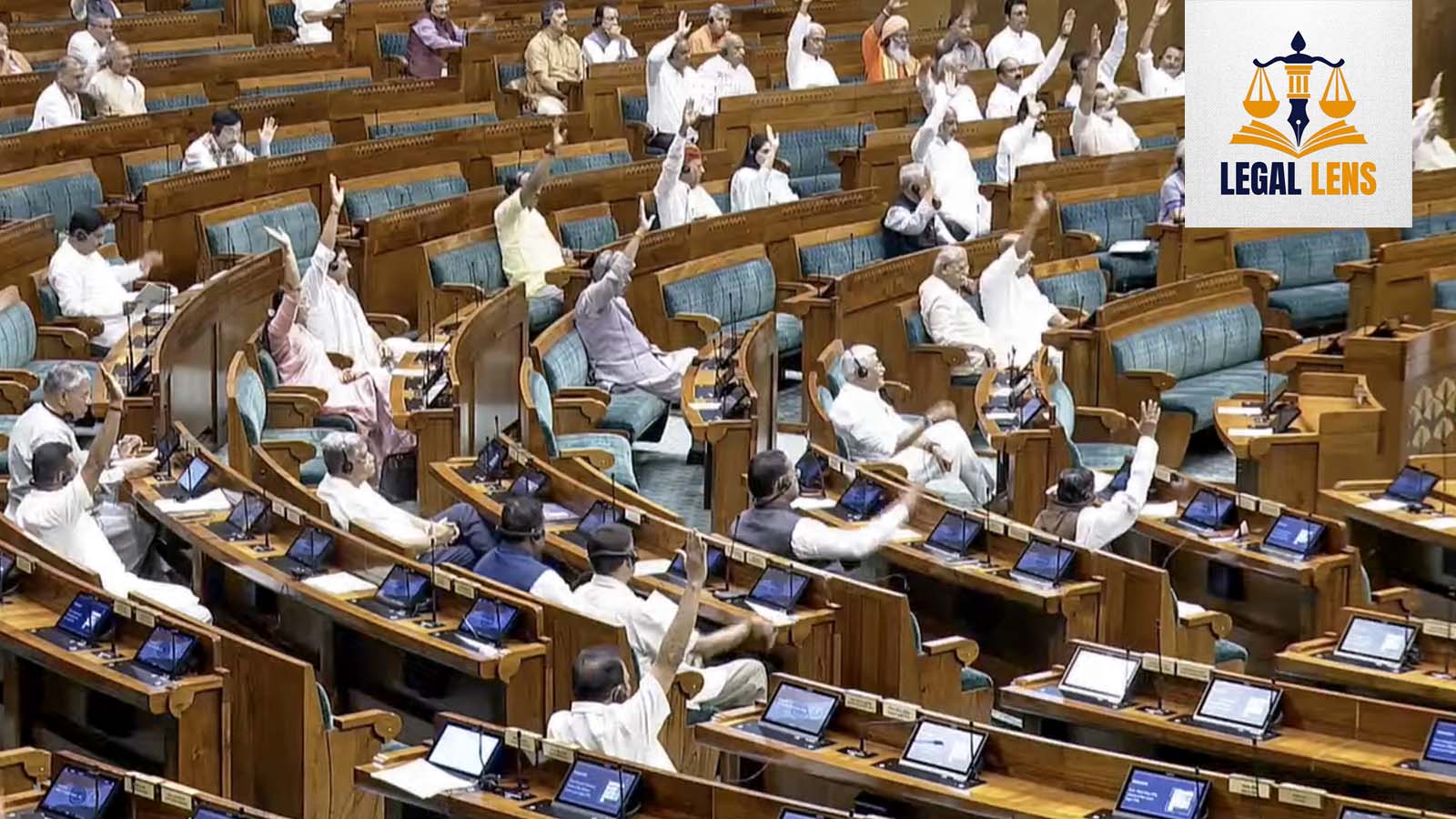
On July 30, the Lok Sabha passed the Prevention of Insults to National Honour (Amendment) Bill, 2026, in under 15 minutes, by voice vote. That is a form of division in which the Speaker gauges consent from the volume of ayes and noes rather than a headcount. The new Bill seeks to clarify the consequences of insulting the National Song.
During the debate in Parliament, members recalled the first President, Rajendra Prasad’s assurance to the Constituent Assembly, on January 24, 1950, that Vande Mataram would be “honoured equally” with Jana Gana Mana.
Also read: New Bill tightens birth registration rules, but leaves key questions unanswered
The precedent for that equality predates Prasad’s 1950 statement by two and a half years. The Constituent Assembly met at 11 pm on August 14, 1947, for the midnight transfer of power. Its first agenda item was the singing of Vande Mataram. Sucheta Kripalani, an Assembly member, sang the opening verse. She later became chief minister of Uttar Pradesh, India’s first woman to hold that office. At the same session’s close, hours later, she sang the first verse of Jana Gana Mana. Both songs were given real, if informal, parity at Independence.
Amendment to 55-year-old parent statute
The amendment touches a single provision of the 55-year-old parent statute: Section 3 of the Prevention of Insults to National Honour Act, 1971. That Act was enacted on December 23, 1971, to protect the flag, the Constitution and the National Anthem.
Under the criminal procedure code’s classification schedule, offences punishable with three years’ imprisonment or more are, by default, cognizable and non-bailable
Section 3, as it stood, punished anyone who intentionally prevented the singing of the anthem. It also punished disturbing an assembly engaged in singing it. The penalty was imprisonment up to three years, a fine, or both. A repeat conviction, added by a 2003 amendment, draws a minimum term of one year.
Also read: Vande Mataram: What you can face for insulting the National Song if new law takes effect
The 2026 amendment substitutes that section wholesale. It extends the identical language, prevention and disturbance, and the identical penalty, to the National Song, Vande Mataram. The Bill’s statement of objects and reasons is the note a minister files explaining a Bill’s purpose before Parliament debates its clauses. This one was signed by Home Minister Amit Shah on July 10. It described the change as closing “a long-standing statutory gap”.
3-year imprisonment punishment
Under the criminal procedure code’s classification schedule, offences punishable with three years’ imprisonment or more are, by default, cognizable and non-bailable. Section 3, as substituted, carries exactly that ceiling. If that classification holds, a police officer may arrest without a warrant on a mere complaint. An accused has no automatic right to bail. Those consequences begin at the police station, well before any court tests whether prevention or disturbance actually occurred.
A Home Ministry circular issued in January fixed the official version of Vande Mataram at all six stanzas, running roughly three minutes and 10 seconds. It also listed the occasions, from presidential arrivals to school assemblies, on which the song must be rendered. A follow-up letter on July 9 directed states to ensure strict compliance. That included the requirement that the Song precede the Anthem wherever both are performed. None of this is in Section 3. All of it will shape how a magistrate, or a constable, reads “intentional disturbance”. That matters when a citizen sings two stanzas instead of six, or none at all.
DMK MP Kanimozhi’s objections
DMK Member of Parliament, Kanimozhi’s speech folded two distinct objections into one. The first: Parliament was wrong to elevate Vande Mataram to the Anthem’s legal status by ordinary legislation, given the song’s contested career. Its own text was trimmed to two stanzas by an October 29, 1937 Congress Working Committee (CWC) resolution, to ease apprehension among Muslim colleagues. The later verses invoked the goddess Durga. The song was adopted for national use only after that trim. The second, sharper claim: the amendment would criminalise a citizen’s refusal to sing all six stanzas.
Also read: Vande Mataram Bill 2026: DMK opposes, calls it ‘joke, fraud and foul play’
The Bill’s text bears out the first objection more than the second. Section 3, as substituted, punishes preventing or disturbing others’ singing. It says nothing about a citizen who declines to sing at all.
In Bijoe Emmanuel v State of Kerala (1986), the Supreme Court heard the case of three schoolchildren expelled for standing silently through the anthem. Their reason was religious conviction. It held they had a constitutional right to abstain. The Court read the 1971 Act, correctly, as an obstruction offence, not a conscription of every voice in the room. Parliament has now written the identical limit into the law for the National Song. Silence remains lawful. Obstruction does not.
National Anthem in film theatres
The 1937 CWC resolution was Jawaharlal Nehru’s own initiative. He consulted Rabindranath Tagore, who advised adopting only the first two stanzas. A committee that included Gandhi, Patel, Bose and Azad endorsed it. That was an act of accommodation within the freedom movement, not a later refusal by the state to honour a settled national symbol.
Tamil Nadu’s own state invocation, Tamil Thai Vazhthu, declared the state song in 1970, had long opened public ceremonies in the state. The National Anthem closed them
In Shyam Narayan Chouksey v Union of India, the petition traced back to a cinema screening of Kabhi Khushi Kabhi Gham in 2000. A National Anthem sequence in that film drew jeers rather than respect. In 2016, the Supreme Court ordered every cinema to play the anthem before each film and directed audiences to stand. A Bengaluru man was arrested in May 2019 for staying seated during a screening.
By then the Court had already reversed itself. In January 2018, a three-judge Bench led by Chief Justice Dipak Misra held that playing the anthem in cinemas was directory, not mandatory. It left the choice to the executive. The Bench also exempted wheelchair users and people with conditions such as autism, cerebral palsy or multiple sclerosis from standing altogether. They were asked only to show respect in whatever way their circumstances allowed. Patriotism, the Bench said in substance, could not be produced by standing order.
TN’s state song pushed to third place
Tamil Nadu’s own state invocation, Tamil Thai Vazhthu, declared the state song in 1970, had long opened public ceremonies in the state. The National Anthem closed them. The Union Home Ministry’s protocol now requires Vande Mataram first, then the anthem, at events across every state. That order pushes Tamil Nadu’s own song to third place at its own functions. Kanimozhi’s complaint is not about compulsion to sing. It is about a sequence the state did not choose, now backed by a criminal statute it had no part in drafting.
In Ananya Radhakrishnan v Joint Secretary, the Madras High Court issued notice in June. The petition challenges the January circular directly, over its effect on Tamil Thai Vazhthu’s precedence. It targets the protocol, not the newly enacted offence. A related plea fared worse in April. The Karnataka High Court declined to entertain a challenge to the companion six-stanza school circular. It noted the circular used the word “may” and carried no penal consequence.
A protocol that reorders a state’s own ceremonial practice does something governments have generally avoided since 1971. It backs that reordering with a three-year criminal statute. It attaches the weight of criminal law to a matter of pure precedence. Whether that choice compels any citizen’s conduct is a legal question, and the answer is no. Whether it demotes a state’s own song at its own functions is a factual question, and the Home Ministry’s own protocol answers that one.
Parliament passed the Bill anyway, without a division. By most accounts, it is the first legislation to clear both Houses this Monsoon Session, otherwise consumed by the NEET paper-leak row. Its implementation, once the President gives her assent to it, would show whether the concerns against it are valid.