


Rajesh Srinet, Senior Journalist
‘Science is organized knowledge and intelligence is organized life.’ This statement of the famous German philosopher Immanuel Kant makes it clear that science is not an activity limited only to laboratories, but is the basis for the development of civilization. On the other hand, politics is the art of converting the collective aspirations of the society into policies, hence the relationship between science and politics is both natural and inevitable.
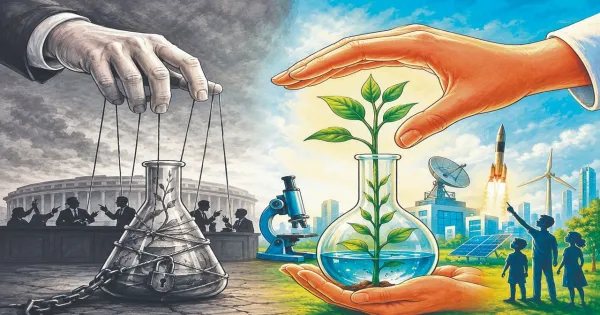
The problem arises when instead of becoming the protector of science, politics starts becoming its controller, then political convenience starts replacing scientific truth and freedom of knowledge becomes subordinate to the priorities of power. In a democratic nation like India, this question is very important that to what extent is political interference in science necessary and at what point does it start causing national harm instead of national interest.
The history of science shows that no scientific revolution was possible without political and social support. India’s first Prime Minister Jawaharlal Nehru considered the scientific approach to be the basis of modern India. His famous statement was that ‘Scientific approach is not just a laboratory thing, but a way of life.’
The result of this thinking was that the Indian Institute of Technology, Atomic Energy Programme, Indian Space Research Organization and many national laboratories were established. Today, India’s space achievements, successes like Chandrayaan and Mangalyaan, are proof that when politics takes a long-term vision and provides resources to science, the result is not just scientific achievement, but national self-confidence.
Similarly, the Covid-19 pandemic has proved how important the cooperation of science and politics is for the society. Indian scientists developed the indigenous vaccine in a short time and the government launched a massive vaccination campaign to reach it among the people. Had this coordination of scientific research and administrative will not been there, the human and economic loss caused by the pandemic would have been much more serious. This makes it clear that the responsibility of politics is not to give direction to science, but to become a medium to convey its potential to the society.
But there is also a serious crisis associated with this positive side. American astronomer Carl Sagan warned, ‘When society ceases to understand science, it becomes a victim of superstition and the deceit of power.’ This warning appears more relevant today than ever. If scientific findings are evaluated on the basis of political gain rather than experiments, then the very purpose of science is lost. In a democracy, the government can change, ideologies can change, but scientific truth is not a supporter of any political party. He is only a supporter of evidence.
From time to time, there have been debates in India regarding the autonomy of scientific institutions, appointments and research priorities. This debate is not only administrative but also democratic. If the leadership of a scientific institution appears to be influenced by political proximity rather than competence, then first of all public trust is weakened. The basis of science is reliability and the basis of reliability is freedom. As soon as independence ends, science can become a means of propaganda.
Environmental policy provides the clearest example of this conflict. Scientists have been warning for decades that climate change, air pollution and biodiversity loss are serious challenges to human civilization. Despite this, many times political and economic interests are given priority over scientific reports in the evaluation of development projects. The air pollution of Delhi and North India is a direct example of this. Scientific solutions have been available for years, but the problem persists due to lack of political coordination and politics of immediate gain. This makes it clear that neglect of science ultimately proves costly for the society.
While considering the relationship between science and politics, the statement of the famous biologist Richard Dawkins is also noteworthy that ‘The greatest power of science is that it can change its conclusions as the evidence changes.’ This flexibility is often not there in politics. There, confession is often considered weakness. As a result, a conflict arises between scientific facts and political desires. This is why scientific institutions should be accountable to the government, but not politically dependent.
The Indian Constitution also gives clear indications in this direction. Article 51(a) requires every citizen to develop a scientific temper, humanism and a spirit of learning. It is not only the responsibility of the citizens but also the moral responsibility of the state to encourage scientific consciousness. If the governance system itself starts presenting unproven claims, pseudoscience or emotional propaganda as equivalent to scientific facts, then the basic spirit of the Constitution is weakened.
Therefore the role of politics should be clear and limited. The government should provide finance for research, set national priorities, encourage scientific education and provide world-class facilities to research institutions. On the contrary, its interference in scientific findings, interpretation of data, direction of research, appointment of experts and academic freedom should be minimal. This balance of democratic accountability and scientific autonomy is the hallmark of any modern nation.
In fact, the question is not about the conflict between science and politics, but about the limits of responsibilities of both. If politics tries to control science, it will sacrifice long-term national interests for short-term gains, but if it provides freedom, resources and institutional security to science, then the same science will become the strongest basis for economic development, social welfare, environmental protection and national security.

Comments are closed.