

During the men’s football tournament at the 2012 London Olympics, South Korea defeated Japan 2-0 to secure the bronze medal. In the post-match celebrations, midfielder Park Jong-woo held up a fan’s sign that read “Dokdo is our territory,” referencing the Dokdo/Takeshima Islands, an area that is subject to a sovereignty dispute between South Korea and Japan.
Park Jong-woo holds up a sign with a political message after South Korea beat Japan 2-0 in the bronze medal match of the men’s football tournament at the 2012 London Olympics. Photo by Reuters |
The International Olympic Committee (IOC) ruled that the gesture carried a prohibited political message and immediately banned Park from joining his teammates on the medal podium. This is widely considered one of the harshest penalties ever handed down for political expressions at a major sporting event, Korea Times reported.
Following subsequent investigations by both the IOC and FIFA, Park was still allowed to keep his bronze medal, and his eligibility for military service exemption remained intact. However, both governing bodies strongly condemned the politicization of the sport.
FIFA later accused Park with violating its disciplinary code. While the Korea Football Association defended the player by claiming the act was spontaneous and lacked political intent, FIFA still issued Park a two-match suspension in international football.
This precedent could heavily influence the disciplinary actions for Argentina in the 2026 World Cup. Under current FIFA regulations, the Argentine Football Association (AFA) faces financial fines for failing to control its delegation and violating tournament guidelines.
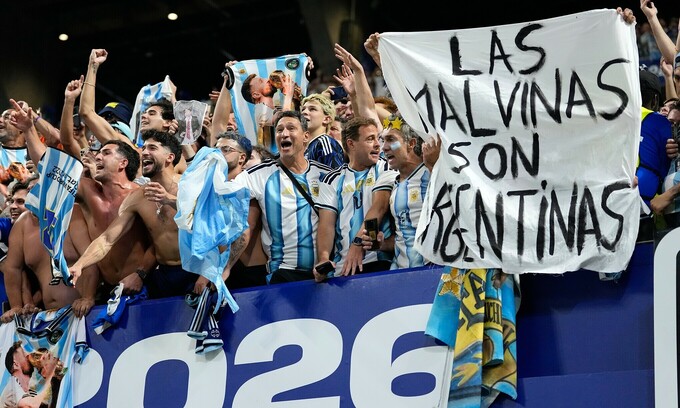
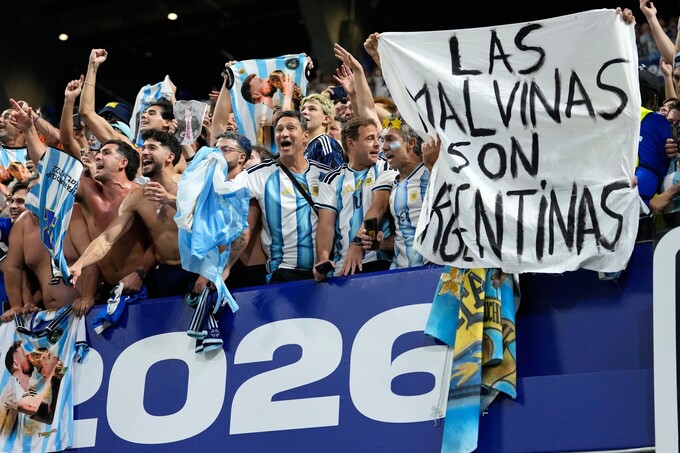 |
Argentinian fans hold up a banner reading “Las Malvinas Son Argentinas” (The Malvinas are Argentinian) after the World Cup semifinal between England and Argentina in Atlanta, USA, on July 15, 2026. Photo by AP |
Individual players who participated in the banner display could receive formal warnings, financial penalties, or multi-match suspensions if FIFA deems the behavior serious or a repeated violation.
The controversy escalated when midfielder Leandro Paredes doubled down on the message during a brief post-match interview, declaring that the Malvinas will always belong to Argentina.
The Malvinas is the Argentine name for the Falkland Islands, an archipelago in the South Atlantic administered by the U.K. but continuously claimed by Argentina.
In response to the incident, the British Prime Minister’s Office affirmed: “The World Cup might not be ours, but the Falkland Islands definitely are.”
British politicians have also criticized the action of Argentina players. Liberal Democrat leader Ed Davey sent a letter to FIFA requesting suspensions for the players involved, ESPN reported.
His letter cited the incident from Euro 2024, where Spain players Rodri and Alvaro Morata were handed one-match suspensions by UEFA for chanting “Gibraltar belongs to Spain” during their championship celebrations.
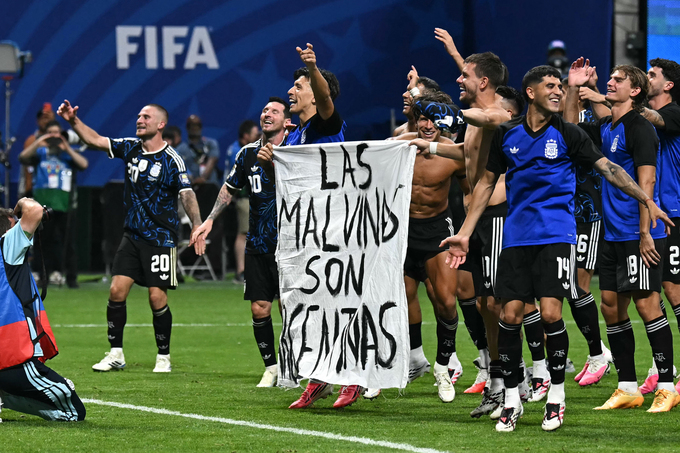 |
Argentinian players hold up a banner reading “Las Malvinas Son Argentinas” (Malvinas are Argentinian) after their victory over England in the 2026 World Cup semifinal in Atlanta, USA, on July 15, 2026. Photo by AFP |
This is not the first time the AFA has faced punishments regarding the Falkland Islands dispute. In 2014, FIFA fined the association US$27,000 after the national team displayed a similar banner on the pitch ahead of a friendly match against Slovenia, Sky Sports reported.
The sovereignty dispute over the islands, roughly 500 km off the Argentine coast, erupted into a ten-week war in April 1982. The conflict resulted in the deaths of 649 Argentinian soldiers, 255 British, and three local residents, ending with a victory for the Brits.
According to Markwhile Argentina surrendered in June 1982, the nation has never given up the constitutional claim over the territory.
Comments are closed.