Used to living in a landed home, Ha often kept the door open for ventilation and saw nothing wrong with the habit. “Yet one day, after I left the door open for just a few minutes, security guards came up to remind me to close it,” she says.
Her experience highlights a growing trend in apartment complexes that discourage or ban open doors to reduce noise, cooking odors, wandering pets and children, and privacy concerns.
Being forced to keep her door closed all day made Ha uncomfortable. She insisted she had no intention of stealing cool air from the hallway air conditioning. When she shared her story on social media, more than half of the commenters disagreed with her.
The debate over whether to leave apartment doors open represents pushback by people who view a closed door as important for privacy, civility, and safety.
But this is increasingly becoming a source of conflict as millions of Vietnamese transition from landed homes to apartments, with multiple families sharing hallways and common spaces.
|
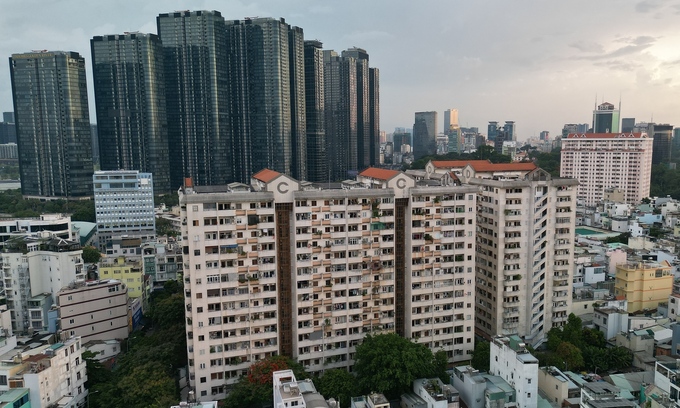
An apartment complex in Phu Luong Ward, Hanoi, does not prohibit leaving doors open. Photo by Phan Duong |
A clash of lifestyles
Le Thanh Mai, 38, who lives in an apartment complex in Tu Liem Ward, Hanoi, says strict rules on keeping doors closed leave families with young children short of space.
Besides, opening doors to allow fresh air in or casual chats with neighbors is a communal living tradition and should not be prohibited.
But Thu Phuong, 47, bought an apartment in Tay Mo Ward, Hanoi, precisely because the building prohibits open doors, which, for her, keeps hallways free of cooking odors and noise, the minimum requirements for a premium residential complex.
Phuong once got into a heated argument with a neighbor whose family regularly left their door ajar while cooking, letting food smells drift into her apartment.
When confronted, the neighbor retorted: “If you get the smell, go buy a door draft stopper.”
After being warned multiple times by the building management, that family eventually moved away.
Living in another high-end complex in Yen Hoa Ward, Phuong Trang, 31, has repeatedly complained about neighbors leaving doors open for their children to run around in the hallway late at night or pets to cause disturbances.
“Our building rules strictly forbid leaving doors open for extended periods, especially while cooking,” she says.
But because the hallways lack security cameras, guards only issue reminders or warning notices when complaints are filed.
Formal fines have yet to be enforced as they have not been approved at the apartment owners’ General Meeting.
A Read survey of 5,000 readers found opinions nearly split, with 55% describing the practice as impolite and 45% considering it acceptable.
Building design and operational headaches
For building managements, open doors represent a major operational headache.
Tran Thi Hoa, who works for a building management board in Long Bien Ward, Hanoi, says complaints about “open-door neighbors” account for 10% of the total number, spiking during the summer.
To address the issue, the complex has a tiered penalty system: an initial warning for the first offense, suspension of building services after a second time, and a VND450,000 (US$18) fine for the third.
A survey of apartment buildings in Hanoi and HCMC found that a ban on keeping doors open was added following disputes.
Pham Van Chuong of property management firm PSE in Hanoi says many projects in Nam Tu Liem and Cau Giay districts in Hanoi and Thu Duc City and District 7 HCMC had to retroactively ban open doors after residents complained about odors, noise, and hallway encroachments.
He explains that these rules are crucial to ensuring fire safety standards.
“Modern apartment hallways are enclosed spaces equipped with fresh air supply, smoke extraction, and emergency evacuation systems. In the event of a fire, leaving an apartment door open could allow smoke to spread rapidly, neutralizing the building’s pressurization and smoke-prevention systems.”
 |
|
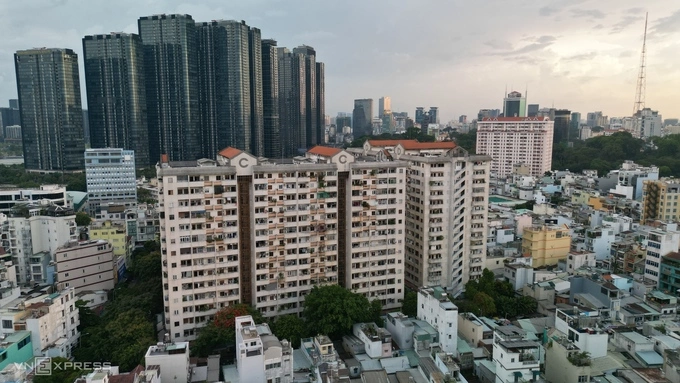
An apartment complex in Thanh My Tay Ward, HCMC, May 2026. Photo by Dinh Van |
Pham Xuan Diep, secretary of the Hanoi Apartment Management Association, points to building designs as the root cause of conflicts.
In high-grade projects, entrance doors are staggered and not dense so that, even when left open, they have a minimal impact on neighbors, he said.
But, in some places, large numbers of doors and directly facing each other across narrow hallways mean opening a door immediately affects the opposite unit, he said.
“In an apartment complex, not everything inside your unit is purely private property, and not everything out in the hallway belongs to the public.”
Smoke detectors and fire sprinklers inside an apartment are part of the building’s common fire safety system. Meanwhile, the water meter located in the hallway is the private property of each unit.
According to Hanoi lawyer Le Hong Hien, while apartment owners have the right to open or close their doors according to their needs, they must not infringe upon the interests of others as stated in the Civil Code. The 2023 Law on Housing and Circular 05/2024 issued by the Ministry of Construction also outline specific conditions for apartment users.
If keeping a door open spreads odors, generates noise, or interferes with common building systems, the management reserves the right to tell those residents to stop their behavior.
But any ban is legally binding only when approved through proper official procedures, and management boards must publicly disclose both the legal and technical rationale before incorporating such restrictions, he adds.
Kim, Phuong Trang’s South Korean husband who has lived in Hanoi for many years, says 20 years ago, apartment culture in his home country was similarly open and neighbor-friendly.
But with urbanization, private space became the top priority, he says.
Since moving to Vietnam, he and his foreign friends have had to relocate multiple times due to neighbors habitually leaving their doors open, he says. “Vietnam will likely follow a similar trajectory. This shift doesn’t necessarily mean people are becoming more selfish; rather, they are placing a higher premium on privacy and quality of life.”
Chuong also expects restrictions on open doors to become increasingly commonplace with tightening fire safety regulations and building operation standards, and a growing desire for privacy. “Establishing clear rules right from the property handover stage is key to balancing individual rights with public safety.