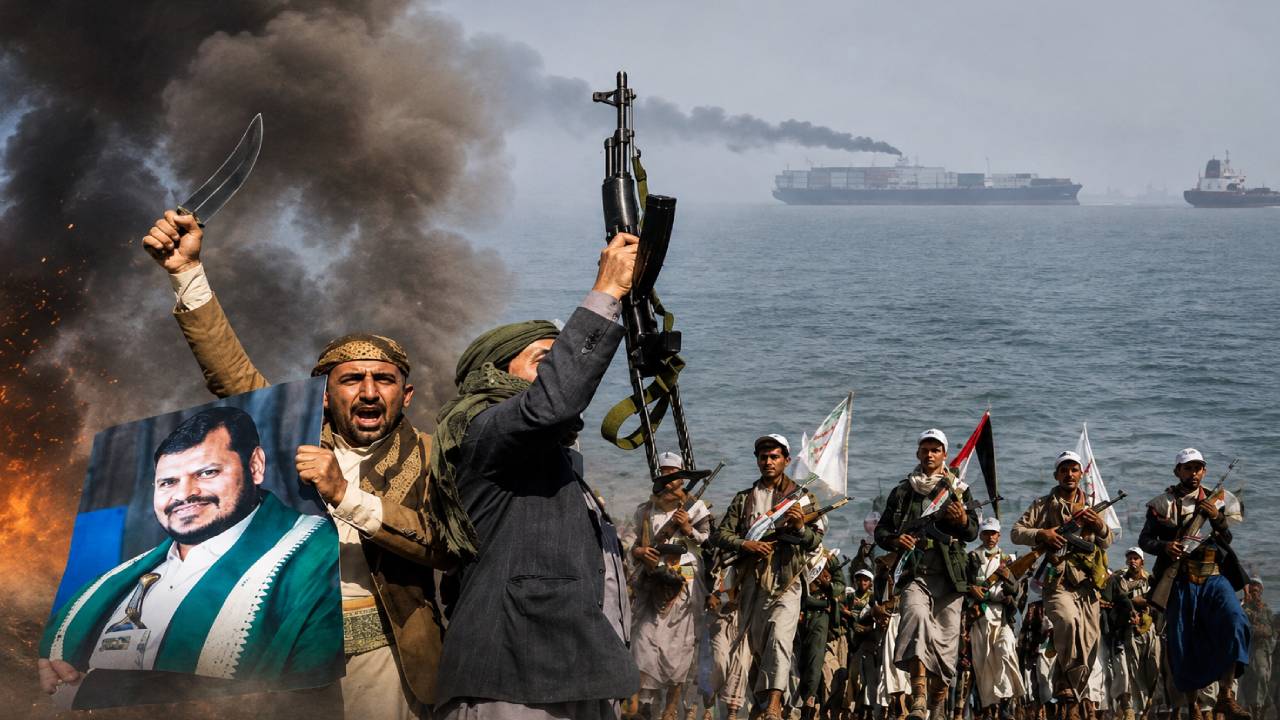
Houthis Attack Indian Ship: An Indian-flagged cargo ship was attacked on Tuesday in the Red Sea off Yemen’s western coast. Following the attack, the ship capsized and sank. Fourteen people were on board, including 13 Indian sailors and one Yemeni national. All 14 were rescued safely by Yemeni security agencies and provided medical assistance.
The ship, MSV Faize Noore Oliya, was struck by a projectile about 13 nautical miles south of the Houthi rebel-held port city of Hodeidah in Yemen.
Yemen’s National Resistance Forces, also known as the Guards of the Republic, said a joint operation by the coast guard and navy rescued all the sailors safely. They claim the attack was carried out by Houthi rebels.
What did India say?
The Indian government has strongly condemned the “unprovoked” attack on an Indian ship near Yemeni waters. Union Minister for Ports, Shipping, and Waterways Sarbananda Sonowal stated that the Indian ship was attacked with a projectile, causing it to capsize and subsequently sink. This raises questions about who the Houthi rebels are, where they live, and how distinct they are from the Yemeni military. Find out the answers to each question.
Who are the Houthi rebels?
The Houthi rebels are a political and armed group in Yemen, also calling themselves “Ansar Allah.” The organization is primarily affiliated with the Zaydi Shia community. Zaydi Shia are a distinct branch of Shia Muslims whose religious beliefs differ significantly from the majority “Twelver Shia” community in Iran, Iraq, and other countries.
The community is named after Zayd bin Ali, who is considered the great-grandson of Hazrat Ali, the Prophet Muhammad’s cousin and son-in-law. Zayd bin Ali rebelled against Umayyad rule in 740 and was later killed. The Zaydi community considers him a symbol of the struggle against corrupt rule.
How did the Houthis thrive?
The Houthi movement initially made the fight against corruption its primary issue. The organization claimed to be fighting against the widespread corruption and abuse of power in Yemen. The Zaidi community has inhabited the mountainous regions of northern Yemen since approximately the ninth century. For nearly a thousand years, the community’s imams have periodically ruled various parts of Yemen. They also fought against the Ottoman Empire and Wahhabi forces at various times.
Following the collapse of the Ottoman Empire in 1918, the Zaidi monarchy, the Mutawakkilite Kingdom, was established in northern Yemen. At that time, the ruler was both a religious and political figure. In 1962, Egyptian-backed military officers overthrew the monarchy in a coup and established a new government with Sana’a as its capital. A civil war ensued, in which Saudi Arabia supported the Zaidi monarchy, while Egypt sided with the new government. The war eventually ended with the Republican government’s victory.
In 1978, Ali Abdullah Saleh, a military officer of Zaidi background, came to power and ruled Yemen for nearly 33 years. He unified North and South Yemen in 1990. The 1990s saw the rise of the Houthi movement. Its founder was Hussein al-Houthi, after whom the organization came to be known as the “Houthi.”
Trouble with Saudi…
The Houthi movement accused then-President Ali Abdullah Saleh of widespread corruption and embezzlement of state assets. It also criticized Saudi Arabia and the United States for their support of Saleh’s government.
How did the nature of the movement change?
The Houthi movement became more radical after the US invasion of Iraq in 2003. It was during this time that the group adopted its famous slogan, “Allah is greatest, death to America, death to Israel, curse on the Jews, and victory to Islam.” The group then officially began calling itself “Ansar Allah.”
How did relations between Hezbollah and Iran grow?
The Houthi movement has drawn inspiration from the Lebanese Shia organization Hezbollah. Although the two belong to different Shia traditions, cooperation has grown between them. Iran has also gradually become a significant supporter of the Houthi movement, a major reason for this being its shared opposition to Saudi Arabia.
After 2003, President Ali Abdullah Saleh launched several military campaigns to eliminate the Houthi movement. In 2004, government forces killed Hussein al-Houthi, the founder of the Houthi movement. Despite this, Houthi rebels continued to gain strength in northern Yemen. Saudi Arabia also participated in these campaigns, but the Houthi rebels were often successful in countering government and Saudi forces.
When the Arab Spring reached Yemen
In 2011, the Arab Spring movement reached Yemen. The Houthi movement also participated in the protests against President Saleh. Saleh was later replaced by Abdrabbuh Mansour Hadi, but the Houthi movement opposed this political process.
The national dialogue on the country’s future proposed the creation of six autonomous provinces. The Houthi group alleged that the new arrangement politically discriminated against Zaidi-dominated areas.
How did the political equation change in 2014?
In 2014, the Houthi rebels allied with Ali Abdullah Saleh, the same leader they had fought against for years. Together, a large segment of Saleh’s loyalist army and the Houthi rebels gradually captured the capital, Sanaa, which fell under their control in January 2015.
Following this, the Houthi rebels established direct air services with Iran. Iran promised to provide Yemen with cheap oil. Meanwhile, reports of increased cooperation between the two sides emerged. The Houthi rebels then captured the port of Hodeidah and began advancing towards the southern city of Aden. This further complicated the Yemen conflict.
Two governments in Yemen?
Currently, there are two governments in Yemen. One part of Yemen is controlled by the Saudi-backed government, while the other part is ruled by the Houthis, led by Abdul-Malik al-Houthi. The Saudi-backed government, the Presidential Leadership Council, currently controls parts of Yemen’s south and east.
While the Houthi rebels control the north and west, including the capital, Sanaa. Simply put, the Houthis rule approximately 80 percent of Yemen.