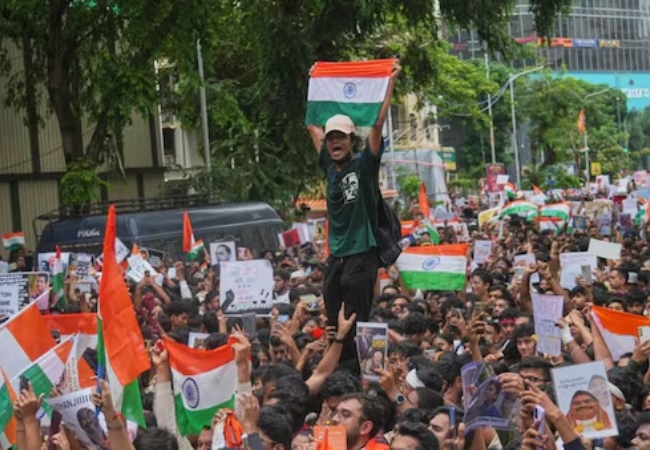
New Delhi. The Supreme Court held an important hearing on petitions related to the recent student protests and police action against the NEET paper leak at Jantar Mantar in the national capital. A three-member bench headed by Chief Justice of India Surya Kant clarified during the hearing that peaceful protest is a constitutional right of every citizen, but at the same time, the administration must adopt a very sensitive approach to controlling social tensions.
There was a debate on the stand of the Yogi government
During this crucial hearing, when the demands of the protesting youth and the states’ tough action were being discussed, the Yogi government of Uttar Pradesh was mentioned in court arguments. Amidst the lawyers’ debate, the question was raised: “Will the Yogi government also bow to the protesters?” Commenting on this, Chief Justice Surya Kant strongly advised governments and security agencies to abandon their aggressive stance and exercise restraint.
Key observations and directions of the Supreme Court
The Supreme Court stated that while some anti-social elements may have engaged in stone-pelting during the protests, any aggressive approach by the government could further inflame social tensions. Appropriate advice and counseling are needed to calm the youth. Furthermore, the Supreme Court granted state governments the freedom to withdraw cases filed against protesting students and minors. The central government has also assured the court that it will not take action against innocent students.
Criminals will not get any relief
The court took a tough stance, clarifying that FIRs and legal action will continue against protesters who have a prior criminal history or were involved in serious violence. The Supreme Court directed the formation of a high-powered committee to investigate alleged excesses by both the police and protesters during the Jantar Mantar demonstration.
There is also concern about the demonstrations at Jantar Mantar
During the hearing, the court also took cognizance of another public interest litigation, which stated that Jantar Mantar is no longer a suitable venue for large protests. The narrow roads there hamper emergency services and ambulances. Considering the matter serious, the Chief Justice directed Solicitor General Tushar Mehta to seek instructions from the central government as to whether a safer and larger alternative venue, such as Ramlila Maidan, could be designated for protests. The court has not yet imposed a ban on protests at Jantar Mantar, but has sought responses from all parties. The next hearing in this matter will be held on August 18th.