
From dropout to property billionaire: How Chua Thian Poh got rich betting on Singapore’s Sentosa Cove

Today, Sentosa Cove is one of the city-state’s most coveted enclaves, and Ho Bee Land is the largest private developer in the neighborhood.
But back in the early 2000s, the area was little more than a reclaimed stretch of land that few believed could become a premier residential enclave. Ho Bee was the first private developer to make a big bet on the area.
“At that time, the concept of luxury waterfront living was new to Singapore, but we saw Sentosa Cove’s potential to become a world-class seafront precinct,” Chua told The Business Times in an article for the city-state’s 60th anniversary last year.
While that would eventually become its best-known achievement, Ho Bee had been established by Chua years earlier.
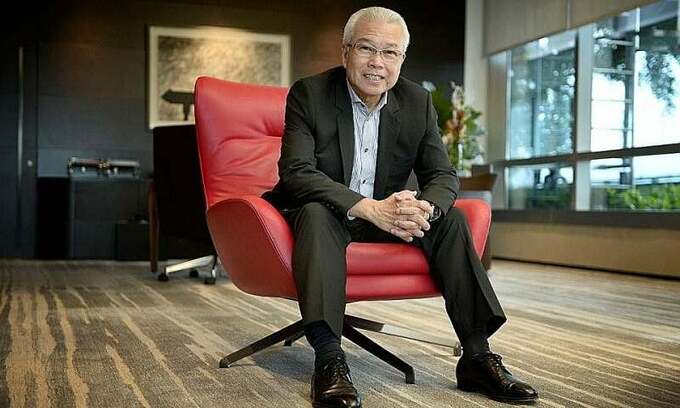
Chua Thian Poh, founder and executive chairman of Ho Bee Land. Photo from NUS Chua Thian Poh Community Leadership Centre’s website |
The fourth of 14 siblings, a young Chua dropped out of high school and borrowed S$15,000 (US$11,600) from his mother to set up a business making hooks and spikes for logging companies.
He later ventured into commodity trading in Indonesia, where he earned the capital needed to establish his property business back home in 1987. Ho Bee started out with the purchase of an industrial building and moved on to developing small- and medium-sized projects. It went public on the Singapore Exchange in 1999.
Chua made his move into Sentosa Cove in 2003, with Ho Bee putting up eight buildings in the following years, according to Forbes. The first five were rapidly snapped up at sharply rising prices by buyers from dozens of countries.
The profits from these projects propelled Ho Bee into one of the Singapore stock market’s standout performers between 2006 and 2010.
However, by the early 2010s, home prices in Sentosa Cove had fallen from their 2008 peak following Singapore’s property cooling measures. Around that time, two of Ho Bee’s three other projects in the area were partially sold while the largest, the 302-unit Cape Royale, was not put up for sale.
Rather than selling into a weak market, Chua turned the project into a rental property, which generated enough income to more than cover the cost of holding the development for nearly a decade while he waited for a more opportune time.
Sales of the project finally began in 2022, with half of the 50 units released sold on the launch day.
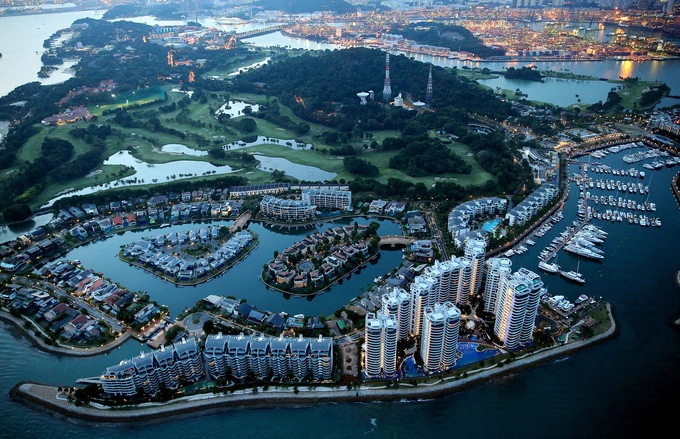 |
Aerial view of Sentosa Cove in June 2015. Photo by SPH Media via AFP |
The Sentosa move was but one of Chua’s bets over the years that have grown Ho Bee into a major property developer with a footprint spanning Australia, China, the UK and Europe.
Another pivotal move came even before Sentosa Cove, when Chua shifted his investment focus from Singapore to London in 1996. The decision inadvertently shielded Ho Bee from the 1997-98 Asian financial crisis.
“In property, you will never know [whether it’s the right time or not]. We were lucky that we escaped,” he told The Edge Singapore in 2023.
Following Sentosa, Ho Bee moved on to The Metropolis, a 23-story twin-tower office development at one-north on the city fringe. Completed in 2013, the project was part of its twin-engine strategy to generate recurring rental income alongside property development, according to The Edge Malaysia.
The early move again put Ho Bee ahead of the curve. The project drew a roster of multinational tenants and helped cement one-north’s position as a thriving business and research hub.
In recent years, the developer has been stepping up its investments in Australia. Earlier this year, it bought a 181-hectare landholding in Queensland for A$318.5 million (US$220 million), as reported by the Australian Financial Review.
The company also gives back to the community through the Ho Bee Foundation, which supports causes including education, healthcare, social welfare and the arts.
Chua, now one of Singapore’s richest people with an estimated net worth of US$1.4 billion, has been gradually passing the reins to his eldest son, Nicholas Chua, who joined Ho Bee in 2002 and is now its CEO and executive director.
The duo have said their working styles differ, though they share several principles when it comes to running the business. Among them are treating people right and finding win-win solutions, whether in joint ventures or when dealing with a counterparty.
As Chua told Tatler in 2019 when asked about building a long-lasting career: “As long as you are fair and reasonable to all your stakeholders, you can run the marathon. No one wants to deal with you if they are always on the losing end.”
Comments are closed.