
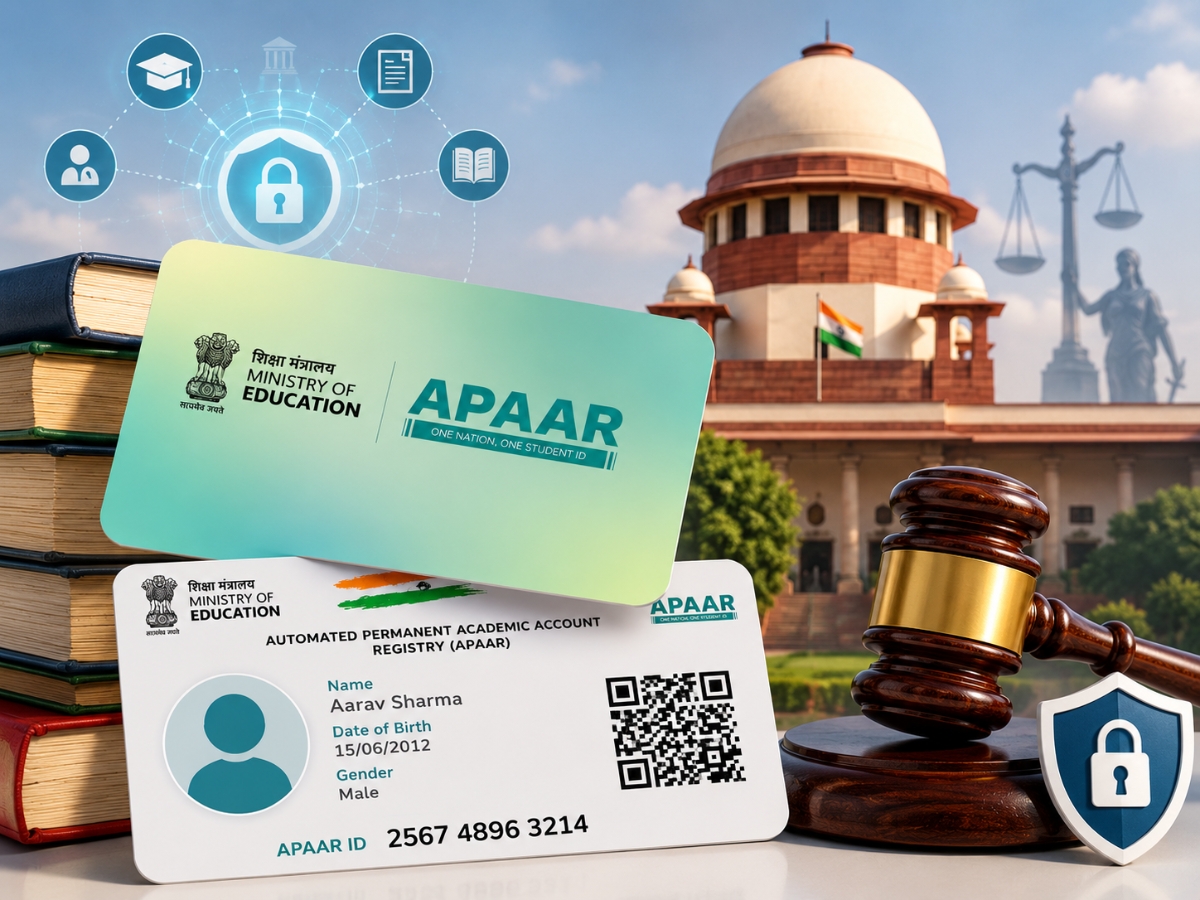
What Is APAAR ID, Who Can Avail And Why Is Supreme Court Questioning It? All You Need to Know

The Supreme Court has brought back into focus the Centre’s APAAR ID programme, stressing that parents should be given a real choice before their child’s academic ID is created. The government has always assured that APAAR was voluntary, but the court has asked the Central Board of Secondary Education (CBSE) to roll out the same privacy safeguards at a national level that were laid out by the Orissa High Court. This move follows concerns expressed by the parents who complained that the Aadhaar-linked student ID could compromise the privacy of children and the enrolment was being made compulsory, though it was called voluntary.
What is the APAAR ID?
APAAR (Automated Permanent Academic Account Registry) is a unique 12-digit lifelong student ID introduced under National Education Policy (NEP) 2020. It has been developed by the Centre as part of its “One Nation, One Student ID” initiative. With consent from the parents, it is linked to the student’s Aadhaar and integrated with DigiLocker and Academic Bank of Credits (ABC). APAAR generates a single digital academic profile to store marksheets, certificates, report cards and other academic documents. The system is designed to cut down on paperwork in admissions and school transfers and enable students to securely access and carry their academic records as they move through their educational journey.
Who is eligible for APAAR ID?
The programme targets students from school education to higher education institutions within the Indian education system.
School students must first require the approval of their parents before an APAAR ID is generated. The government has emphasised that participation is voluntary and not mandatory.
What Led The Supreme Court To Interfere?
A bench of Chief Justice of India Surya Kant and Justices Joymalya Bagchi and V. Mohana was hearing a petition filed by parents of four students challenging the validity of the APAAR scheme.
The petition contended that while APAAR is said to be voluntary, students are practically forced to join it, as it is linked to Aadhaar and, in some instances, to school admission and examination processes.
The Supreme Court during the hearing noted that the Centre accepted the Orissa High Court’s December 2025 judgement directing the authorities to give a clear option to the parents not to give consent. “We will direct the CBSE to implement this judgement on a pan-India basis, as the High Court order has been accepted. We are directing the CBSE to examine the issues as well,” the bench said.
It said a detailed order would be uploaded later too.
What Are The Privacy Issues?
The existing system does not give meaningful and informed consent to parents before admitting children, submitted senior advocate Indira Jaising, appearing for the petitioners.
Referring to the Supreme Court’s 2019 Aadhaar judgement in the K.S. Puttaswamy case, she argued that children cannot be forced to get Aadhaar indirectly through APAAR. “The right to education is a constitutional right. Asking a child to obtain Aadhaar and APAAR to appear in examinations is against the Constitution,” the senior lawyer said.
The petitioners also said that the implementation is not fully in compliance with the Digital Personal Data Protection (DPDP) Act, 2023. They raised issues about informed consent, withdrawal of consent, long-term storage of children’s academic records and what they termed an individual’s “right to be forgotten”.
The petition also sought a declaration that the Aadhaar-linked academic ID system was unconstitutional, saying it violated Articles 14, 19, 21 and 21A of the Constitution.
What Did The Chief Justice Say?
While noting the concerns raised over privacy, Chief Justice Surya Kant also pointed out that APAAR serves a legitimate public purpose. “Let us not doubt everything in the country with a suspicious eye; it is a welcome step,” the CJI said.
A unique student ID, he said, could help education authorities keep accurate records, improve the delivery of education programmes and monitor such things as teacher-student ratios.
The bench also made it clear that circulars issued by the CBSE cannot override the provisions of the Digital Personal Data Protection Act, 2023.
What Did The Orissa High Court Direct?
The Orissa High Court, in its judgement dated 12.12.2025 in the case of Rohit Anand Das vs State of Odisha, has observed that if APAAR is really voluntary, then the parents should be provided a real choice before enrolment.
The High Court had directed the Ministry of Education to amend the model APAAR consent form to “include an opt out/refusal of consent option”.
It also said the absence of such a provision undermines the government’s claim that the scheme is voluntary and raises concerns about the fundamental right to privacy. The court also ruled that the ability of parents to revoke consent later cannot substitute their right to refuse to participate in the first place.
Is APAAR Compulsory?
times by the Ministry of Education. However, some schools have tied its implementation to administrative processes such as student registration and examinations, leading to confusion. The Supreme Court has now asked CBSE to ensure that parents are clearly informed that they can refuse consent prior to admission or withdraw consent later. And the entire process must also be in line with the Digital Personal Data Protection Act, 2023, it has said.
Also Read: SBI Funds Management Lists At Nearly 7% Premium On NSE: Should You Buy, Hold Or Book Profits?
Priyanka Roshan is a business writer and assistant editor at the NewsX website who tracks everything from stock market swings and corporate earnings to personal finance trends and policy shifts. Known for turning fast-moving business developments into sharp, reader-friendly stories, she combines speed, accuracy, and a data-driven approach to break down complex financial news for everyday audiences.
With over 9.5 years of newsroom experience, Priyanka has worked with leading media organisations, including Bussiness, Times Now, and Ping Digital, covering diverse beats such as business, politics, technology, auto, travel, sports, and the world. From live breaking news desks to SEO-led digital storytelling, she specialises in creating engaging content that keeps readers informed without overwhelming them.
The post What Is APAAR ID, Who Can Avail And Why Is Supreme Court Questioning It? All You Need to Know appeared first on NewsX.

Comments are closed.