


The All India Distillers’ Association expects motorists with high daily usage to become the first serious customers for flex-fuel vehicles.
Its logic is based on utilisation. A person driving 30,000 kilometres a year can recover a fuel-cost advantage much faster than someone covering 7,000 kilometres. Fleet operators also track fuel use more closely and replace vehicles according to operating economics rather than occasional personal preference.
But AIDA has not set 80 or 100 kilometres a day as an official adoption threshold. More importantly, the current data does not yet prove that E85 is cheaper per kilometre. The pump price is lower. The mileage figure needed to calculate the actual saving is still missing.

E85 was introduced in Delhi at Rs 82.12 per litre. E20 petrol cost Rs 102.12, creating an exact Rs 20 difference.
At those prices, E85 costs 80.4 percent as much as E20. For the running cost per kilometre to be lower, a vehicle using E85 must retain more than 80.4 percent of its E20 mileage.
The maximum break-even mileage loss is therefore approximately 19.6 percent.
Consider the WagonR Bioflex. The equivalent 1.2-litre petrol manual has an official efficiency figure of 23.56kpl. If the flex-fuel version achieved the same mileage on E20, it would need to deliver more than approximately 18.9kpl on E85 to cost less per kilometre at the Delhi launch prices.
At exactly 18.9kpl, the fuel costs would be almost identical. Any figure below that would make E85 more expensive per kilometre despite the Rs 20 pump-price discount.
Maruti has not published an official E85 efficiency figure. Hero has stated that its flex-fuel motorcycles develop more power and torque on E85, but it has not released directly comparable certified E20 and E85 mileage numbers.
Until those figures are available, claims of lower running costs remain projections rather than demonstrated savings.
Regional pricing adds another complication. E85 launched in Mumbai at Rs 91.18 per litre, around Rs 9 more than in Delhi. The comparison must therefore be made against the local price of E20, not a national headline discount.

The WagonR Bioflex cost Rs 86,000 more than the comparable petrol version when prices were announced.
A high-mileage user must recover that additional amount through fuel savings before the financial case turns positive.
At a saving of Re 1 per kilometre, recovering Rs 86,000 requires 86,000 kilometres. A vehicle covering 100 kilometres every day would take about 2.4 years. At 60 kilometres a day, the same distance would take nearly four years.
If the actual saving is only 50 paise per kilometre, the recovery distance doubles to 1.72 lakh kilometres.
These calculations exclude interest on the higher purchase price, insurance, maintenance and resale value. They also assume that the owner can use E85 for almost every kilometre.
If the vehicle regularly falls back to E20 because no E85 outlet is available, the recovery period becomes longer. The owner has paid for ethanol-compatible components without receiving the fuel-price advantage.
This is why fleet operators near dependable E85 stations offer a more realistic first market than private users scattered across the country.
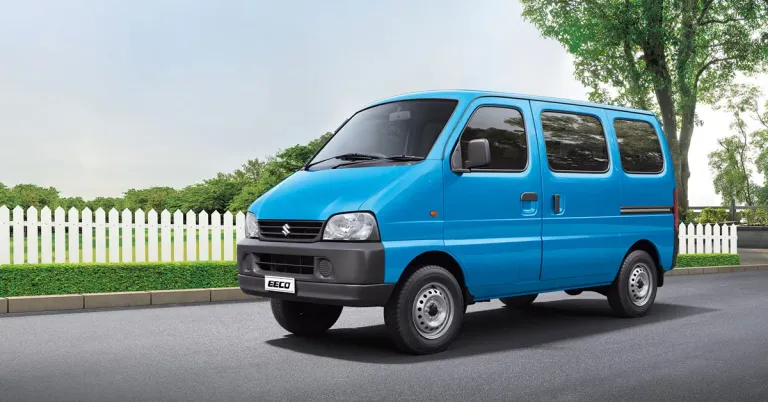
High-mileage users are not waiting for flex fuel to reduce their running costs. The WagonR already has a factory-fitted CNG option with an official efficiency figure of 34.05km per kg. CNG prices and availability vary by city, but taxi operators understand its operating cost, service requirements and resale market.
Electric cars and two-wheelers can offer still lower energy costs where a fleet has fixed routes and reliable overnight charging. Commercial users can also calculate charger utilisation, battery warranties and daily downtime with reasonable accuracy.
Flex fuel offers a different combination of benefits. Refuelling takes a few minutes, range is similar to a petrol vehicle, and E20 can be used when E85 is unavailable. It does not require a charging stop or a large CNG cylinder taking up luggage space.
Its commercial position will probably sit between these alternatives. It may be easier to operate on irregular long routes than an EV, but it must deliver a larger saving than petrol and a sufficiently competitive result against CNG.
For Hero’s commuter motorcycles, the comparison is equally difficult. Petrol models are cheaper to buy, while electric scooters can deliver low city running costs for riders with home or workplace charging. The E85 versions need dependable fuel availability and a clear mileage calculation to justify their additional complexity.
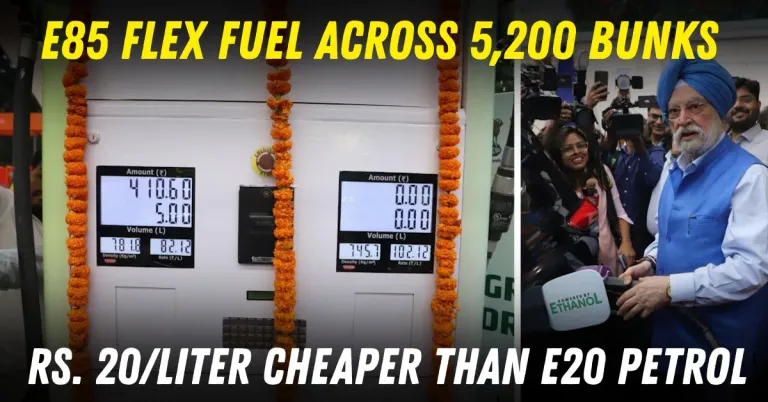
E85 began at only 48 outlets. Even the planned 500 stations by December 2026 would represent a small network relative to the national fuel-retail system. AIDA has proposed allowing rural ethanol producers to dispense fuel directly.
Its argument is that many distilleries are located near agricultural regions, so locally produced ethanol could support nearby flex-fuel vehicles without travelling through the entire conventional distribution chain. That is a proposal, not current policy.
Direct retailing would require licences, fuel-quality checks, calibrated pumps, taxation systems, fire-safety compliance, storage standards and a clear process for handling consumer complaints. Ethanol producers cannot simply begin selling E85 at the factory gate.
A more realistic early model may involve defined corridors or fleet clusters. A taxi operator, government fleet, delivery company or industrial business could use vehicles based near one or two reliable E85 stations.
Such fleets would generate the usage data the market currently lacks. Within two or three years, they could show how fuel economy changes across different blends, whether injectors and fuel pumps remain reliable, how often vehicles fall back to E20 and what happens to resale value.
High-mileage users can test the economics faster because they expose the vehicle to more kilometres in less time. They are not automatically the most likely customers merely because E85 is cheaper per litre. They will adopt only when the full calculation works: purchase premium, actual E85 mileage, fuel availability, maintenance and resale.
Comments are closed.