
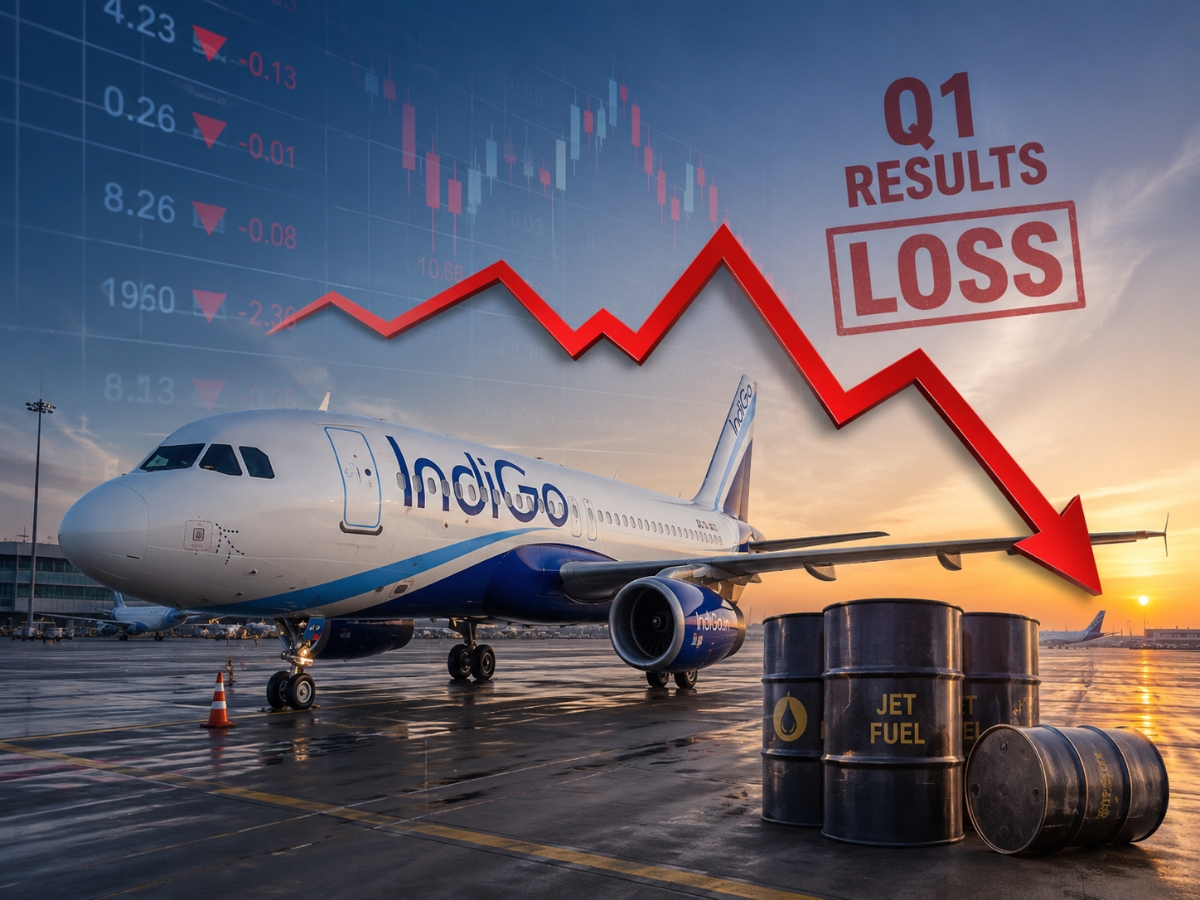
Why Did IndiGo Report A Rs 238 Crore Q1 Loss Despite 20% Revenue Growth? Key Numbers Explained

Despite record high revenues and demand from the highest passenger growth and strong yield on a solid top line, the biggest Indian airline, IndiGo, reported a surprise loss in April-June FY27 as a sharp surge in operating costs – fuel price rise and impact of the Middle East conflict – offset its bottom-line profits. Consolidated net loss of IndiGo’s parent, InterGlobe Aviation, stood at Rs 237.6 crore for the quarter ending on June 30, 2026, against a net profit of Rs 2,176.3 crore in the same quarter of last year. Results were declared after trading hours on Thursday. InterGlobe Aviation stock slipped 1.8 per cent to Rs 5,023.50 Thursday on NSE.
Revenue Climbs But Costs Rise Even Faster
The airline’s profit line was satisfactory. Operating income increased 20% YoY to Rs 24,584 crore from Rs 20,496 crore a year ago. Gained from increase in passenger traffic and better ticket pricing.
But earnings lagged behind costs. The revenue picture was a little improved. The average yield per ticket of the airline went up to Rs 6.04 from Rs 4.98, and Revenue per Available Seat Kilometre (RASK) rose 16.5% to Rs 5.66, indicating the airline was charging higher fares.
Fuel Costs Almost Doubled
The biggest dent was the aviation turbine fuel (ATF), which was still the airline’s biggest cost in the quarter.
IndiGo’s fuel bill went up 86 per cent to Rs 10,833 crore, almost double the Rs 5,833 crore it spent in the year-ago quarter.
Prices for crude oil and jet fuel globally have been high during this period. The price of jet fuel increased to $149.40 a barrel for the week ending July 17 from $127.06 a barrel a week earlier, the International Air Transport Association (IATA) said.
A large expense line for the airlines, the run-up in world fuel prices was highly problematic for margins in profit but it was mitigated to a degree in part of the quarter by domestic controls that constrained prices.
“The first quarter was shaped by a volatile operating environment, with elevated fuel costs and network-related constraints in the Middle East impacting profitability. At the same time, demand remained healthy, and our revenue performance improved year-on-year, supported by improved yields and continued customer preference for IndiGo,” said Rahul Bhatia, MD of InterGlobe Aviation.
Margins Were Under Pressure
The key operating metrics reflected the higher costs.
EBITDAR came down 33% YoY to Rs 3,833 crore against Rs 5,739 crore last year. The EBITDAR margin decreased to 15.6% from 28% in the year-ago quarter.
EBITDAR on a constant currency basis stood at Rs 4,065 crore. Profit after tax was a marginal loss of Rs 6 crore as against a profit of Rs 2,347 crore a year ago, adjusted for foreign exchange movements.
The airline’s Cost per Available Seat Kilometre (CASK) increased to Rs 5.71 from Rs 4.31 last year. Excluding fuel costs, CASK also rose to Rs 3.22 from Rs 2.93, indicating that inflationary pressures were not confined to fuel.
Revenues look a little brighter. IndiGo’s average ticket yield increased from Rs 4.98 to Rs 6.04, and its Revenue per Available Seat Kilometre (RASK) increased by 16.5 per cent from 4.86 to Rs 5.66 per km. That shows there was price recovery.
Foreign exchange movements also affect earnings. Forex losses fell to Rs 82.5 crore from Rs 147.3 crore a year ago. But forex hedging losses rose sharply to Rs 149.9 crore, against Rs 23.7 crore last year.
Higher Capacity But Lower Load Factor
IndiGo continued to grow its operations during the quarter.
ASK (Available Seat Kilometres) was 43.5 billion and up three per cent, and revenue passenger km (RPK) was 36.2 billion and up one per cent. BUT the load factor or rate of capacity utilised fell from 84.6 per cent in 2025 to 83.3 per cent year on year. The operation’s network operated a fleet of 432 aircraft as of 25 March 2027, up from 416 a year earlier and down from 441 at the end of March 2026. It connected 97 domestic and 46 international destinations and also offered connecting services to another 97 international destinations.
Strong Cash Position
IndiGo reports a quarterly loss but remains financially strong.
As of June 30, 2026, the airline had Rs 52,885 crore of total cash, Rs 39,039 crore of free cash and Rs 13,846 crore of restricted cash.
The total debt rose to Rs 81,531 crore from Rs 68,488 crore a year ago. The operating lease liabilities too went up to Rs 53,756 crore.
Looking ahead, the airline expects capacity in the second quarter to be broadly flat as a result of lower aircraft utilisation. But management expects utilisation levels to improve once the seasonally weaker travel period is over.
The stock has been under pressure for the last several months but it has a very strong long-term track record. Shares of InterGlobe Aviation have rallied over 191% in the last five years and nearly 88% in the last three years. But the stock is down about 15% in the past year, down 1.5% so far in 2026 and has fallen 4.4% in the past five days. The firm’s market capitalisation at the end of trade on Thursday was at around Rs 1.94 lakh crore.
(Disclaimer: This article is for informational purposes only and should not be considered investment advice. The views, opinions, and recommendations expressed herein are those of the respective experts. Readers are advised to consult a qualified financial advisor before making any investment decisions.)
Also Read: How Divorce Cost This Indian-Origin Businessman His Fortune At 55 And Forced Him To Start Afresh
Priyanka Roshan is a business writer and assistant editor at the NewsX website who tracks everything from stock market swings and corporate earnings to personal finance trends and policy shifts. Known for turning fast-moving business developments into sharp, reader-friendly stories, she combines speed, accuracy, and a data-driven approach to break down complex financial news for everyday audiences.
With over 9.5 years of newsroom experience, Priyanka has worked with leading media organisations, including Bussiness, Times Now, and Ping Digital, covering diverse beats such as business, politics, technology, auto, travel, sports, and the world. From live breaking news desks to SEO-led digital storytelling, she specialises in creating engaging content that keeps readers informed without overwhelming them.
The post Why Did IndiGo Report A Rs 238 Crore Q1 Loss Despite 20% Revenue Growth? Key Numbers Explained appeared first on NewsX.

Comments are closed.