
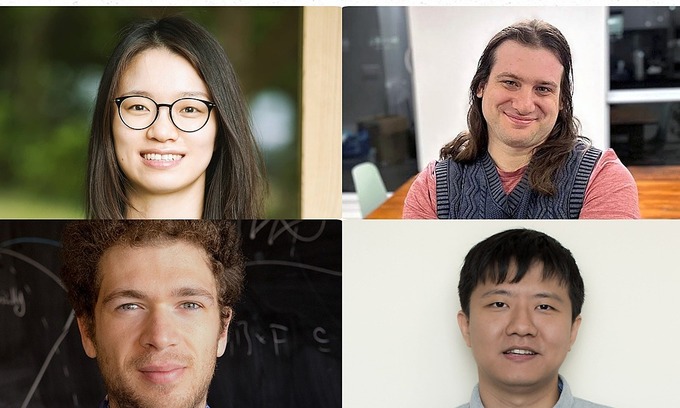

The 2026 Fields Medal, regarded as the Nobel Prize of mathematics, was awarded to Yu Deng, Jacob Tsimerman, John Pardon and Hong Wang, it was announced at the International Congress of Mathematicians (ICM) on July 23.
It is the first time two mathematicians of Chinese descent have won the medal simultaneously, and the third time a woman has been honored.
All four winners work in North America.
(From L) A screenshot from Simons Foundation’s YouTube livestream shows Yu Deng, John Pardon, Jacob Tsimerman, and Wang Hong receiving the 2026 Fields Medal at the International Congress of Mathematicians at the Pennsylvania Convention Center in Philadelphia, U.S., July 23, 2026. |
Deng, 37, a professor at the University of Chicago in the U.S., was recognized for his contributions to partial differential equations, including the rigorous derivation of the Boltzmann equation from hard-sphere dynamics for dilute gases, the derivation of wave kinetic equations from nonlinear dispersive systems, and probabilistic approaches to nonlinear Schrödinger dynamics.
In high school, Deng won direct admission to Peking University on the strength of a gold medal at the International Mathematical Olympiad in 2006. He later moved to the U.S., earning his bachelor’s degree at MIT and his doctorate at Princeton University.
Pardon, 37, is a professor at Stony Brook University in the U.S. He was honored for his achievements in symplectic geometry, including new approaches to virtual fundamental cycles, the Fukaya categories of certain manifolds, and the counting of holomorphic curves. He has also contributed to other areas of geometry and topology, including group actions on 3-manifolds and knot theory.
Pardon took gold medals at the International Olympiad in Informatics three years running from 2005 to 2007. He graduated as valedictorian of Princeton University’s class of 2011 and earned his doctorate at Stanford University.
Tsimerman, 38, is a professor at the University of Toronto and the first Fields medalist to have built his academic career in Canada.
He was recognized for recasting o-minimality as a fundamental method of complex algebraic and arithmetic geometry, and for his role in proving several central conjectures, including the Griffiths conjecture on the algebraicity of images of period maps and the André-Oort conjecture for Siegel modular varieties.
Tsimerman won IMO gold medals in two consecutive years. He studied mathematics at the University of Toronto and earned his doctorate at Princeton University in the U.S.
Wang, the youngest of the four, at 35, is a professor at New York University.
She was awarded the 2026 Fields Medal for her research in harmonic analysis and geometric measure theory, including applications of multi-scale and layer-decomposition techniques to the local smoothing conjecture for the wave equation in the plane. She has also delivered major advances on the Fourier restriction problem, Falconer distance sets, Furstenberg sets in the plane and the Kakeya problem in three dimensions.
The third woman in the history of the Fields Medal, Wang was regarded as a prodigy when she entered Peking University in China at 16. She completed her bachelor’s degree at home and her doctorate at MIT in the U.S.
The Fields Medal goes to up to four mathematicians under 40 and is awarded every four years. Winners receive a 14-karat gold medal engraved with the image of Archimedes and a cash prize of CAD15,000 (US$10,600).
Comments are closed.