
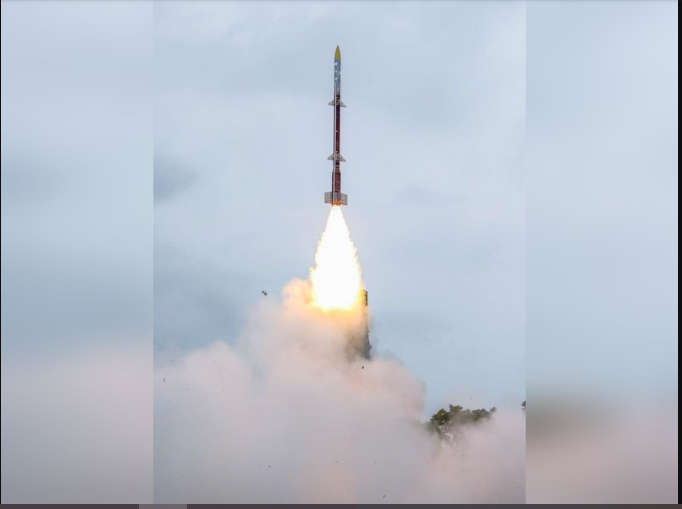

NEW DELHI, July 23: India on Thursday achieved a significant milestone in strengthening its indigenous air defense capabilities as the Defense Research and Development Organization (DRDO) successfully carried out the maiden flight test of the Kusha Long-Range Surface-to-Air Missile (LR-SAM) from APJ Abdul Kalam Island off the coast of Odisha.
In a post on X, the Defense Ministry said the missile was tested against an electronic target simulating a high-speed, high-altitude aerial threat. The target was successfully intercepted, validating the performance of the missile and the integrated weapon system.
It added that the maiden trial demonstrated the effectiveness of the entire Kusha air defense system, with all critical components functioning as designed. The weapon system includes the missile, advanced radars, command-and-control center and other supporting elements, all of which have been developed indigenously by various DRDO laboratories in collaboration with Indian industry partners.
Defense Secretary and DRDO Chairman Rajesh Kumar Singh monitored the launch and congratulated the scientists and engineers involved in the successful test.
The Kusha missile system is India’s indigenous long-range surface-to-air missile (LR-SAM) designed to provide layered air defense against a broad spectrum of aerial threats. It is intended to significantly strengthen the country’s capability to protect strategic military assets, critical infrastructure and population centers from hostile aircraft and missile attacks.
The system is designed to detect, track and engage multiple airborne targets simultaneously over long distances and at varying altitudes. It integrates long-range surveillance radars, fire-control radars and a command-and-control network that enables rapid threat assessment and coordinated engagement.
According to the Defense Ministry, the Kusha missile system is capable of neutralizing a wide variety of aerial threats across a broad range and altitude envelope, which include Fighter aircraft carrying out offensive missions. Cruise missiles flying at varying altitudes, Unmanned Aerial Vehicles (UAVs) and drones. Large enemy aircraft, including airborne early warning and support platforms and high-speed, high-altitude aerial threats.
The successful flight test against an electronic target demonstrated the missile’s ability to intercept fast-moving aerial targets under realistic operational conditions. As a long-range surface-to-air missile system, Kusha is expected to become a key component of India’s multi-layered air defense architecture, complementing existing short-, medium- and long-range air defense systems to provide comprehensive protection against modern aerial threats.
The Ministry of Defense said every major element of the Kusha weapon system, including the missile, radars, launcher, and command-and-control centre, has been designed and developed within the country.
Defense Minister Rajnath Singh hailed the successful trial as a landmark achievement for India’s defense research and development programme.
“The successful test flight of Kusha marks an important milestone in Indian defense R&D. The capability to develop a long-range surface-to-air missile system is possessed only by a handful of nations. This achievement will eliminate import dependency for such systems and signifies a giant leap in the nation’s air defense capability,” Singh said.
(Rohit Kumar)

Comments are closed.