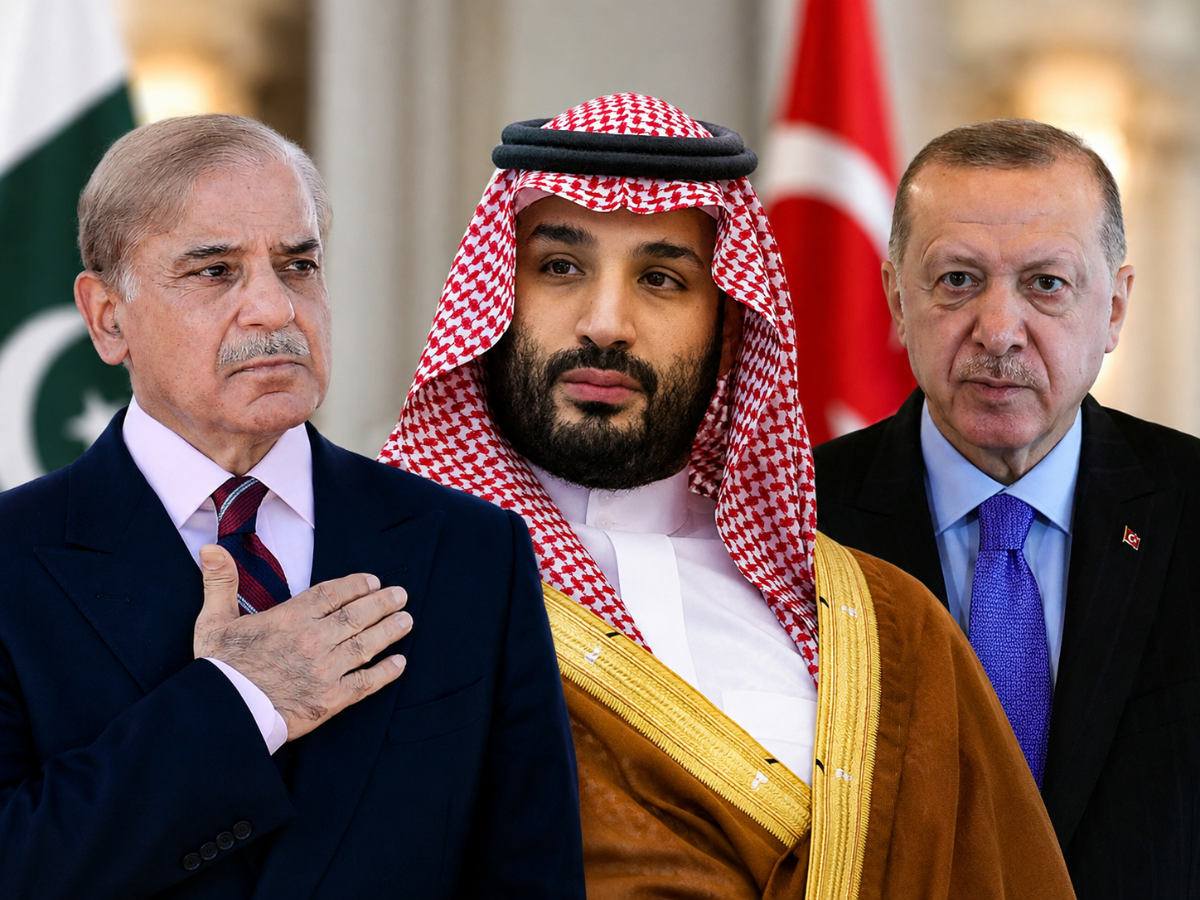
In a major strategic shift, Pakistan, Saudi Arabia, and Türkey signed a landmark trilateral defense agreement during a summit in Mecca. Pakistani Prime Minister Shehbaz Sharif, Saudi Crown Prince Mohammed bin Salman, and Turkish President Recep Tayyip Erdogan inked the Makkah Joint Defence Agreement. Under the terms of the pact, any armed attack against any one of the three signatory nations will be treated as an attack against all three, establishing a framework for mutual defense and collective security.
What is “Islamic NATO”?
Commonly known as “Islamic NATO,” this trio alliance brings together three distinct strategic powers in the Muslim world. Saudi Arabia provides massive financial resources, regional influence, and economic capital, while Türkey contributes a highly advanced, NATO-standard defense industry. Pakistan brings battle-tested armed forces and its nuclear-armed Muslim state. According to the joint official statement, the agreement is intended to strengthen collective deterrence against potential foreign aggression, mandate mutual defense, and significantly enhance all aspects of defense, intelligence, and military-industrial cooperation among the three member states.
What is the Need for the Pact?
The security pact responds directly to heightened instability and ongoing conflict in West Asia and the Middle East. Over recent years, critical infrastructure, petroleum facilities, and trade routes in Saudi Arabia and the broader Gulf region have come under repeated missile and drone attacks from regional networks and proxy groups, including the Houthis. These attacks have inflicted billions of dollars in damage and exposed critical vulnerabilities in regional defense. By forming a collective deterrence pact, Saudi Arabia aims to diversify its security architecture, reduce reliance on external Western powers, and create a strong, unified defense coalition capable of discouraging hostile actions from state actors such as Iran as well as non-state militant groups.
How It Would Prevent Attacks
The agreement aims to deter potential aggressors through several strategic mechanisms. First, the core collective security clause creates a major calculation risk for any potential adversary, who must now weigh the reality that an attack on one state could trigger a combined military response from all three. Second, by leveraging Türkey’s sophisticated defense production capabilities such as advanced drones and missile defense systems alongside Saudi financial backing, the bloc can rapidly modernize its combined hardware. Furthermore, enhanced military interoperability, shared threat intelligence, and joint training exercises will make border monitoring and drone interception significantly more effective. Ultimately, combining nuclear deterrence, large standing conventional forces, and vast economic leverage provides a formidable shield designed to preserve regional stability and safeguard critical borders and infrastructure.\
Also Read: No Speeches, No Videos, No Public Appearances: Is Iran’s Supreme Leader Mojtaba Khamenei in Critical Condition?
Shamshad Ali is a New Delhi–based journalist with over six years of experience spanning breaking news writing, on-the-ground reporting, and editing. When he isn’t chasing headlines, Shamshad is usually exploring new destinations, discovering hidden culinary gems, and striking up conversations with strangers. Many of whom turn out to be great sources, and even better friends. He can be reached at shamshadali.dar@gmail.com.
The post “Islamic NATO”? Turkiye, Saudi Arabia And Pakistan Sign Joint Defence Pact: What It Means appeared first on NewsX.