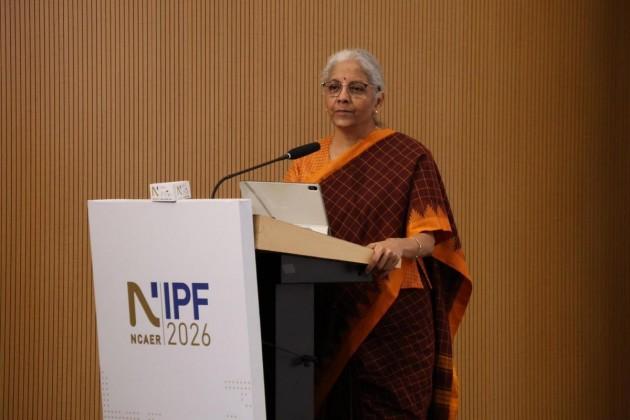
Finance Minister Nirmala Sitharaman on Thursday hit back at senior Congress leader Jairam Ramesh over his criticism of the Taxation and Other Laws (Amendment) Bill, 2026, clarifying that the proposed changes do not make UPI transactions chargeable for users.
Responding to Ramesh’s allegations, Sitharaman said the Merchant Discount Rate (MDR) applies only to merchants and not to end users or customers. She added that the provision would help banks and fintech companies invest more in infrastructure, innovation and security, ultimately benefiting all UPI users.
“Before spreading a canard, Jairam Ramesh, please consider this: Merchant Discount Rate (MDR) applies only to the merchants and not on the end users/customers. It will support the Banks & Fintech to invest more on infrastructure, innovation & security. All users of UPI will reap the benefits of this investment,” the Finance Minister said.
Sitharaman also criticised the Congress for raising the issue outside Parliament instead of debating it during the legislative process. She said the matter could have been discussed on the floor of the House if the Opposition had engaged constructively when the Bill was tabled in the Lok Sabha.
“All this could have been discussed on the floor of the House if your party engages constructively in Parliament when the Bill was/is tabled,” she added.
Earlier, Jairam Ramesh alleged that the proposed amendment removes the statutory guarantee that has kept UPI transactions free of charges, thereby opening the door for the future imposition of MDR on digital payments. He argued that any such levy would eventually be passed on to ordinary users and rejected the government’s claim that MDR is necessary to make UPI financially sustainable.
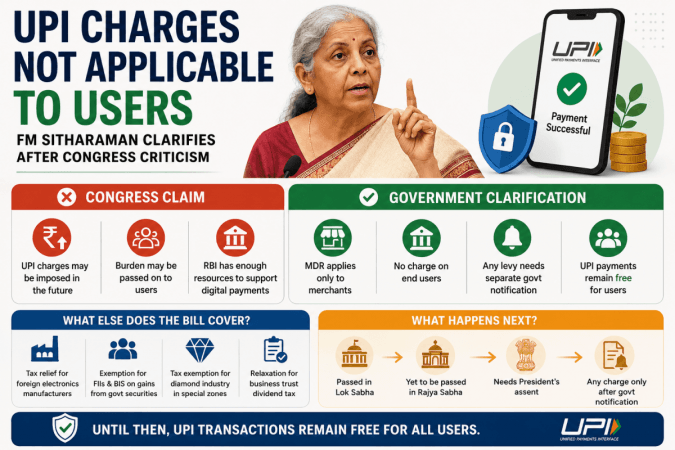
The Congress leader also said the Reserve Bank of India has sufficient financial resources to support the country’s digital payments ecosystem without imposing additional costs on merchants or consumers, citing the RBI’s surplus transfer of Rs 2.86 lakh crore to the Centre in 2025-26.
However, multiple reports citing officials and the text of the Bill clarify that its passage does not mean UPI transactions will become chargeable immediately. Under the existing framework, UPI payments will continue to remain free. Any future charge would require a separate government notification specifying the payment modes on which MDR or other charges may be levied.
The Bill removes the existing legal restriction that prevented such charges from being introduced, but it does not itself impose any fee. The Finance Ministry has previously described reports claiming an immediate MDR on UPI as “completely false, baseless and misleading”, reiterating the government’s commitment to promoting UPI adoption.
What else does the Bill cover?
Apart from the digital payments provision, the Taxation and Other Laws (Amendment) Bill, 2026 introduces several tax measures. It extends income tax exemptions until 2040-41 for foreign companies that engage contract manufacturers in India for electronics goods and also covers foreign companies that store components in customs warehouses for supply to Indian manufacturers.
The Bill further exempts Foreign Institutional Investors (FIIs) and the Bank for International Settlements (BIS) from income tax on interest and capital gains earned from investments in government securities from April 1, 2026.
It also proposes a tax exemption until March 31, 2041, for income earned by eligible foreign diamond mining companies, sight holders, brokers, aggregators and auction entities from rough diamond sales through notified special zones. Additionally, it removes a restriction that had denied tax exemption on dividends received by unit holders of business trusts where the underlying special purpose vehicle had opted for the new tax regime.
What happens next?
The Bill has so far been passed only by the Lok Sabha. It must still be tabled and approved by the Rajya Sabha before receiving the President’s assent to become law. Even after enactment, any charge on UPI or other digital payment modes can only take effect through a separate government notification issued under the amended framework.
Until such a notification is issued, UPI transactions made through platforms such as Google Pay, PhonePe and other UPI apps will continue to remain free for users, as they have been since 2020.