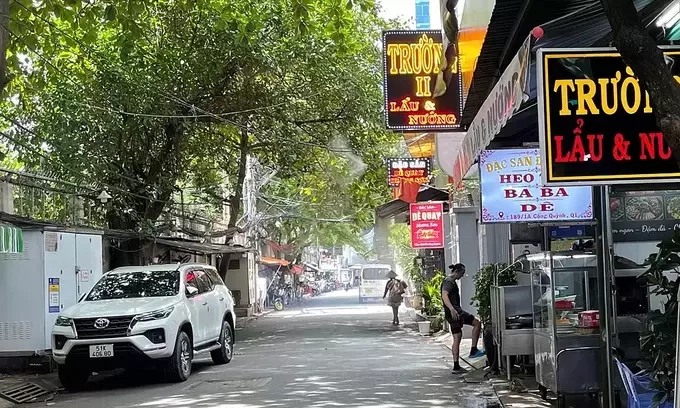
“This alley used to be one of the most famous dog meat hubs in Ho Chi Minh City, but now it’s completely gone,” he says. “People born after 2000 hardly ever eat dog meat, and some even actively oppose it.”
Binh first started out in 2001. Back then, Alley 189 had seven other eateries where tables were packed constantly from noon to late evening. The golden era was between 2010 and 2015, when dozens of venues lined the alley.
Five years ago, business started to slump as new customers stopped coming. His regular clientele shrank by half, leaving behind mostly middle-aged diners who still had a taste for the dish.
One by one, the surrounding eateries shuttered. In 2024, only three remained, and by late 2025, Binh was the sole survivor. After two rounds of persuasion from local authorities urging him to switch to a different line of work, Binh decided to call it quits early this year.
Though his remaining regulars expressed disappointment, he had already decided to move away from the trade. He traveled to Huong Son in Ha Tinh Province to learn how to cook goat meat before returning to change his signage, ingredients, and menu.
Binh’s pivot reflects a trend sweeping across Ho Chi Minh City’s historically famous dog meat districts. On Pham Van Hai Street and near the Ong Ta Intersection in Tan Son Nhat Ward, more than 10 dog meat stalls shut down by late last year.
|
Alley 189 Cong Quynh Street, Ben Thanh Ward, Ho Chi Minh City, noon on July 30. Photo by Ngoc Ngan |
Fifteen years ago, vendors along these curbs packed pushcarts with roasted and boiled dog meat. Today, those sidewalk stalls have been replaced by retail shops, corporate offices, and commercial services.
A similar shift occurred on Pham Van Bach, Bach Dang, and Tan Son streets in Tan Son Hoa Ward. Once the strongholds of dog meat eateries, the area has thinned out dramatically, leaving Pham Van Bach Street with just two remaining outlets as of late last year.
Nguyen Thi Thu, a 55-year-old resident of the Cong Quynh alleyway, recalled how vibrant the neighborhood was before 2020, when tables overflowed into the street and servers ran back and forth continuously. “The eateries gradually emptied out.”
Since early 2026, many former dog meat vendors have switched to selling goat meat, roasted calf, com tam (broken rice), or office lunches.
Changing habits
A decade ago, dog meat was a staple at drinking sessions for Minh Tuan, 40, of Duc Nhuan Ward.
That changed in 2018 when Tuan adopted a pet dog. Every evening, hearing his motorbike approach, the animal would run to the gate to greet him and follow him inside. “I started viewing him as a friend, and did not want to eat dog meat anymore,” he says.
Later, when Tuan’s daughter learned about animal care and protection at school, she expressed deep disappointment upon finding out her father used to eat dog meat. That reaction convinced him to give up the item for good.
A 2021 survey done in Hanoi and Ho Chi Minh City by the global animal welfare organization Four Paws revealed that young people under 24 recorded the lowest consumption rates.
In Ho Chi Minh City, 88% of respondents said they would refuse to eat dog meat, compared to 44% in Hanoi.
Besides, 91% of survey participants opposed the dog and cat meat trade, while 95% said consuming dog or cat meat is not part of Vietnamese culture.
Elizabeth Homfray, founder of the animal rescue organization Laws for Paws, has watched Ho Chi Minh City’s dog meat trade steadily shrink during her 19 years in the city. Homfray attributes the shift primarily to diners themselves. The demographic accustomed to consuming dog meat is aging, while younger generations refuse to take up the habit.
Furthermore, more families now keep dogs indoors as loved pets, transforming social attitudes toward the animals. Rather than frame the issue as moral, Homfray emphasizes the practical reality that the vast majority of dogs in slaughterhouses are stolen pets rather than farm-raised animals.
Last year, Laws for Paws visited 59 schools to teach students about responsible pet care. By encouraging children to share these lessons at home, the organization aims to help families realize that eating dog meat inadvertently sustains pet theft.
Dr Nguyen Thanh Phong, a lecturer at the Ho Chi Minh City University of Social Sciences and Humanities, says dog meat was never part of traditional southern cuisine, having been introduced through migration in the early 20th century.
The shrinking number of eateries reflects a clear drop in demand, as rising incomes and a wider variety of foods give people a lot of new options, he says.
Global integration is also playing a crucial role, he says.
The increasing influx of foreign tourists and expatriates, cross-cultural marriages, and opportunities for Vietnamese to travel abroad are exposing them to alternative perspectives on animal welfare, he claims.
Adopting pets for emotional companionship and stress relief has gained popularity in recent years, particularly among younger generations. As household finances improve, pets receive attentive care and become integral members of the family.
But Phong says the disappearance of high-profile storefronts does not mean the trade has vanished entirely since some vendors may have relocated deeper into residential alleys, operate from home, or switch to selling raw dog meat.
Even so, the disappearance of entire dining streets indicates that dog meat is steadily exiting the city’s mainstream food culture, he admits. “The disappearance of these dog meat streets reflects more than just a shift in palate. It marks a change in how society perceives and treats companion animals.”