
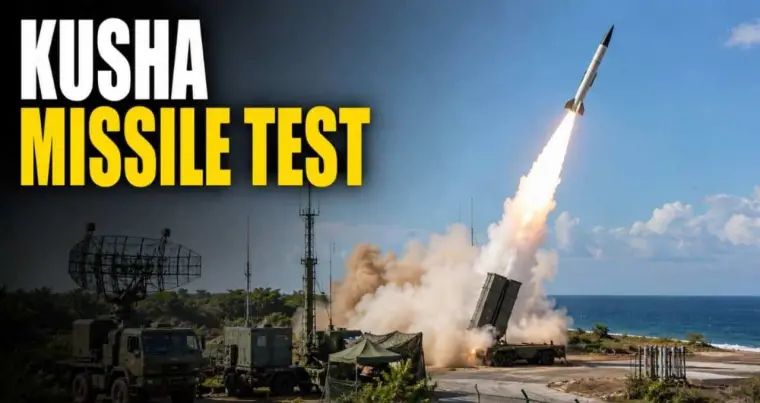

India has taken an important step towards strengthening its air defense capability by conducting the first successful test of the long-range missile system ‘Kush’. This missile system is said to be capable of neutralizing aerial threats coming from long distances.
Kusha Long-Range Surface-to-Air Missile: India has taken an important step towards strengthening its indigenous air defense capabilities. Defense Research and Development Organization (DRDO) has successfully conducted the first flight test of long-range surface-to-air missile system ‘Kush’ from Dr. APJ Abdul Kalam Island located off the coast of Odisha.
This test is being considered an important achievement for India’s indigenous defense research and development programme. The new missile system aims to strengthen the protection of the country’s sensitive and strategic assets from various types of aerial threats. However, the final details regarding the actual operational capability and deployment of this system will become clear only after a complete series of tests and official evaluation.
DRDO conducted the first flight test
‘Kush’ is a long-range surface-to-air missile system developed by DRDO. Its first test was conducted from Dr. APJ Abdul Kalam Island located off the coast of Odisha. Defense Minister Rajnath Singh described the test as an important achievement in the field of Indian defense research and development and congratulated DRDO, the Indian Armed Forces and the scientists and engineers associated with the project.
The objective of developing this system is to increase the capability of the Indian air defense network, so that the country can be protected from various types of air threats.
Which air threats can ‘Kush’ target?
According to the Defense Ministry, the ‘Kush’ missile system is being developed to deal with various types of air threats. These may include fighter aircraft, cruise missiles, unmanned aerial vehicles i.e. drones and other aerial platforms. The biggest strategic advantage of a long-range air defense system is that it provides the ability to intercept any potential threat before it can reach the target. This can strengthen the security of military bases, critical infrastructure and other sensitive areas.
India’s indigenous air defense capability boosted
India is already developing a multi-layered air defense network. This includes indigenous systems as well as technology and weapon systems acquired from other countries. The S-400 air defense system received from Russia is an important part of the Indian air defense infrastructure. In such a situation, the development of long range indigenous system can be strategically important for India’s defense needs in future.
However, the development of the ‘Kush’ system does not mean that India will immediately replace existing systems like the S-400. In modern air defense an integrated network of several systems operating at different distances and altitudes is considered more effective.
Emphasis on security of major strategic bases
Long-range surface-to-air missile systems are commonly used to protect critical military installations, strategic infrastructure and sensitive areas. The development of such an indigenous system is also important for India because it can boost the country’s defense production capacity and technological self-reliance. Domestically developed missile systems can help in reducing dependence on foreign defense systems in future.
Why important in the context of China and Pakistan?
In terms of India’s security strategy, the importance of long-range air defense capability increases because the country’s two important borders are connected to China and Pakistan. Both countries have modern fighter aircraft, drones and missile systems. In such a situation, indigenous long-range air defense system can provide additional capability to India to deal with possible air threats.
However, the actual effectiveness of any defense system does not depend solely on the strike capability of the missile. Equally important is its integration with radar, sensors, command and control systems and other air defense platforms.
What will be the next phase of ‘Kush’ project?
After the successful first flight test, further tests of this missile system are expected to be conducted. During these tests its technical capability, accuracy, reliability and performance under various conditions will be assessed. If this system is successful in the next stages of development and testing, it can become an important part of India’s multi-layered air defense network. Along with this, it will also strengthen the country’s indigenous defense industry and self-reliance campaign.

Comments are closed.