
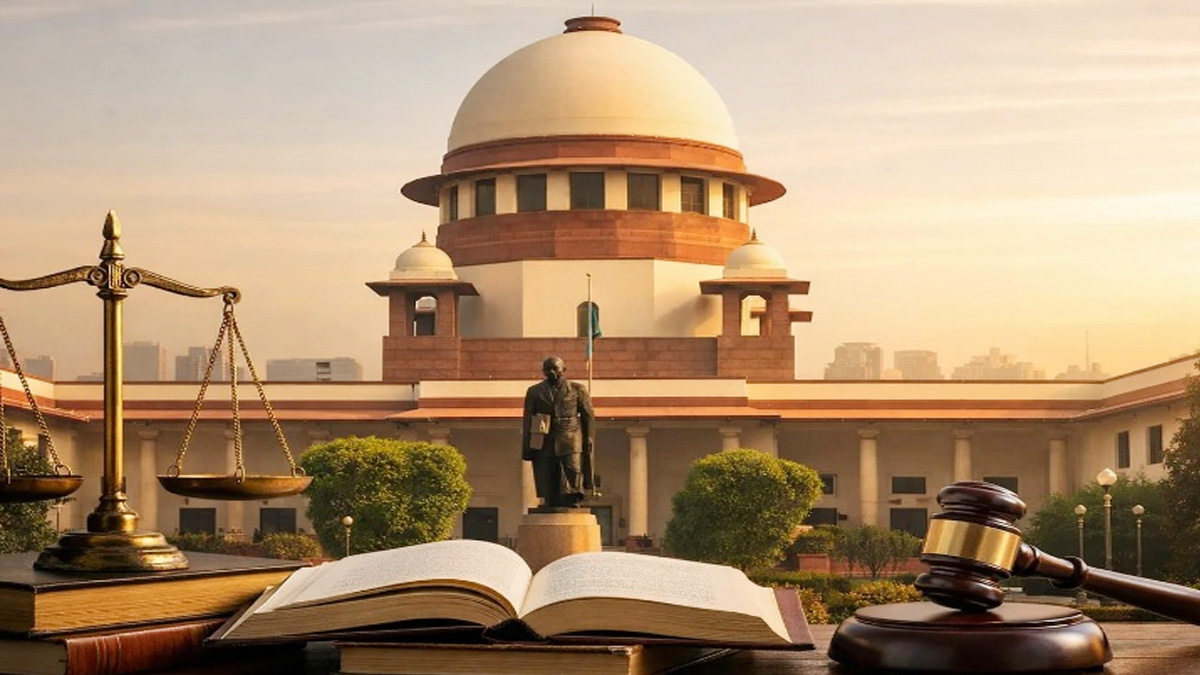
Supreme Court: Supreme Court gave a big decision regarding the arrest, this lack alone will not give relief

Regarding legal process and arrest rights Supreme Court Making an important comment, the Supreme Court has given a big decision. The court has clearly said that if the grounds for arrest are given to an accused, then the arrest cannot be considered illegal merely by claiming that they are not sufficient. In such cases, the court will also see whether the accused has actually suffered any loss or not.
This decision has come in the case related to the bail of Sonam Raghuvanshi, the main accused in the famous honeymoon murder case of Meghalaya. After the decision, new clarity has emerged on the legality of arrest and legal aspects related to bail.
Supreme Court canceled the High Court order
The division bench of Justice MM Sundaresh and Justice PB Varale quashed the order of the Meghalaya High Court and the Trial Court, on the basis of which Sonam Raghuvanshi was granted bail.
The High Court had held that in the arrest documents, instead of Section 103(1) of the Indian Judicial Code, non-existent Section 403(1) was mentioned, due to which the grounds of arrest were not stated correctly.
Not disclosing grounds for arrest and not providing sufficient information are different.
The Supreme Court said that in this case the grounds for arresting the accused were not completely hidden. The only dispute was whether the grounds given were sufficient or not.
The court clarified that not disclosing the grounds for arrest at all and not providing sufficient information are two different situations. If the grounds are not stated then the arrest can be considered illegal, but if the grounds are stated then it will be seen whether it caused actual loss to the accused or not.
First expressed satisfaction, later raised questions Supreme Court
The division bench said that Sonam Raghuvanshi had initially expressed satisfaction over the reasons for her arrest. It cannot be considered appropriate to seek relief later on the basis of the same issue.
The court also noted that the accused had not raised this issue in his first three bail pleas. This was made a ground for the first time in the fourth bail application.
The right to re-arrest remains
The Supreme Court said that even if there is some deficiency in giving information about the grounds of arrest, it does not take away the statutory power of the investigating agency to arrest again (Supreme Court). According to the division bench, the law does not prevent the investigating agency from making a second arrest and such technical deficiency does not affect the future investigation process.
Instructions to surrender within three weeks
The court said that bail is a general rule and jail is an exception (Supreme Court), but the circumstances of this case are different. Earlier bail petitions have been rejected on merits and the hearing of the case has also started. In such a situation, continuation of bail may affect the fair trial.
on these grounds Supreme Court Canceled the bail given to Sonam Raghuvanshi and directed her to surrender within three weeks (Supreme Court). However, the court also clarified that if the trial is not completed within six months, the accused will be free to file a fresh bail plea and this order will not be considered as a bar against him.

Comments are closed.