There are a few key things to consider before buying Ryobi tools, with the battery size being one of the most important. Not only should you know the battery voltage — 18V or 40V — this measurement can indicate the tool’s best use cases. While Ryobi tools of the 18V and 40V variety are typically capable of getting their intended jobs done, sometimes less in more in the power tool world.
You’re more than likely going to encounter scenarios where an 18V Ryobi tool is more than enough, meaning its 40V contemporary can sit on the sidelines for the time being. Sometimes this is a matter of cost, as 18V tools and batteries tend to run cheaper than 40V, so why spend more than you need? Naturally, power and on-the-job capabilities are a factor, too, since in some situations, the 40V platform can prove too much. Ultimately, it comes down to assessing which tool you need, and if the 18V version is just fine for your goals.
It’s easy to think that bigger tools with more power behind them are always the answer, but sometimes, they can become a hindrance in multiple ways. There are some Ryobi tools and use cases where 40V isn’t essential, and 18V will get you by just fine.
Light power washing
Typically, when power washing, you want a unit that delivers fast and hard spouts of water to remove dirt, grime, and other elements from a surface. However, sometimes, light power washing calls for a powerful, yet somewhat restrained approach. For example, if you want to clean outdoor furniture, get dirt and debris off of a bicycle, or clean any surface without risk of knocking off paint, an 18-volt Ryobi power washer is in your best interest.
This specific model has a respectable maximum PSI of 321, and it’s a cost-effective choice compared to other Ryobi battery-powered washers at $49.00 for the tool alone. Ryobi’s 18V power washers go as high as 700 PSI, which won’t knock off paint or gouge wood, but does pack significantly more punch than 321.
Meanwhile, Ryobi’s 40V pressure washers start at 600 PSI, and their ceiling is much higher, going as high as 2,000 PSI — at the cost of multiple hundreds of dollars — which certainly will lift paint and even damage things like windows, shingles, and soft forms of stone. If you’re in need of something to effectively clean grime and moss off of a driveway or walkway, this is the kind of unit you want. For anything less, it’s probably a good idea to skip the 40V range altogether and go for a smaller and less powerful yet still effective 18V model.
Light, infrequent branch trimming is an 18V job
Tree branches can get out of control, so having a capable chainsaw on hand to do some seasonal pruning is worth the investment. Fortunately, Ryobi has some strong options that don’t go overboard power-wise, and also don’t break the bank. Ryobi 18-volt units start at $119.00 for the tool itself, going up to $249.00, all with a 10-inch bar equipped. There are also brushless motor options for prolonged, more efficient us, and Whisper Series models if you want less noise. For the odd branch or two, these choices are more than enough for a non-professional tool-user to keep their trees trim and tidy.
As for 40-volt chainsaws, while tempting, they’re significantly costlier. They start at $145.00 and climb as high as $379.00. Yes, the 40V Ryobi chainsaw may last a while on its larger battery, the bars go as large as 20 inches, and they may deliver higher chain speeds than an 18V choice, but when you’re only dealing with a few branches, infrequent use, and a limited budget, there’s really no need to opt for such a tool.
Besides, for beginner users, a larger, more powerful chainsaw could prove intimidating, so passing on it in favor of something slightly more newcomer-friendly isn’t a bad idea. Thus, unless you’re a professional or someone who’s chopping through multiple, thick branches and trunks every day, an 18V Ryobi chainsaw will more than likely suffice.
Some yards only need an 18V lawn mower
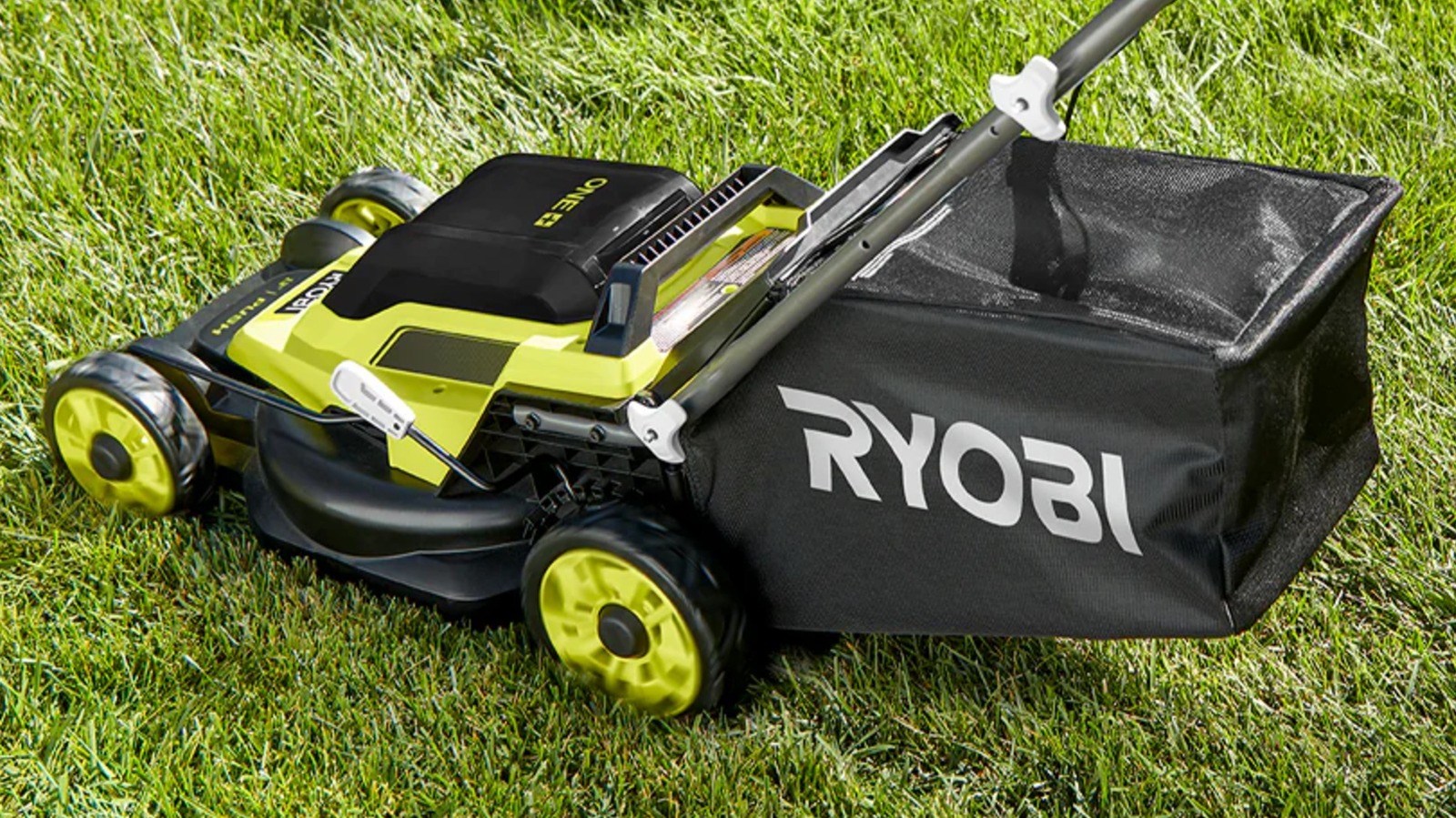
With gas prices seemingly always on the rise, an electric lawn mower can be an extra tempting proposition. Ryobi has options in spades, and while many users have reported common problems with these mowers, 18V and 40V units remain widely used. More often than not, an 18V mower will get the job done just fine on a small residential lawn.
Deck sizes range from 13 to 20 inches, they tend to skew lighter in weight than 40V models, and some models come with performance perks like brushless motors and self-propel functionality. At time of writing, the priciest unit goes $499.00, so while they can get expensive, there are more budget-friendly models in the $200 to $300 range.
With that said, theoretically, there’s nothing stopping someone with a small yard from using a 40V Ryobi mower. However, it isn’t always the best option, especially if you’re just looking for a simple, easy to use mower that’s effective and relatively easy on the wallet. While they cover a lot of ground at between 18 and 21 inches in deck size, can mow almost full acres on a single charge, and claim to rival the power of gas mowers, they are oftentimes significantly heavier and harder to maneuver while in use, making their use frustrating in tight, fenced-in yards. They can cost over $700 brand new, too, making them potentially financially taxing as well.
An 18V blower will clear most areas
There are a lot of Ryobi leaf blowers, with the assortment spanning both the 18V and 40V battery platforms. All in all, the latter category gets pretty powerful, with these models ranging from 300 to 850 CFM (cubic feet per minute), with large, bulky backpack units on offer. These can undoubtedly clear driveways, parking lots, or even sizeable yards that have lots of leaves and other debris to clear. Still, not all of those in need of a Ryobi blower necessarily need so much power, potential back pain from a backpack unit, and holes in their budget ranging from $94.97 to a steep $629.00.
If you don’t have a lot of tree coverage, and just want something straightforward and light to clear off your deck, short driveway, or other similarly small area, one of Ryobi’s 18V blowers is plenty powerful enough. These models range between 220 and 510 CFM depending on the model, are strictly handled models with different handle shapes for your ideal grip, and cost between $69.97 and $229.00 depending on the blower and whether they include batteries and chargers. If you care about elements like brushless motors and reduced volume with Ryobi Whisper Series technology, 18V has you covered, too.
An 18V auger is more than suitable for gardening tasks
An electric auger isn’t one of the most versatile Ryobi tools out there, but whether it’s powered by an 18V or 40V battery, it does the job of digging holes just fine. Depending on the task at hand, though, the larger, more powerful 40V auger isn’t essential. Those two attributes make it a good buy — though an expensive one at either $369.00 or $449.00 should you want the entire battery and charger-including kit — if you need multiple deep holes, or you’re trying to plow through hard, rocky soil. Otherwise, there’s nothing wrong with opting for an 18V model instead.
With less power and size to it, Ryobi’s 18V auger line is best utilized in smaller gardening tasks, like planting bulbs and other tasks requiring holes several inches deep, where trying to break through the soil isn’t so much a concern. These models are noticeably lighter than Ryobi’s 40V offerings, meaning they’re less of a hassle for novice gardeners to use, and they come in either 3-inch or 6-inch bit form, so you have options depending on your intentions for the tool. Cost-wise, they go up to $329.00 for the 18V brushless auger kit, including a battery and charger alongside the tool. Yes, this is still a lot of money to drop, but it doesn’t even touch the low end of the 40V range.
How we made these selections
These situations and Ryobi tools were chosen by looking over a handful of factors. For one, there had to be notable differences in performance between the selected tools. If the 18V and 40V tools performed too similarly, there was no reason to draw such a hard line between the two. The price difference had to be noticeable as well, since a large part of the appeal of choosing an 18V model over a 40V was the potential savings, while still getting a tool that meets your needs.
Of course, the biggest thing to consider was power level. Not only did the 18V tool need to deliver on the job, but it had to justify itself as the preferred choice over the 40V option. Could the 18V work in a given scenario, while saving money and being easier to use? If a 40V was selected, could there be consequences beyond the inflated cost, such as unintended damage or unnecessarily difficult use? Thus, the 18V had to prove itself both a capable, cost-effective option that was significantly less cumbersome or risky to use than the 40V version.