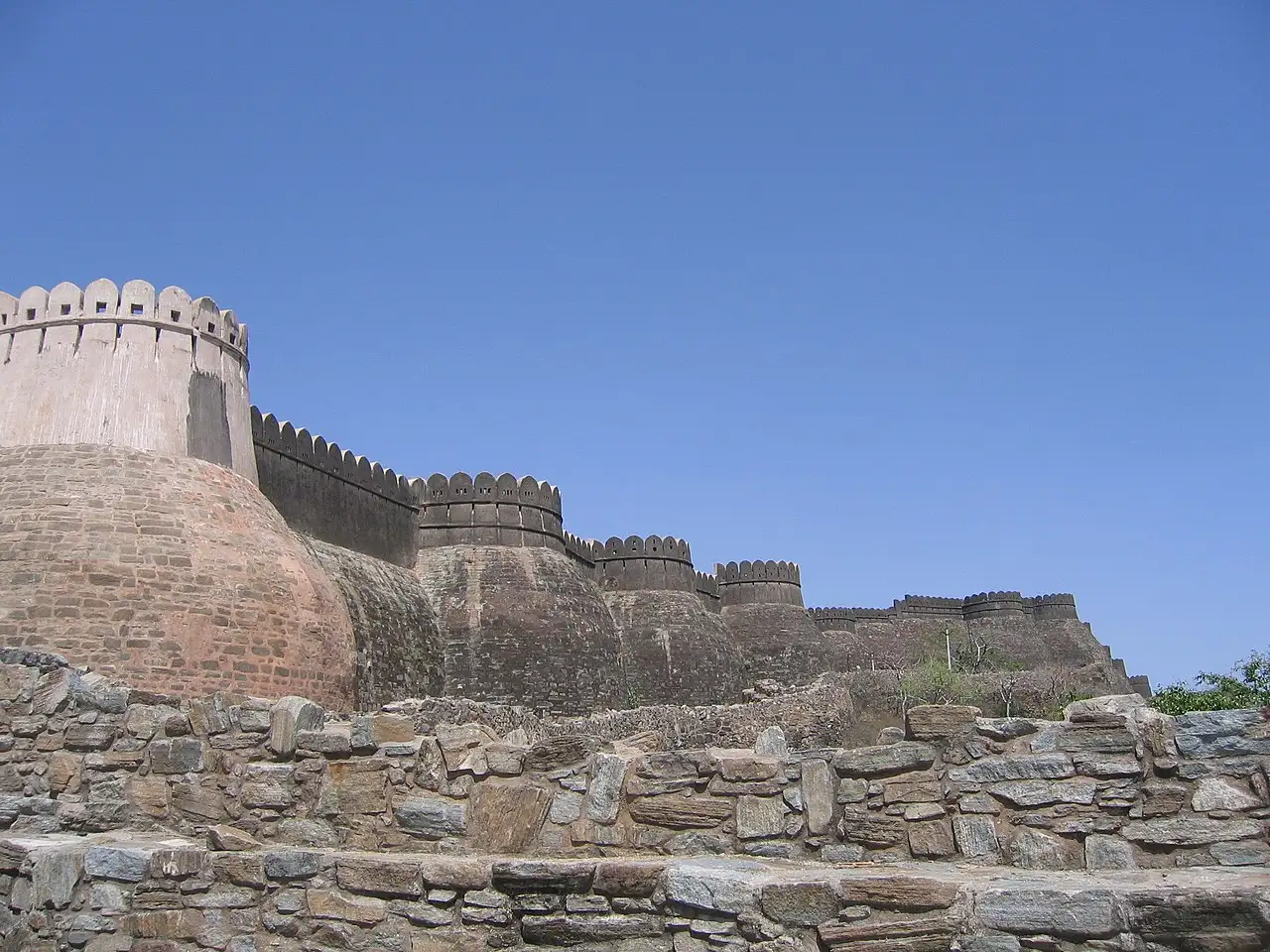
Kumbhalgarh Fort, nestled among the Aravalli Hills in Rajasthan’s Rajsamand district, is considered one of India’s most magnificent and fortified forts. Perched at an altitude of approximately 1,100 meters, the fort is renowned for its massive defensive wall, strategic layout, and countless historical tales. The fort’s wall stretches approximately 36 kilometers and is often referred to as the “Great Wall of India.”
The fort was built by Maharana Kumbha
Kumbhalgarh was built in the 15th century during the reign of Maharana Kumbha, ruler of Mewar . Its location among the high Aravalli hills made it extremely difficult for enemies to reach the fort. Strong walls, massive bastions, and numerous entrances made it an impregnable fortress.
The fort’s strategic position can be gauged from the fact that it provided a long-range view of the surrounding area. Secret passages and tunnels were also used within the fort for troop movement and protection during sieges.
Occupied only once in 500 years
The most widely known fact about Kumbhalgarh’s strength is that it was long considered extremely difficult to conquer. According to a source, in 1576, the fort was captured by the combined forces of Mughal Emperor Akbar, Raja Man Singh of Amer, and the Sultan of Gujarat. This event is attributed to a lack of water rather than the fort’s military defeat.
There was a strong water storage system within the fort, but the lack of water eventually became a major challenge during the prolonged siege.
Birthplace of Maharana Pratap
Kumbhalgarh’s history is also deeply intertwined with that of Maharana Pratap . According to history and tradition, Maharana Pratap was born in Kumbhalgarh on May 9, 1540. Therefore, the fort is also known as the birthplace of this great warrior of Mewar.
The life of Maharana Pratap is an important chapter in the history of Mewar’s struggle for independence. Kumbhalgarh is one of the important sites associated with his childhood and the royal tradition of Mewar.
The 36-kilometer-long Great Wall
The fort’s most prominent landmark is its massive ramparts, which are said to be approximately 36 kilometers long. In places, the walls are so wide that popular accounts say that several horses could run on them simultaneously.
This massive wall not only enhanced the beauty of the fort but also served as the first line of defense against enemies.
Temple and reservoir inside the fort
The Kumbhalgarh complex contains a large number of ancient temples. Sources indicate that there were over 365 temples, along with numerous reservoirs and water storage systems. Among these, the Neelkanth Mahadev Temple is particularly famous. The temple’s construction is believed to date back to the 15th century, during the construction of Kumbhalgarh.
Special recognition in folklore
There are many folk tales surrounding the construction of the massive wall of Kumbhalgarh. According to one legend, after the wall repeatedly collapsed during construction, a sage was advised to perform a sacrifice, which ultimately led to the completion of the construction. However, such tales should be viewed as folklore rather than historical evidence.
The glorious heritage of Rajasthan
Today, Kumbhalgarh is not just a fort, but a vital part of Mewar’s history, Rajput architecture, and Rajasthan’s identity as the birthplace of Maharana Pratap. Its massive walls, hill defenses, temples, and water structures offer a remarkable example of medieval architecture and military prowess.