
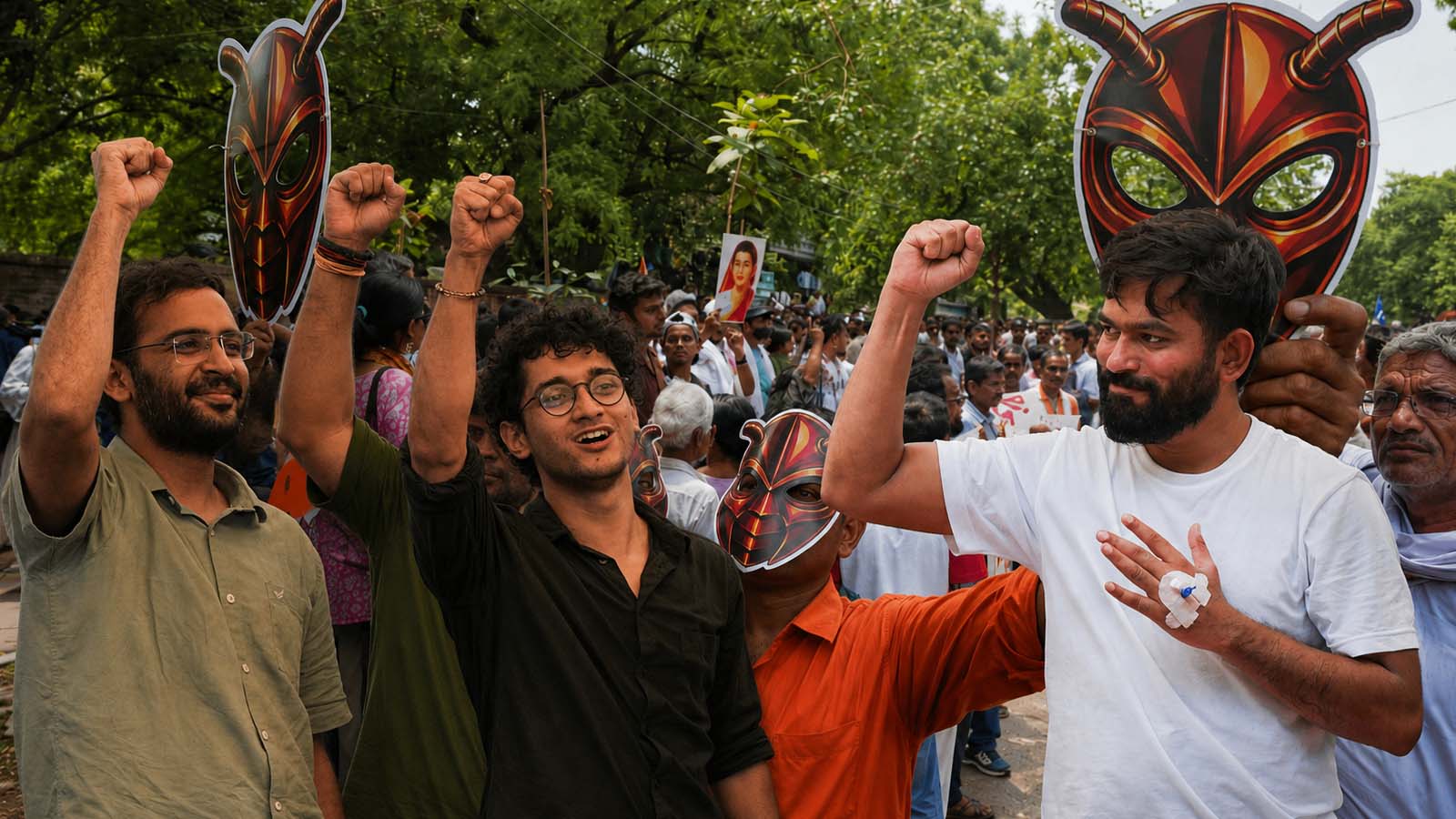

When Dharmendra Pradhan resigned as the Union education minister on Saturday (July 25) following weeks of relentless protest over the NEET-UG paper leak in New Delhi and many other cities of the country, it marked a striking political triumph for a movement that began, improbably, as an online satire a little over two months ago.
The Cockroach Janta Party (CJP) — a satirical page that has since amassed millions of followers on social media platforms and rapidly grown into a youth-powered movement — surfaced as a reaction to a remark by Chief Justice Surya Kant comparing unemployed youth to “cockroaches”.
What happened after Pradhan resigned: Follow here
As the agitation drew national attention and heavy policing at Jantar Mantar, curiosity only headed north about some of the most prominent faces of the CJP, including its founder Abhijeet Dipke, who recently returned from the US to spearhead the protests that made the Narendra Modi government blink.
Abhijeet Dipke: US-returned crusader
The 30-year-old Dipke is a political communication strategist by training. He studied journalism in Pune before moving to the United States, where he recently completed a Master’s in Public Relations from Boston University. Notably, the youth leader said he is currently job-hunting — an unusual admission for someone who just forced a Union minister’s resignation.
Before the CJP, Dipke spent three years working with the Aam Aadmi Party (AAP), another party which had evolved from street protests in the early 2010s. There, he handled social media strategy and election campaigns. During the 2020 Delhi Assembly polls, Dipke was involved in meme-based digital outreach aimed at young voters — a skill set that would later define the CJP’s communication style.
Also read: ‘CJP protests may have ended, but youth movement is far from over’ | Interview
The man from Maharashtra, who also faced difficulties during the month-long street protests and was not well when the victory came, advised the citizens not to feel intimidated by the government. However, despite his preaching about how a republic works, his immediate plan was not political. As he retreated to take a nap, Dipke’s anxious parents expressed relief that he finally returned home.
However, although the CJP protests were called off after Pradhan’s resignation, Dipke reminded his social media followers in his first message on the very next day that it was just the beginning. Given his background in the AAP, it would not be surprising if the youth leader joins full-fledged politics in the days to come.
Saurav Das: The investigative brain
Saurav Das, the CJP’s chief spokesperson, was another most visible face during the protests. Of the two leaders who met representatives of the government during the protests, he brings a very different professional background — one rooted in journalism and transparency activism.
The youth leader, who holds a Bachelor of Arts in Journalism and Mass Communication from Amity University, Noida, where he studied between 2016 and 2019, has penned many research-based stories over the years. He has also written extensively for many publications. He is based out of New Delhi.
Das has worked extensively on issues related to the Right to Information (RTI) Act, and is presently working on his debut book, Complicit Silence: The Court’s Role in India’s Quiet Suffering, which, according to his website, “explores how the Indian judiciary has contributed to the nation’s slide into electoral autocracy under the right-wing Hindu nationalist Prime Minister, Narendra Modi”.
Das, whose passion for investigative journalism dates back to his college years, harbours interest in open governance and institutional accountability. He was also seen at the anti-air pollution protests in New Delhi in 2025.
When various media outlets asked Das about his immediate goal, it was far from “joining politics”. While he rejected allegations that the protest was against Prime Minister Modi or any political party, he asserted it aimed at putting in place a working system that caters to the interests of India’s youth.
Also read: Minister’s resignation, PM’s midnight reels: Why CJP protest is a rare political spectacle
Speaking to NDTV, Das was unambiguous about the movement’s near-term direction: India already has 750-800 political parties, none of which, in his assessment, have managed to fulfil youth aspirations. Instead, Das said, the movement’s agenda is to push whichever party or leader holds power to actually deliver for young people. “That is our agenda right now,” he said.
Ashutosh Ranka: From IIT Kanpur, LSE
The third spokesperson, Ashutosh Ranka, who accompanied Das to meet Union ministers such as JP Nadda and Jitendra Singh with the CJP’s demands, brings an engineering and public policy pedigree to the group. He completed his B Tech from IIT Kanpur and later worked with McKinsey & Company in London, where, the CJP says, “he advised top-tier international organizations on complex operational and economic strategies”. He has experience in consulting and public-interest advocacy. He was also associated with the AAP in the past.
According to the CJP, Ranka returned to India in 2025 and has “led several public movements in Jaipur focused on environmental, educational and youth issues, such as Dol Ka Badh, Amaira Suicide case, NEET Paper leak”.
The leader, whose LinkedIn account says, “Currently building a public life in India,” told NDTV after the protests’ culmination in Pradhan’s resignation that he wanted to return home, sleep and reconnect with family. The leader, who hails from Rajasthan, described the moment of victory as “overwhelming”, which brought both pride and relief. Also, when he was asked about mulling a career in politics by the channel, he came up with an open-ended response, “Never say no to anything in India.”
Also read: From JP to CJP: How Delhi remains the epicentre of India’s power-shifting protests
Together, the trio represents strikingly different professional lanes — communications strategy, investigative journalism, and policy consulting — that converged around a single satirical premise and turned it into sustained political pressure on a powerful regime.
While it’s not certain whether the CJP becomes a full-fledged political force next or just remains a watchdog, it’s not withering away any time soon.

Comments are closed.